



Gasgoo Munich - China's new energy vehicle sector is undergoing a profound shift, moving from policy-driven growth to a dual-engine model powered by market forces and technology. Competition has entered a fierce elimination phase, with the smoke of price wars filling the air and marketing concepts emerging endlessly.
Against this backdrop, the measure of an automaker’s ability to weather cycles and maintain steady growth is no longer just short-term sales explosions. It depends on the solidity of the brand’s core, the completeness of its systemic capabilities, and the endurance of its strategic focus.
Leapmotor, a company that wasn't widely favored when it entered the fray ten years ago, has completed a decade-long journey akin to "still waters running deep." It has truly transformed from the periphery to center stage, moving from survival crises to scalable profitability. By climbing to the top of the sales charts among new EV startups, Leapmotor’s decade serves not just as a history of corporate struggle, but as a valuable case study for how Chinese brands can achieve endogenous, sustainable growth amidst radical change.
At a recent forum hosted by Gasgoo, Zhou Ying, Vice President of Leapmotor Technology, outlined the core logic of the brand’s construction. "Brand building isn't about sudden explosions, but a long-term process of accumulation, like deep water flowing silently," Zhou said. She emphasized that the fundamental principle is "respecting truth and restoring truth." This philosophy runs through the entire value chain—from R&D and product development to communication and user engagement. While the industry chases maximum noise, Leapmotor's adherence to "truth," backed by its engineer culture and full-domain self-research system, has forged a unique growth path.

Zhou Ying | Vice President, Leapmotor Technology
Anchoring "Truth" in a Noisy Era
In an era of information overload and endless marketing gimmicks, automotive communication often falls into "funhouse mirror" distortion or pandering. Zhou argued that Leapmotor aims to be a "magnifying glass"—not twisting or catering to short-term market preferences, but clearly and accurately amplifying the genuine beauty found in its products and technology.
This pursuit of truth stems from Leapmotor's engineer DNA. Zhou described the team as "simple, low-key, efficient, and sincere," viewing the world through a pragmatic and pure lens.
This cultural trait dictates that Leapmotor's brand expression will remain immune to over-packaging and performative stunts.
Leapmotor's 10th-anniversary campaign illustrated this philosophy. Unlike brands that rely on grand CGI effects and celebrity lineups for dreamy launches, Leapmotor took a back-to-basics approach. A 60-meter technology corridor replaced the flashy stage, intuitively displaying a decade of technical accumulation, allowing visitors to "touch" the company's development trajectory.
Essentially, this adherence to truth is a deep-seated user communication strategy.
As consumers grow more rational and immune to marketing rhetoric, exaggerated promises and illusory images struggle to build lasting trust. By showcasing the solid R&D process, real manufacturing scenes, and the everyday stories of its employees, Leapmotor has built a credible, approachable, and tangible brand personality. It doesn't try to pose as an omnipotent myth but candidly presents itself as a pragmatic striver making continuous progress. As Zhou noted, brand building requires "focusing on heritage and emotional resonance with users"—and the deepest resonance comes from maximum authenticity.
This philosophy of truth extends beyond communication into product definition and service. Leapmotor’s "good but not expensive" concept is the commercial realization of real value. It avoids the tricks of high prices for low specs or low prices for stripped-down features. Instead, leveraging the cost advantages of full-domain self-research, it strives to offer superior technology and configuration within the same price range. This tangible value-for-money is the foundation of Leapmotor’s stability and growth in the fiercely competitive 100,000 to 300,000 yuan mainstream market.
Brand and product form a closed loop here: real technical strength supports "good but not expensive" products, and the authentic product experience reinforces a sincere brand image. In a volatile market, Leapmotor has built a unique moat based on trust.
Resilience Through Full-Domain Self-Research
If truth is the "spirit" Leapmotor presents, the deep power driving its "still waters and continuous growth" is its unwavering full-domain self-research strategy and the complete industrial system it has built.
Reviewing the decade, Zhou compared Leapmotor’s growth to the "vivid microcosm of the Yellow River's source," growing from a tiny pool of clear water into a mighty river surging forward. The ability to gather this momentum comes from continuous deep-digging at the source of technology and key links in the supply chain.
Leapmotor’s ten years are a typical microcosm of the shift among Chinese EV startups from simple assembly to deep manufacturing.
Early on, many startups relied on supply chain integration to launch products quickly. Influenced by the technical background of founder Zhu Jiangming, Leapmotor chose a harder, longer road. Starting with its first "Three Electrics" lab, it viewed holding core technology as its lifeline. Official data shows Leapmotor’s R&D system now covers vehicle architecture, E/E architecture, batteries, electric drive, cockpit, and intelligent driving. Self-developed components account for up to 65% of total vehicle cost. This implies strong control over performance and quality, and crucial cost advantages and profit margins in the price war.
Zhu previously emphasized in an internal letter that full-domain self-research is not a slogan, but a systematic capability.
This capability manifests in three areas: rapid tech iteration and mass production (e.g., LEAP 3.5 central domain control, 800V high-voltage platform); building a self-controlled super supply chain with 17 highly automated factories in Huzhou, Jinhua, and Hangzhou covering cells, battery systems, motors, lights, AR-HUD, and AC compressors; and a "Vehicle + Tier 0.5" dual-drive business model where self-developed parts are sold to other automakers, creating new revenue streams.
This deep vertical integration and systematic capability is the substance of the "deep flow" Zhou mentioned. It isn't as conspicuous as surface waves but acts as ballast against market storms and a propeller for continuous progress.
When the industry is mired in price wars, Leapmotor’s cost-digging ability allows it to reduce costs through self-research rather than just cutting prices. This protects the bottom line while maintaining competitiveness. In fact, Leapmotor turned profitable in the fourth quarter of 2024, becoming the second startup to do so, and remained profitable for three consecutive quarters in 2025, accumulating a net profit of 180 million yuan. The shift from burning cash to self-sufficiency is built on the efficiency and cost advantages of its self-research system.
The evolution of its product portfolio is another visible result. From the explorational S01 to the volume-proving T03, and the reputation-building B and C series, up to the brand-elevating D series, Leapmotor has spent a decade building a complete matrix covering A0 to D segments, sedans, SUVs, and MPVs, offering both pure electric and range-extended powertrains.
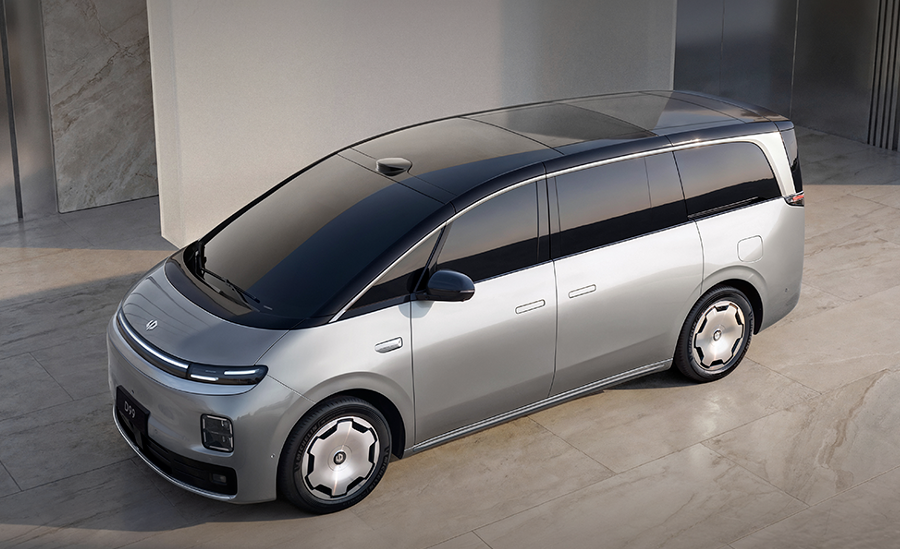
Image Source: Leapmotor
Latest data shows monthly sales broke 60,000 units in December 2025. For the full year 2025, cumulative sales reached 597,000 units, a 103% year-on-year increase.
The success of each product isn't accidental; it is the inevitable result of continuous tech accumulation, refined product definition, and maturing manufacturing systems.
Next Step: From Startup to World-Class?
Standing at the ten-year mark, Leapmotor has achieved impressive milestones: over 1.2 million deliveries and sustained profitability. Yet, Zhou’s sober analysis at the forum—"brand recognition lags behind sales status"—and Zhu’s internal letter acknowledgement—"we’ve only just crossed the subsistence line" and "competition will be crueler"—show the management’s acute crisis awareness and higher ambitions.
Zhu announced Leapmotor will no longer define itself as a "new force" but aims to become a "sustainable, respectable world-class smart EV company." The flag has been planted: challenge 1 million annual sales in 2026, and target 4 million annually within a decade.
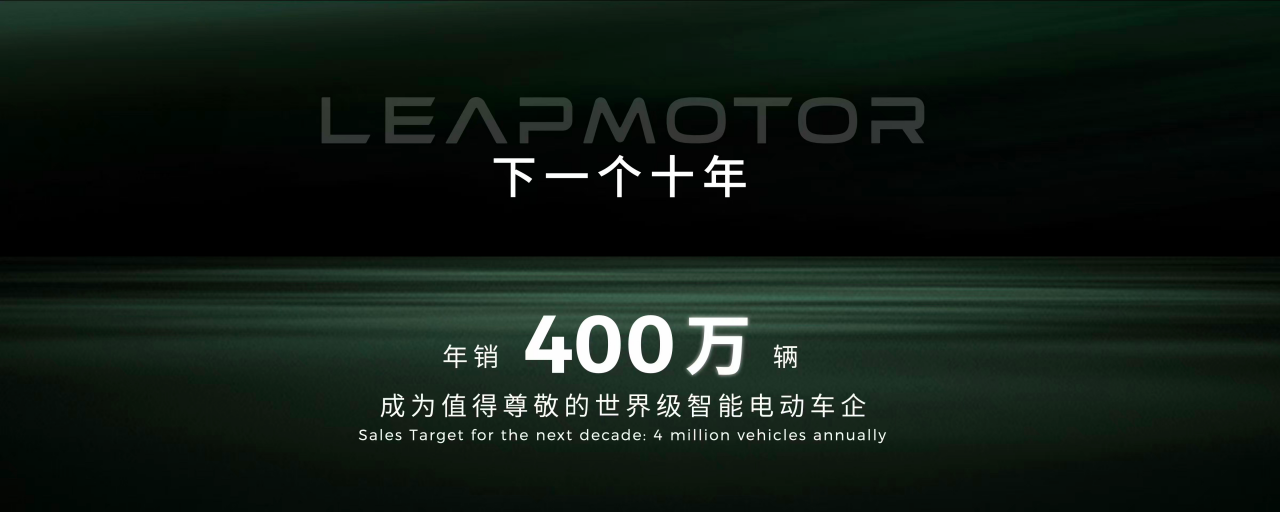
Image Source: Leapmotor
The next decade will be an upgrade battle from "living well" to "running far and high." The core challenge is maximizing the synergy between brand and product and converting systemic advantages into global competitiveness.
First, brand elevation is essential.
Over the past decade, Leapmotor won rational consumers with value and authentic communication. But to hit a million sales and support premium lines like the D series, brand value needs lifting. Zhou’s direction: "Continue the engineer gene, blending rigor, rationality, and truth with the product, while better grasping emotional needs." This requires infusing more design aesthetics, user experience, and lifestyle resonance into the technical narrative.
The D series, showcasing "tech luxury" and "tech equality," is a key carrier for this ascent. Leapmotor’s branding must evolve from a "magnifying glass" to a "condenser" and "prism," refracting the brand’s multidimensional value more clearly, richly, and warmly on the foundation of truth.
Second, navigating the deep waters of globalization faster.
In 2025, overseas deliveries were about 60,000 units across 35 countries. The partnership with Stellantis has paid off, opening a second growth curve. But selling cars abroad is step one. The next goal is local manufacturing, requiring a global localization system covering R&D, production, supply chain, marketing, and service.
The Stellantis partnership offers channels and experience, but adapting to different cultures, regulations, and competitive environments to replicate the "good but not expensive" model and build influential brand awareness is a far more complex challenge than the domestic market.
Success in globalization will be the key test of Leapmotor’s systemic capabilities.
Third, tempering systemic capabilities during the scale leap. Moving from 600,000 to 1 million units is a stress test on organization, supply chain, quality control, and digital operations.
Will scale bring cost reductions or "diseconomies of scale"? How to ensure R&D efficiency and quality consistency across diverse global product lines? These are core management puzzles Leapmotor must solve while sprinting.
Finally, and most importantly, maintaining a lead in technological innovation. Full-domain self-research was the past moat, not a future comfort zone. In the second half of the smart EV race—fast charging, autonomous driving, AI models, next-gen E/E architecture—competition will intensify. Leapmotor must combine pragmatic engineer culture with forward-looking research to ensure its tech reserves stay ahead.
Conclusion
Leapmotor’s decade is a poem of struggle with "still waters" as the melody, "truth" as the base color, and "full-domain self-research" as the skeleton. Choosing a path less noisy, it grew steadily in a brutal elimination round through deep accumulation and iteration. It offers a differentiated path for the industry: relying not on marketing hype or founder halo, but on solid systemic capabilities and sincere communication to build long-term competitiveness.
Zhou’s "still waters, continuous growth" is a summary of the past and a hope for the future. Facing the next decade, Leapmotor has sounded the charge from "Chinese startup" to "global automaker." The road is full of challenges. Can brand value and market scale scale the peak together? Can tech innovation drive product leadership? The answers will determine if the world-class ambition is realized.
The results of the next decade await time’s verdict, but Leapmotor’s past ten years have profoundly shown that in the historical process of China’s auto industry growing from big to strong, those who respect industry rules, adhere to long-termism, cultivate core tech, and connect authentically with users will eventually receive time's reward.
Leapmotor's story continues. The resilience, pragmatism, and ambition it displays undoubtedly inject confidence and inspiration into the collective rise of Chinese auto brands.


