



Gasgoo Munich- On March 24, Li Auto announced its board approved a share repurchase plan of up to $1 billion, valid through March 31, 2027. The news sent its U.S. shares surging in pre-market trading, with gains topping 5% at one point after the open. The next day, Li Auto's Hong Kong stock followed suit, climbing 3.3% to HK$69.8 per share.
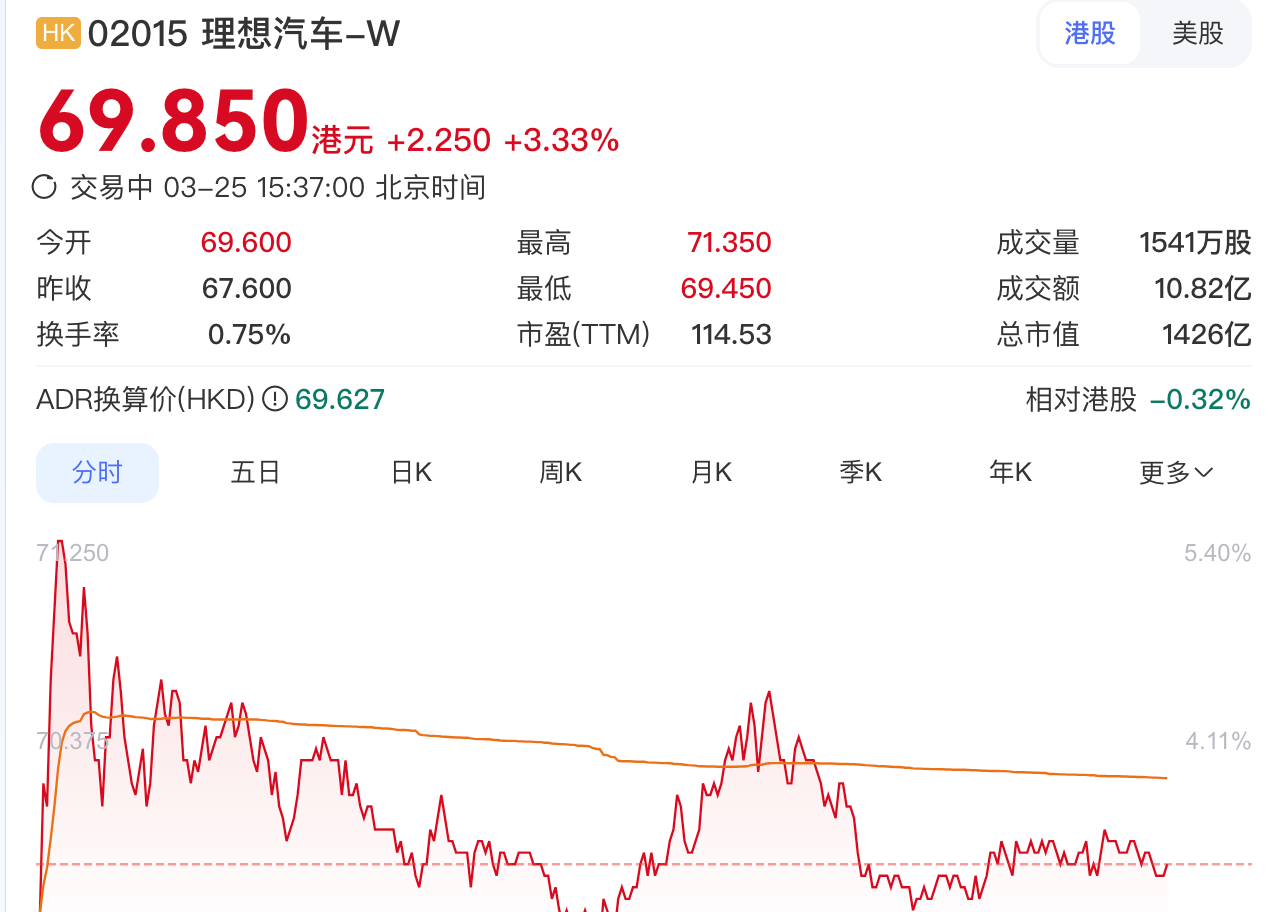
Image source: Baidu Stock Tong
Li Auto noted that a general repurchase authorization was actually approved by shareholders at the annual meeting on May 30, 2025. Li Xiang, chairman and chief executive officer, said the plan demonstrates the company’s firm confidence in its strategic roadmap and future value creation—benefiting the company and delivering value to shareholders.
A Full Pivot to Embodied Intelligence
While the industry remains fixated on computing power, sensor counts, and the speed of city-level autonomous driving rollouts, Li Auto is proposing something different: pushing smart EVs to evolve into embodied intelligence products, effectively building cars as if they were embodied intelligent robots.
The logic behind this shift is that Li Auto no longer views cars merely as extensions of transportation. Instead, it aims to equip them with a complete "perception-brain-body" architecture, allowing vehicles to understand and interact with the physical world like thinking robots. The upcoming new-generation Li Auto L9 Livis embodies this philosophy.

Image source: Li Auto
To achieve this, Li Auto is doubling down on R&D. Financial reports show R&D spending hit 11.3 billion yuan in 2025—a record high. Notably, AI-related investments accounted for 50% of that total. Over the past three years, the company has poured an average of 1 billion yuan into R&D every month, a high-intensity bet on breaking through core technologies in embodied intelligence.
The payoff from that spending is starting to show. First is the in-house "brain": the Mach 100 chip. Long constrained by supplier timelines for intelligent driving chips, Li Auto chose to develop its own 5nm Mach 100, delivering 1,280 TOPS of effective computing power per chip.
The new-generation L9 Livis is equipped with two of these in-house 5nm Mach 100 chips. With 1,280 TOPS each, the dual-chip setup delivers a combined 2,560 TOPS. Li Auto claims this effective computing power is triple that of Nvidia’s Thor-U chip.
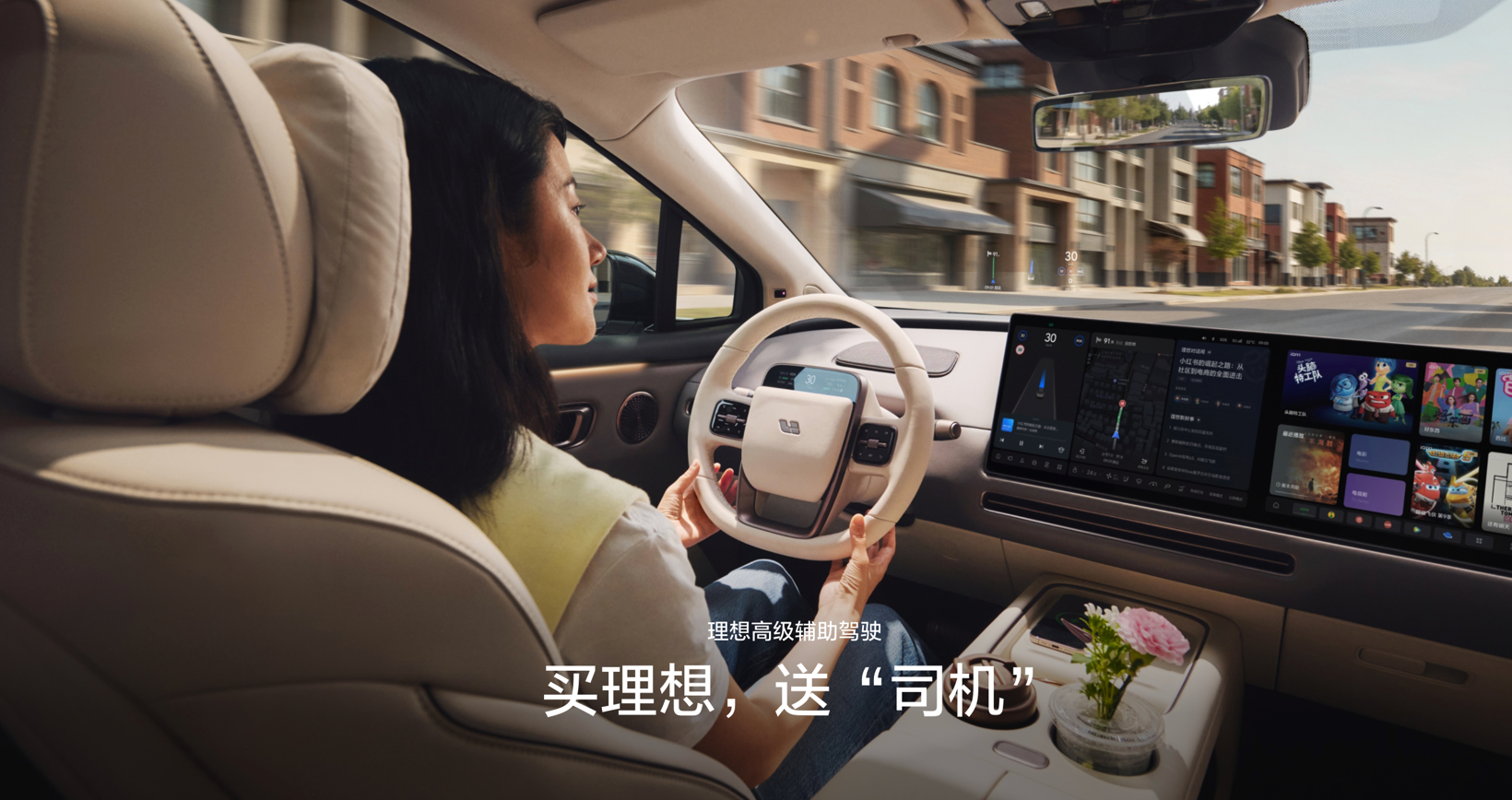
Image source: Li Auto
More importantly, this chip is customized for VLA large models. Using a data-flow architecture, it eliminates the need to constantly shuttle data back and forth—a bottleneck for traditional GPUs—when running 3D ViT models, completing calculations directly on the chip.
Then there is the evolution in "perception" driven by self-developed large models. Li Auto believes true intelligence should rise from recognition to understanding. Equipped with its proprietary base model, the vehicle possesses 3D spatial understanding of the physical world, allowing it to accurately predict obstacle trajectories and make intuitive judgments.
To support this model, Li Auto overhauled its R&D organization, dividing teams into base model, software entity, and hardware entity groups. This restructuring accelerated the iteration cycle for intelligent driving models from once every two weeks to daily updates.
There is also a hardware overhaul at the "body" level. The L9 Livis features the world’s first "fully integrated" steer-by-wire chassis, including steer-by-wire and fully electro-mechanical braking (EMB), with millisecond-level response. Paired with an 800V fully active suspension system—a first for vehicles under 600,000 yuan—the car can actively adjust its posture to resist roll, achieving precise control of the "body" by the "brain."
Organizationally, Li Auto has made corresponding adjustments. Earlier this year, the R&D team shifted from being divided by hardware and software functions to a structure designed to create "digital humans" and "silicon-based humans." Teams are now organized by base model, software entity, and hardware entity, enabling co-design of chips and models.
Li Xiang stated that the company has comprehensively restructured its R&D to truly operate as an embodied intelligence company. "Building products," he said, "is building humans."
Fortifying Investor Confidence
Strategic transformation requires real money—and even more importantly, understanding and support from capital markets. Yet Li Auto’s stock performance over the past six months leaves room for improvement.
By March 24, Li Auto’s U.S.-listed shares had fallen from a peak of $45.80 to around $18, wiping out roughly 40% of its market value. In Hong Kong, the stock dropped below the HK$70 mark, bringing its market capitalization nearly level with XPENG.
The decline reflects both the broader investment winter cooling the EV sector and the company’s own headwinds. In 2025, Li Auto’s deliveries fell 19% year-on-year to just over 400,000 units, missing sales targets. In February of this year, it delivered 26,000 vehicles—a mere 0.6% annual increase and a 4.5% drop from the prior month.

Image source: Li Auto
Financials are under pressure as well. In the fourth quarter of 2025, revenue fell 35% to 28.775 billion yuan, while net profit plummeted 99.4% to 6.52 million yuan. For the full year, revenue dropped 22.3% to 112.312 billion yuan, with net profit sinking 86% to 1.139 billion yuan.
Faced with this landscape, the $1 billion buyback sends a clear signal to the market: trust in Li Auto. As of the end of 2025, the company held a cash reserve of 101.2 billion yuan, providing ample cover for the repurchase.
The positive impact is already visible. Following the announcement, Li Auto’s U.S. shares surged more than 5% during intraday trading.
For 2026, Li Auto is focusing on three core drivers: sales system management, a refresh of the L series, and ramping up pure electric vehicle volumes. Notably, addressing past weaknesses in managing its direct-sales system with a dealer mindset, the company launched a store partner plan in March. It grants store managers operational decision-making power and a share of profits. This shift from a management role to an operational one aims to energize the frontline and ensure orders and deliveries return to the industry's first tier.
Capital markets remain divided. Goldman Sachs, for its part, argues that Li Auto’s fourth-quarter gross margins have already recovered and that the new L9 is poised to reclaim share in the premium segment. If new products gain traction, financial metrics could see significant improvement. As Li Auto pivots to an AI technology company, 2026 could mark its major turning point from a manufacturer to a tech player—provided the market embraces its intelligent features.
Citi, however, takes a dimmer view, noting that net profit fell far short of expectations and that a sluggish extended-range market could drag margins even lower. While in-house chips and autonomous driving systems look promising on paper, any delays in implementation could weaken Li Auto’s technology narrative.
Whether Li Auto’s transformation succeeds will hinge on two critical moments: first, whether the new L9’s order and delivery data can hold the line above the 300,000 yuan benchmark; and second, the actual performance of its self-developed chips, the competitiveness of its driver-assist systems, and tangible progress in its robotics projects.


