



Gasgoo Munich- XPENG CEO He Xiaopeng recently confirmed that the 2026 XPENG X9 pure electric edition will hit the market on March 2.
That marks more than two years since the X9 first arrived as a battery-only model.
From its early 2024 battery-only debut to the range-extended launch in late 2025, and now the return of a refreshed pure electric version, the X9 has closed a full strategic loop over two years: starting with electric power, breaking into the mainstream with range extension, and circling back to electric with greater strength.
This is no simple reversal of course, but a carefully calculated move in a broader strategic game.
As XPENG's first MPV, what does this rhythm—pure electric first, then range-extended, then a pure electric refresh—reveal about the company's strategic thinking?
From Pure Electric to Range-Extended: The X9's Strategic Shift and Market Logic
XPENG was once the industry's staunchest defender of pure electric power.
He Xiaopeng revealed that executives pushed for a range-extended powertrain five times internally; it only passed on the fifth attempt. That years-long internal debate was ultimately settled by market reality.
As XPENG's debut MPV, the X9 was charged with a threefold strategic mission from the start: serve as a flagship to elevate the brand, showcase technical prowess, and crack the family market. It aimed to shatter the "stodgy" stereotype of MPVs with a high-tech vibe, carving out a niche as the "first MPV for young families."
Yet the pure electric route hit real-world resistance when reaching a broader audience—a reality starkly reflected in order data following the range-extended launch.
After the range-extended X9 hit the market, orders from northern regions topped 50% for the first time. For users in colder climates, range loss in battery-only cars is an unavoidable pain point. The range-extended version offers 452 kilometers of battery range—enough for daily commutes—and a total range of 1,602 kilometers to eliminate long-distance anxiety. That "big battery plus big fuel tank" combination turns the X9 into a true vehicle for all of China.
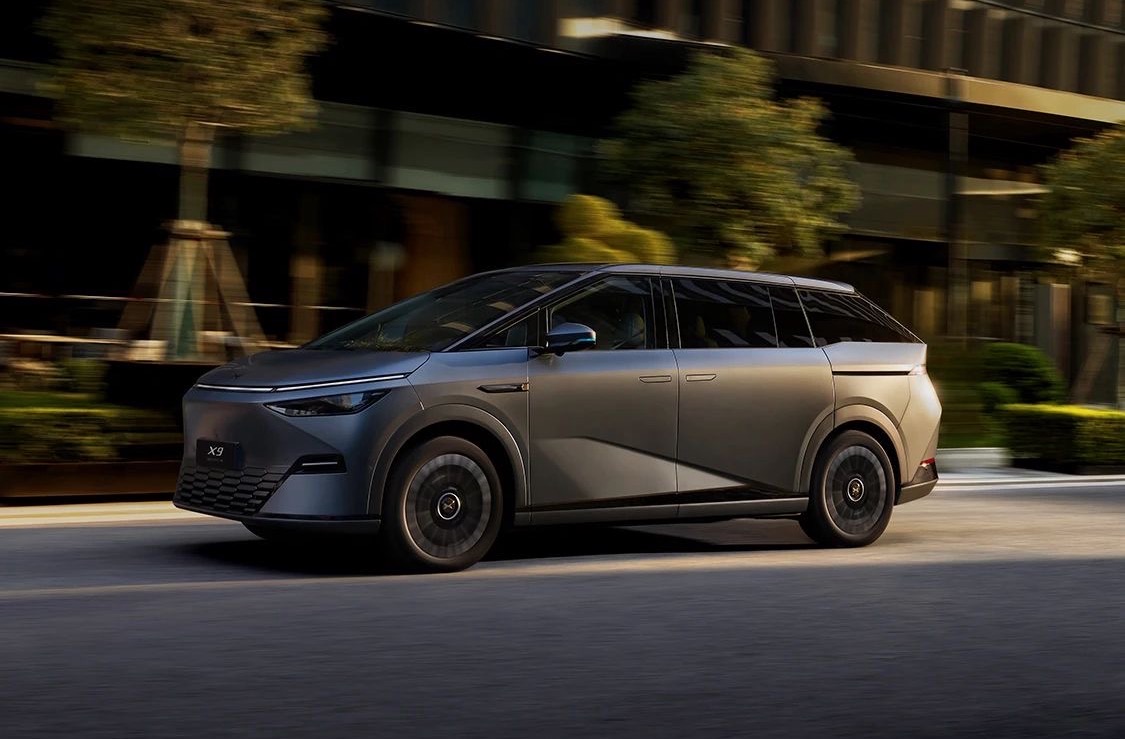
Image Source: XPENG
The shift in buyer demographics is equally telling. Data shows that among buyers of the X9 "Super Range-Extended" version, 57.2% were born in the 1990s and 13.7% in the 2000s—making them a full decade younger than the average MPV buyer. First-time car buyers accounted for 21%, nearly double the industry norm. These young buyers want to care for their families without sacrificing their own preferences; the range-extended version provides a "psychological safety cushion" as they transition from internal combustion engines to new energy vehicles.
Strategic considerations for overseas markets cannot be ignored. After visiting multiple countries, He Xiaopeng found that "in many nations and regions, power infrastructure will remain poor for many years to come." Range-extended and hybrid models are better suited for these markets. From January to November 2025, XPENG's overseas deliveries jumped 95.0% year-on-year, with range-extended models set to act as the "icebreaker" for its global expansion.
Even more critical is the reality check on profitability. The revenue-generating power of range-extended models has already been proven by Li Auto and AITO. For XPENG, the range-extended X9—priced as a high-margin model—will directly improve the overall profit structure once delivered at scale. In the third quarter of 2023, XPENG's gross margin exceeded 20% for the first time and net losses narrowed further, a feat to which the range-extended version contributed significantly.
Dual-Track Strategy: The Synergy of Pure Electric Fundamentals and Range-Extended Expansion
Strong sales of the range-extended version do not mean XPENG is abandoning pure electric power.
On the contrary, the launch of the 2026 pure electric model confirms XPENG's strategic resolve in its dual-track layout: pure electric remains its "root," while range extension is the "branch" reaching into broader markets.
Technically, the 2026 pure electric version comes standard with an 800V high-voltage platform and 5C ultra-fast charging batteries, offering a maximum range of 750 kilometers and recovering 400 kilometers of range in just 8 minutes.
This technological foundation is precisely the source of XPENG's advantage in building range-extended cars. As the XPENG technical team puts it, they "maximize the benefits of electric power so users feel the Super Range-Extended version is indistinguishable from a battery EV in over 95% of scenarios." Even with a fuel tank on board, XPENG's range-extended models retain the technical DNA of 800V architecture, 5C charging, and large batteries.
In terms of product matrix, the new pure electric version aligns fully with the Super Range-Extended version across four dimensions: energy efficiency, space, safety, and comfort. This achieves parity in product capability under a "one car, two powertrains" approach. The range-extended version is tasked with "expansion"—attracting users in northern regions and internal combustion owners—while the pure electric version is tasked with "holding the line," serving users who have charging access and demand the ultimate electric experience. The two work in synergy, not as a wavering between strategies.
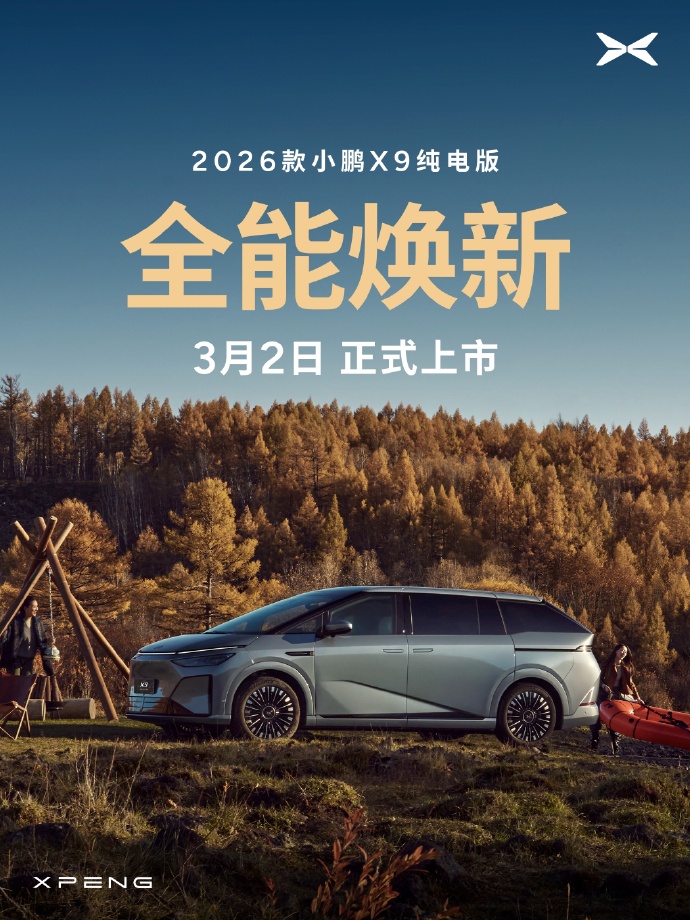
Image Source: He Xiaopeng's Weibo
Looking at long-term trends, He Xiaopeng has admitted there was an "unexpected" development when the range-extended model launched in 2025: the hybrid market was shrinking, while the pure electric market was rising. This suggests pure electric remains the long-term direction. Now that the range-extended version has helped XPENG survive and thrive, the pure electric version still represents the determination to march toward the ultimate form of mobility.
Reviewing the X9's performance since launch, the strategic results are already visible. In December 2025, XPENG X9 deliveries hit 5,424 units, a 289.1% year-on-year surge. In a market where selling 5,000 units a month qualifies as a "hit," these figures carry significant weight.
On a deeper level, the X9 is not just a car; it is the strategic starting point for XPENG's transformation from a "smart car company" to a "physical AI company." He Xiaopeng has explained that range-extended and hybrid systems offer unique advantages in adapting to future autonomous driving and even robot applications. With three Turing AI chips, 2,250 TOPS of computing power, and a VLA large model, the X9 serves as the most vivid showcase of XPENG's intelligent technology, laying the groundwork for a "car + robot + flying car" ecosystem.
On March 2, the new pure electric version will launch, marking the X9's completion of a strategic loop from "testing the waters" to "deep cultivation." The game is not over, and every move counts. In what promises to be an even more "brutal and bloody" 2026, whether the XPENG X9 can continue to serve as a pioneer remains to be seen.


