



Gasgoo Munich- In the future, whenever a German robotics firm sells a mechanical arm or a Japanese company delivers an unmanned vessel, Chinese automaker XPENG could pocket a cut of the revenue.
On November 25, XPENG unveiled its Turing Embodied Intelligence architecture, unifying cars and robots under a single intelligent framework. The World Action Model, WorldGPT, launched a day earlier, boasts even greater ambition: it is learning from mechanical arms and boats that XPENG itself doesn't even manufacture.

Image Source: XPENG
So, who gets to use these honed AI capabilities?
More than a month ago, XPENG had already put its physical world foundation model on the shelf for global partners at the Paris Motor Show.
Three years ago, Volkswagen came knocking for car-making technology; today, XPENG is proactively selling its tech prowess worldwide. The company has already tasted success, and with the arrival of WorldGPT, this business stands to expand beyond the automotive sector entirely.
Volkswagen's Cars Are Already Using XPENG's AI
On March 13, at Volkswagen's Anhui plant, two vehicles wearing VW badges—the Zhongyu 08—rolled off the assembly line. Behind them, a large screen displayed a striking line: "Standard equipped with XPENG VLA full-scenario intelligent driving assistance system." The car also carries XPENG's dual Turing AI chips, delivering 1,500 TOPS of computing power.
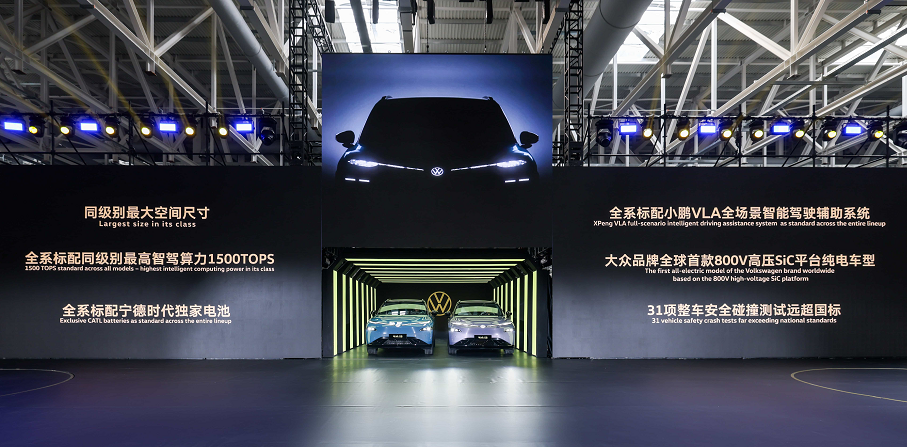
Image Source: Volkswagen Anhui
A German automaker, at its own new car launch, highlighting technology from a Chinese rival as a core product selling point.
What was just a cooperation agreement three years ago is now sitting in Volkswagen showrooms. In September, the Zhongyu 08 Shadow Edition launched, featuring the VLA 2.0 (Vision-Language-Action) intelligent driving model. Then, on October 24, their second jointly developed model, the Zhongyu 09, officially hit the market.
From Volkswagen and XPENG to Opel and Leapmotor, European automakers are starting to pay for Chinese automotive technology.
The technological partnership between Volkswagen and XPENG has even extended into the internal combustion engine market.
In 2023, the collaboration focused on two pure electric vehicles; by 2024, it had deepened into electronic and electrical architecture development. By August 2025, the scope expanded to VW's ICE and plug-in hybrid platforms in China. Under the plan, starting in 2027, their jointly developed electronic and electrical architecture will further power VW's traditional and hybrid models produced locally.
Volkswagen's product lineup is expanding, and so is XPENG's technology business—all without XPENG needing to build a single internal combustion engine production line.
A look at XPENG's third-quarter earnings reveals two striking figures: a 13.1% gross margin for automotive sales versus 67.1% for services and other businesses—a gap of 54 percentage points.
Service and other revenue hit 2.647 billion yuan for the quarter, up 13.7% year-on-year, driven largely by increased carbon credit trading income. Yet despite the revenue rise, the segment's gross margin fell 7.5 percentage points year-over-year and 8 points quarter-over-quarter.
XPENG attributed the dip to reduced revenue from technical R&D services this quarter, whereas the prior two comparison periods saw income recognition from major project milestones.
The profit potential in technical services is enticing, but when that revenue actually hits the books depends entirely on where a project stands.
Projects run on cycles, but R&D spending can't pause. Over the same period, XPENG's R&D expenses reached 2.85 billion yuan—a 17.5% annual increase—primarily funding new models and AI-related development.
But Volkswagen is just one partner. XPENG needs more buyers.
In July, during the first internal employee test of its Robotaxi service, He Xiaopeng already defined the playbook: sell hardware, sell services, and take a commission cut, while leaving offline operations to partners.
Maintaining a global fleet of robotaxis requires purchasing, charging, maintenance, cleaning, and building local operational systems. XPENG can offload these tasks to partners and focus strictly on the technology business.
At its recent Tech Day, XPENG revealed it has begun L4 autonomous passenger testing with no driver behind the wheel and is in talks with several global ride-hailing platforms. Its first custom Robotaxi model for the mass market, the YOYO-01, is slated for release in 2027.
The pool of potential buyers keeps widening.
In September, Reuters reported, citing insiders, that XPENG is expanding its technology licensing business to include physical AI technologies like Robotaxis and humanoid robots for overseas clients.
At the Paris Automotive Summit, XPENG officially launched XPENG AI Engineering, opening up its vehicle platform, electronic and electrical architecture, intelligent driving, electric drive, AI chips, and engineering tools like remote calibration and production line testing to global partners. The company says it has already received cooperation inquiries from multiple firms.
Alongside smart car solutions, XPENG is also offering a "Physical AI Full-Domain Solution," covering humanoid robots, Robotaxis, flying cars, Turing AI chips, and even the physical world foundation model.
A little over a month later, WorldGPT arrived.
How Many Businesses Can XPENG Build From One AI Training Session?
A decade ago, the automotive industry was busy poaching talent from the robotics sector.
At the 2026 China Automotive Software Conference, Zhang Guangxiao, head of embodied intelligence at CAIC, recalled that most autonomous driving engineers hired in 2016 and 2017 came from robotics. Back then, robotics technology was empowering autonomous driving.
Over the past decade, China's auto industry has battled through electrification, then smart driving, and now large language models. Automakers have purchased massive computing power, built data collection and training systems, and trained armies of AI engineers. They've installed this tech into millions of cars, testing it against the rigors of the real physical world.
Now, technology is beginning to flow in the opposite direction.
In the past, automakers could bring motors, batteries, and sensors to the robotics industry; now, even the AI they spent billions to train has the chance to cross over.
At Tech Day, XPENG proposed a development model of "one infrastructure, two product types," allowing smart cars and humanoid robots to share computing power, data infrastructure, and accumulated expertise in control and safety.
Inside XPENG's robot data factory,the company is collecting and training data across more than 250 scenarios and 15 job categories. Notably, the data processing and evaluation tools there reuse R&D results from the automotive business.
The R&D tools paid for by the car business are finding a second life in robotics.
YetWorldGPT's joint training includes far more than just XPENG's own cars and humanoid robots. It also encompasses boats, drones, single-arm robots, and dual-arm robots.
Cars must dodge sudden obstacles; mechanical arms need to predict an object's movement during grasping; drones must navigate 3D spaces without collisions. These machines have vastly different bodies, yet they can share knowledge of the physical world.
WorldGPT acts as a cloud teacher model. Through distillation and capability transfer, it imparts this knowledge to edge models across different forms. According to XPENG's technical roadmap, introducing a new form factor requires only a small amount of specialized data to calibrate unique control details, slashing redundant R&D investment.
Industrial robots, agricultural machinery, drones, and boats all have their own manufacturers. XPENG has no need to build factories to compete for these orders—those companies could very well become XPENG's customers.
In this market, however, the competitive landscape shifts.
Nvidia is building a physical AI ecosystem through models like Cosmos and GR00T, while Google DeepMind and Physical Intelligence are developing cross-ontology foundation models. These players don't need global robot factories to claim a slice of the robotics industry's value.
Yet XPENG holds a distinct advantage: it has millions of smart cars driving on real roads and humanoid robots nearing mass production. Its own products provide continuous opportunities to accumulate data and verify technology.
When both companies spend tens of billions on AI, one can only recoup costs through its own car sales, while the other has a chance to let the automotive, robotics, and industrial equipment industries share the bill.
In the next round of AI competition, the ability of these two companies to sustain heavy R&D spending could diverge significantly.
Beyond expanding its roster of AI buyers, XPENG is also figuring out how to extract more value from a machine long after the initial sale.
Last year, IRON was just walking the catwalk on the Tech Day stage; this year, it took the podium to speak and interact with the audience. According to XPENG's roadmap, IRON is expected to enter hardware mass production next January and start working as an intern sales associate in XPENG dealerships by the first quarter.

Image Source: XPENG
XPENG also launched a robot ecosystem open platform, allowing partners to download capability packs, customize them, and develop new skills. The company plans to explore token-based subscriptions and scenario-based services.
One day it's greeting customers in a store; the next, it's training staff; the day after, it's hosting an event. A single robot can continuously learn new job skills.
In the future, XPENG might not sell a single additional robot, yet still manage to sell plenty of new AI skills.
In the automotive sector, XPENG plans to launch a Turing AI driving subscription service for new global buyers in the second quarter of 2027.
The true promise of WorldGPT lies in transforming technology that once required repeated development into a product that can be sold repeatedly.
AI Has No Fixed Body, But Business Has Borders
Imagine the head of a German industrial robotics company sitting across the negotiating table from XPENG.
On the table is AI technology that XPENG spent years training. It could help robots learn new skills faster, allowing the firm to hire fewer AI engineers, buy less computing power, and launch products sooner.
But to use this AI, he first has to see how much his own robots need to change.
At Tech Day, He Xiaopeng argued that the value of isolated, point-solution hardware or software self-development will diminish. "Full-stack self-development plus cross-domain fusion plus global manufacturing" may become a prerequisite for tech companies in the physical AI era.
Just look at XPENG's own IRON. It boasts 76 degrees of freedom, over 1,500 touchpoints, and three Turing AI chips, enabling large models and whole-body motion control to run locally on the device.
Whether a robot can steadily pick up an object depends on both the model understanding the task and the fingers sensing resistance, while joints adjust force in real time.
XPENG can redesign its own robots to achieve specific AI capabilities. But would an established industrial robot maker be willing to scrap its entire control system, sensors, and actuators just to use XPENG's AI?
XPENG understands this difficulty firsthand.
To equip older models equipped with dual Nvidia Orin-X chips with second-generation VLA capabilities, XPENG had to perform cross-chip model distillation. This required deep engineering optimization for different chip architectures, computing power, memory limits, and response times.
XPENG is changing how it develops. Starting with VLA version 6.4.0, the R&D process has shifted to autonomous closed-loop training by AI agents, boosting overall training speeds by 10 to 12 times. These capabilities are now being used to accelerate distillation for the dual Orin-X versions. The first over-the-air update for relevant models is scheduled for December.

Image Source: XPENG
For the same automaker, with the same type of car, simply switching a chip platform demands dedicated engineering resources. So, what happens when XPENG tries to install its AI into a body designed by someone else?
Then cross national borders, and you face entirely new working environments.
Since July, XPENG's NGP (Navigation Guided Pilot) system, powered by the second-generation VLA, has completed localized generalization testing in Germany, the Netherlands, and France. In November, XPENG opened NGP to public trials at its Paris store, with a target to begin the first batch of European deliveries in the first half of 2027.
Even XPENG's own cars, moving from Chinese roads to European ones, must undergo validation for local traffic conditions, driving habits, and regulatory requirements.
That German robotics executive, meanwhile, has to bring XPENG's AI into his own factory.
One day a production line is running one batch of parts; the next, a new product, and the robot's tasks must change. XPENG can certainly handle the skill development, but the data required for training? That's not necessarily something customers are willing to hand over.
Years of accumulated industrial operation data from a European robotics firm likely contain its most core manufacturing secrets. It might be willing to pay for XPENG's AI, but reluctant to use its own data to help train a smarter robot for XPENG.
After all, XPENG is building robots itself.
If clients demand data remain local and specialized models be deployed independently, XPENG will need to rethink how it handles subsequent training and upgrades.
This also raises the question of how the technology itself crosses borders.
Just three days after XPENG announced its open physical world foundation model in Paris, new policy movements emerged in China regarding AI technology exports.
On October 16, the Ministry of Commerce and the Ministry of Science and Technology sought public comments on revisions to the "Catalog of Technologies Prohibited and Restricted from Export." The proposal aims to add restrictions on certain AI large models, intelligent agents, computing clusters, and information processing technologies. Simultaneously, temporary registration management prior to export was implemented for the listed technologies.
According to the Ministry of Commerce's explanation, whether an LLM export falls under technology export management hinges on whether restricted technology undergoes cross-border transfer. Services like API calls, SaaS applications, and local lightweight deployment face different regulatory requirements than directly transferring model technology abroad.
WorldGPT's architecture—separating the cloud teacher model from edge-specific models—leaves room for different delivery options in overseas commercial partnerships.
Will XPENG authorize a model to a client, or retain the base model and continuously supply new AI capabilities via technical services? And to what extent can clients independently develop new skills without constantly consulting XPENG?
These are questions that must be resolved before any contracts are signed.
As Others Sell More, Can XPENG Earn More?
Let's return to the Zhongyu 08 and Zhongyu 09, already sitting in Volkswagen showrooms.
For every additional car Volkswagen sells, how much more does XPENG make? The companies haven't disclosed the full fee structure. A one-time development fee pays for the project, but royalties per unit allow revenue to grow with the client's sales. Software updates and subscription services, meanwhile, can extend revenue throughout the product's lifecycle.
The commission-sharing model XPENG proposed for Robotaxis offers another perspective: the more cars partners run and the more orders they complete, the more XPENG can participate in the distribution of operational revenue.
The distinction between these revenue models is critical for a company pouring massive capital into AI R&D.
If a single technology partnership ends and revenue depends solely on finding the next development project, XPENG must endlessly expand its client list. But once tech revenue can grow alongside a client's product sales, usage frequency, and demand for new skills, XPENG's commercial scale is no longer strictly limited by how many development contracts it signs in a year.
Of course, clients have their own calculations to make.
A German robotics firm buying XPENG's AI—plus the cost of hardware modifications, model adaptation, and future upgrades—must find it cheaper than developing the tech in-house. Otherwise, why hand over a technology that determines its own product competitiveness to an outsider?
For XPENG, having invested heavily in compute, data, and R&D to distill common knowledge into a foundation model, the least economical outcome would be having to rebuild expensive training, adaptation, and maintenance systems for every different country and client overseas.
Selling one model could mean raising a dedicated team for every client.
In the end, you might achieve technical cross-ontology capability, but commercially, you're still doing bespoke projects, with revenue still tied to project milestones.
That is why, WorldGPT's commercial value ultimately depends not just on how many types of machines it makes smarter, but on how much additional R&D resources XPENG must invest for each new machine type or client added.
In its third-quarter earnings report, He Xiaopeng already spoke to the potential for physical AI technology to create high-margin commercial opportunities in global markets.
To capture that money, XPENG must enable clients to gain stronger AI for less cost, allowing its own tech revenue to scale with its clients' product volumes—without letting engineering costs rise at the same pace.
China's auto industry has been battered by a price war for years. In the past, for an automaker to earn more, it usually had to steal customers from its rivals.
WorldGPT offers another possibility.
One day, XPENG's competitors could be running at full tilt producing cars and robots—and generating revenue for XPENG in the process.


