



2025 marked the conclusion of China's 14th Five-Year Plan, closing a significant chapter for the auto market. Data from the China Association of Automobile Manufacturers (CAAM) shows annual passenger vehicle sales reached 30.1 million, up 9.2% year-on-year. New energy vehicle (NEV) sales rose 28.2% to 16.49 million, pushing the penetration rate close to 48%.
This indicates that despite global economic volatility, industrial restructuring, and recovering consumer confidence, China's auto market has entered a stable development phase, even as the competitive landscape grows more complex.
For automakers, the competitiveness of the product lineup is what really drives scale and growth. Looking back at the past year, the companies that posted the biggest sales volumes and fastest growth rates were not relying on a single "blockbuster"; they were buoyed by a portfolio of best-sellers.
In other words, while hit products remain crucial, their power as a standalone force is diminishing.
They All Rely on Multiple Hits
Looking at the top 15 sellers of 2025, leaders like BYD, Geely, and Chery all captured segment share through "multi-brand, multi-product" strategies. Although they still have core models, the share these contribute to total sales has fallen significantly compared to the early days, when a single hit made up the bulk of volume.
Take BYD, which topped the charts. Its 2025 sales reached 4.6 million, a 7.7% increase. The Seagull was its best-seller with over 500,000 units sold, accounting for roughly 12% of the total.
Yet the Seagull alone cannot support such a massive system. Data from Gasgoo shows BYD has over a dozen models selling more than 100,000 units annually. The Song Plus DM moved over 300,000 units; the Yuan series, Qin Plus DM, Dolphin, and Song Pro DM each fell in the 200,000 to 300,000 range; the Seal 05 EV and Qin L BEV were among several selling between 100,000 and 200,000; and a handful of others neared the 100,000 mark.
Spanning price points from 70,000 to 200,000 yuan and covering both sedans and SUVs, this "multi-pronged" layout gives BYD high resilience against volatility in specific market segments.
Geely's momentum is similarly driven by synergy across multiple brands and product lines. In 2025, sales exceeded 3 million units, jumping 39%. The Galaxy series alone contributed 1.236 million units, a 150% surge that accounted for 40% of the total. Through differentiated positioning of sub-brands like ZEEKR, Galaxy, and Lynk & Co, Geely covers the full price range from 50,000 to 1 million yuan.
The Xingyuan was Geely's best-seller, moving nearly 500,000 units in 2025, or about 15% of the total. Meanwhile, the Xingyue L and Bin Yue series each sold over 200,000 units, while models like the Boyue L and Panda Mini topped 130,000. With one or two strong contenders in every major segment, Geely has built a substantial product lineup.
This strategy is common among most leading traditional automakers. SAIC-GM-Wuling relies on small cars like the Hongguang MINI EV (over 400,000 units) and the Binguo series (about 200,000). Chery, for its part, is powered by a fleet of SUVs including the Tiggo 5X, Tiggo 7 series, and Tiggo 8 series, each selling around 200,000 units annually.
Among multinational automakers, Volkswagen Group saw a slight dip in overall sales, but still counts the Sagitar, Passat, and Magotan as pillars with roughly 200,000 units each, alongside the Audi A6L and Lavida, which both held above 100,000. Toyota also maintains multiple internal combustion engine models with monthly sales exceeding 10,000 units, such as the RAV4 and Frontlander.
General Motors is also worth watching. In 2025, it staged a double-digit recovery, surpassing 600,000 units sold (excluding SAIC-GM-Wuling). The Envision family was its best-seller, breaking 160,000 units, with the Envision Plus alone surging 88%.
Cui Dongshu, secretary-general of the China Passenger Car Association (CPCA), notes that Buick remained stable amid a broader downturn thanks to precise positioning of models like the Envision Plus and its transparent pricing strategy. With competitive pricing and superior product specs, the Envision Plus delivered steady market performance in 2025.
Among traditional luxury brands, BMW delivered a standout performance, keeping sales in China steady at around 600,000 units in 2025. This was underpinned by its two mainstays, the 3 Series and 5 Series, which together contributed 40% of the total.
A breakdown of the top sellers reveals that in today's market, a single hit model can no longer sustain long-term growth expectations. Intensifying competition in niche segments has compressed product life cycles, while consumer demand is fragmenting, with widening preferences for price, powertrain, and vehicle size.
In this context, relying on a single model to cover all mainstream needs carries inherent structural limitations. Consequently, only automakers capable of spawning multiple hits can hope to scale up, making it a prerequisite for reaching the million-unit annual sales mark.
New Players Rely on Hits Too
In the new-energy startup camp, hit products are equally prevalent, and for a long time, they played an even more critical role. Data shows startups rely far more heavily on single hits than traditional automakers. Xiaomi, for example, sold over 400,000 vehicles in 2025, driven primarily by two models. Its debut, the SU7, contributed about 250,000 units, claiming a massive 60% share.
By contrast, the best-selling models for BYD and Geely typically account for less than 20% of sales. This reflects how new players, in the early stages of brand building, often need a breakout product to quickly capture consumer mindshare.
Leapmotor, which sold nearly 600,000 units in 2025, saw its C10 model become the best-seller with 160,000 units, representing 26% of the brand total. Combined with the B10, which sold over 90,000 units, just these two models delivered 40% of the brand's volume.
XPENG also broke the 400,000 mark last year, with the MONA M03 alone selling nearly 200,000 units, a remarkable 46% of the total. Li Auto sold over 400,000 units during the same period, with its L6 model alone contributing a 40% share. NIO's mainstream sub-brand, Onvo, saw its first model, the L60, secure about 60,000 sales in its debut year, accounting for 20% of NIO's total volume.
Tesla's retail sales in China reached approximately 600,000 units in 2025 (excluding exports), capturing about 2% of the domestic NEV market. While this represents a slight decline from the previous year, it remains a top-tier performance.
The Model Y and Model 3 remain its primary drivers. The Model Y consistently ranks among the top pure electric vehicles in China, contributing 60% of Tesla's sales. Together with the Model 3, Tesla has effectively built a structure where a few hits support the entire volume.
The success of new players in creating hits is largely due to precise product definition and a technological superiority in intelligent experiences. Most target mainstream or premium price brackets, offering perceptible advantages in configuration and smart tech, while simplified product lines help lower consumer decision costs.
Take the XPENG MONA M03: in the 100,000 to 150,000 yuan range, it makes high-end driver assistance and stylish design accessible, tapping into young consumers' desire for technology. The Xiaomi SU7's rapid rise stems not just from Lei Jun's personal brand appeal, but from its closed-loop "human-car-home" ecosystem, an interactive experience traditional models struggle to match.
Wang Xianbin, an analyst at Gasgoo Automotive Research Institute, argues that in a growth market, startups achieve high platform unity and standardized production through a "lean and focused" approach, thereby building competitive barriers in specific segments.
A comparison reveals a shift and fusion in competitive logic. Traditional automakers cast a wide net to uncover hits, whereas startups start with a single blockbuster and expand toward multi-product matrices.
The relatively small number of hits for startups reflects their developmental stage and resource constraints. Compared with established giants, new players have fewer platforms, production layouts, and channel coverages, making them more likely to concentrate resources on perfecting a single product. This strategy helps build market awareness early on while keeping costs and rhythm in check.
As sales volume scales, a single model must shoulder not just sales targets, but also the pressure of after-sales service, supply chains, and quality control, amplifying risk exposure.
Tesla is a case in point. Although the Model 3 and Model Y long dominated the global NEV market, the pressure on a single product has grown in an era of fierce competition and diverse consumer needs. Impacted by Chinese automakers among other factors, Tesla saw sales slip in core markets like China and Europe in 2025, leading to an 8% annual decline.
For new players, transitioning from a reliance on a single model to spreading growth across multiple models is a hurdle they must clear. In fact, the leading startups are already doing so. NIO, XPENG, Li Auto, and Leapmotor are all adding brands or product lines to capture a broader slice of the market.
Most Models, However, Will Not Sell
Whether traditional giants or new challengers, the strategy of "flooding the market" with brands and products has become the mainstream choice. Companies hope that richer matrices covering wider price ranges and demographics will help them seize opportunities in a fiercely competitive landscape.
Yet the reality is stark: within these vast matrices, only a handful of models ever become hits. The vast majority linger on the margins of sales.
This is particularly true for traditional automakers. Most top-ranked companies currently have 40 to 50 models on sale, with some group enterprises approaching or exceeding 70. These models span different brands, powertrains, and price points, creating a seemingly dense market coverage net, but in terms of actual performance, only a small fraction deliver stable volume.
Incomplete statistics from Gasgoo show the Geely Group (including Volvo) has about 80 models on sale; Chery Holdings follows with roughly 75; Volkswagen Group and BYD hold about 70 and 60 models respectively; and Toyota, Honda, and GAC each offer more than 30. (Note: Sales are counted by powertrain type, so the Han DM and Han BEV are calculated separately.)
Behind this massive lineup lies an automaker's attempt to occupy every niche. Yet sales contribution is heavily concentrated in a few headlining models.
For instance, Geely's top 10 models account for 70% of its total sales, while BYD's top 18 contribute roughly the same share. The story is similar elsewhere. This means the remaining dozens of models must compete for the remaining share, with many selling only in the hundreds or low thousands each month.
The trend toward multi-brand and multi-product expansion is also evident among startups. Leapmotor has about 13 models on offer, XPENG around 12, and NIO about 14. Only Li Auto still adheres to a focused model strategy. Yet the sales structure remains "pyramidal," where core hits drive the brand's volume while other models play supporting or exploratory roles.
This hasn't stopped startups from expanding their matrices. Even Tesla, long renowned for a "lean and focused" approach and relying on just two products to dominate the global market, has launched the Model Y L and plans a budget model for 2026 to meet diverse global demands and fierce competition. Xiaomi, meanwhile, is launching three major new models this year.
Startups are pivoting to multi-product strategies because a single-product structure is increasingly ill-equipped to handle the complexities of China's auto market. Auto analyst Bai Yiyang notes that in a growth phase, a multi-product strategy maximizes the discovery of niche markets, primarily by meeting differentiated needs across price points and use cases.
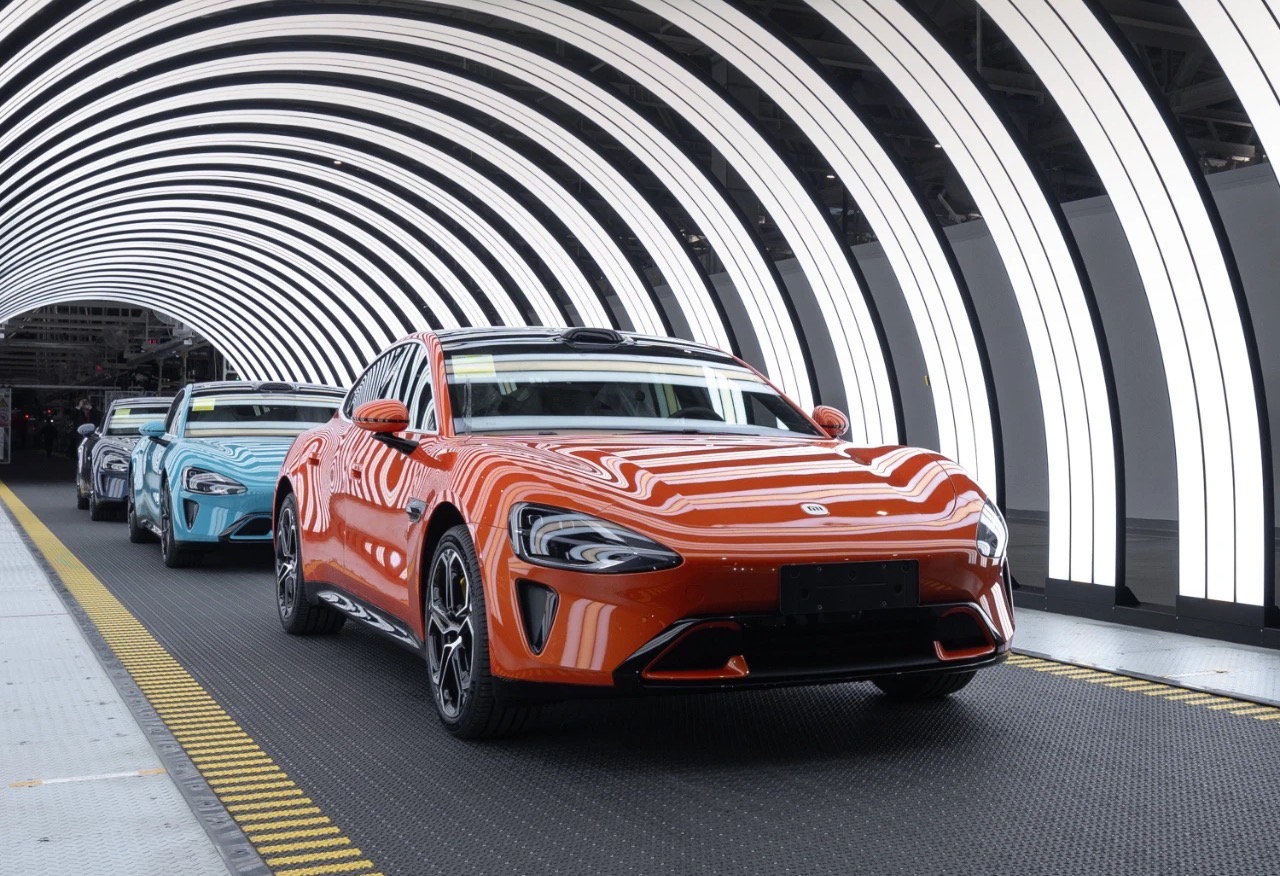
Image source: Xiaomi EV
At the same time, consumer demand is becoming increasingly fragmented and personalized. More than one auto executive has told Gasgoo that it is hard to build a "universal car" for everyone. By leveraging distinct brand positions, such as NIO's premium focus, Onvo's mainstream appeal, and Firefly's entry-level status, and product characteristics, like the stability of BYD's Dynasty series versus the youthfulness of its Ocean series, automakers aim to secure a foothold in the minds of different consumer groups.
For traditional automakers, multi-brand strategies serve as a crucial bridge to the new energy era, helping to distinguish their identity from the internal combustion engine past. Geely launched ZEEKR and Galaxy, while Changan rolled out Avatr, Deepal, and Qiyuan.
One industry insider noted that looking at the success of multi-model hits at BYD and Geely, a strong product offensive at reasonable prices creates a sense of value. "In terms of experience, I feel BYD's hybrid products are already superior to Toyota's at this stage."
The fast pace of competition also means the market rarely grants enough room for every model to grow. User attention, channel resources, and internal investment are finite. When product numbers swell without a clear hierarchy, sales naturally concentrate on the strong contenders, squeezing the rest to the periphery.
Conversely, a multi-brand, multi-product approach disperses resources across R&D, marketing, channels, and supply chains. If brand positioning is blurred, price bands overlap, or products are mere "badge-engineered" clones, internal cannibalization becomes inevitable.
There are lessons to be learned from the past. Geely previously suffered from overlapping sub-brand positioning and resource cannibalization, which slowed its NEV transition until it reorganized its brand matrix. Chery's earlier stumbles with a multi-brand strategy also serve as a cautionary tale.
After continuous exploration, many automakers are now integrating everything from organizational structures to R&D systems. The goal is resource sharing, improved efficiency, modular development, and ultimately, cost reduction. Some have already succeeded. This means that even in a market norm where "most products don't sell and only a few do," automakers can still seize the initiative and ensure the benefits outweigh the costs.
Analyst Bai Yiyang points out that growth stages often hold many undiscovered niches, making multi-brand or multi-product strategies ideal for seizing first-mover advantage. Once the market matures and product refinement peaks, a return to focused brand strategies may follow.
When the auto market will return to a "lean and focused" path remains unknown. We may have to wait until the end of this current cycle of competition and consolidation to find out.


