



Gasgoo Munich- Mergers and acquisitions in the auto parts sector picked up significant pace in the first half of 2026.
Citing data from iFinD, the Economic Information News reports that 67 listed automotive companies had announced M&A plans by June 12. Parts suppliers formed the bulk of this wave.
Notably, acquirers are overwhelmingly seeking controlling stakes rather than minority investments, with some deals even featuring smaller players swallowing larger ones. The focus is tightly locked on securing technology and expanding global footprints.
What’s the Rush? Control.
A clear trend emerges from this wave of deals: the core objective is no longer about sharing profits—it is about calling the shots.
On June 17, Bethel announced it had closed the acquisition of a 50.97% stake in Yubei Steering, making it the controlling shareholder. Yubei Steering will be consolidated into Bethel’s financial statements starting in June 2026. The deal was valued at approximately 1.12 billion yuan.

Source: Screenshot of Bethel announcement
On June 8, Tianqimo unveiled plans to purchase a 60% stake in Dongshi Shares for 1.83 billion yuan. Already holding 25%, Tianqimo will own 85% upon completion, making Dongshi a subsidiary.
On the same day, Ruixin Technology announced its intention to acquire a 51% stake in Deheng Equipment from ten sellers, including Tong Xiaoping and Zhang Yapeng, for 500 million yuan.
On May 26, Yishi Precision revealed plans to acquire 100% of Zhangjiagang Hengjin Electromechanical, signing a letter of intent with BMC Corp. The target will become a wholly-owned subsidiary.
On March 24, Hengbo Shares stated that a wholly-owned indirect subsidiary intends to purchase a 75% stake in Indonesia’s PT OPTIMA ELEKTRONIK MANUFAKTUR (PT.OEM) for 861.18 billion Indonesian rupiah.
Also in March, Meili Technology acquired 100% of Hitched Holdings 3 B.V. in cash from Hitched Holdings 2 B.V. through its German subsidiary, Meili Holding GmbH.
In January, Mingke Precision Technology announced plans to spend 143.78 million yuan to acquire a 53.25% stake in Anhui Shuangjun Intelligent Technology, funding the deal with 90 million yuan from raised capital and 53.78 million yuan from internal funds.
Some companies are tightening their grip on existing subsidiaries. Joyson Electronics plans to spend 2.52 billion yuan to raise its stake in Joyson Safety from 57.12% to 69.54%. Meanwhile, Ruili Kemi acquired a 16% stake in Wuhan Codes for 16 million yuan, securing full ownership.
The obsession with control comes down to one thing: the need to dictate strategy.
Historically, Chinese parts makers treated M&A as financial investment—buying into promising players and waiting for valuations to rise. This wave is different: acquirers are no longer content being minority stakeholders; they want control.
The shift stems from a fundamental rewrite of the industry's competitive logic.
For years, the parts market offered ample growth, making minority stakes a viable way to share in the industry's expansion. Now, with overall growth slowing, many segments have entered a zero-sum game.
In this environment, returns on financial investment are being squeezed. More critically, as technology roadmaps shift rapidly, the real strategic value lies not in sharing profits, but in controlling resources.
With control, acquirers can directly deploy a target’s core technology, client base, and capacity to align R&D, product portfolios, and supply chains. Minority stakes offer dividends and a voice, but they cannot deliver the same depth of strategic integration.
Bethel’s acquisition of Yubei Steering is driven by the synergy between steering systems and its own braking business—only control can truly fuse these two technological systems. Tianqimo’s purchase of Dongshi Shares aims to complete a "mold design plus parts manufacturing" chain; only control can deeply integrate Dongshi’s body, chassis, and powertrain products with Tianqimo’s molding capabilities.

Source: Tianqimo
This explains the "small eating big" phenomenon. Smaller companies are swallowing larger targets not because of deep pockets, but because the strategic value is too high to ignore.
Post-acquisition, Tianqimo transforms from a simple mold supplier into a provider of integrated "mold plus component" solutions—a genuine leap up the supply chain value ladder.
In short, the underlying logic of this wave is trading cash for control to secure long-term industrial returns. With margins under pressure, investments without control offer little leverage over technology, clients, or positioning—leaving strategic transformation without a foundation.
Two Paths: "Completing the Chain" or "Going All-In"
Clearly, every company securing control has its own agenda. But the strategies vary.
Two distinct approaches emerge. One involves "piecing together" capabilities within the core business, extending upstream or downstream to fill gaps. The other is a cross-sector "all-in" bet, jumping entirely into a new lane.
The former is the choice of the majority.
Tianqimo’s acquisition of Dongshi Shares focuses on vertical integration. The deal transforms Tianqimo from a mold and parts supplier into a comprehensive components provider covering body, chassis, and powertrain systems. This upgrade aims to elevate its status within OEM supply chains and boost its ability to secure core orders.
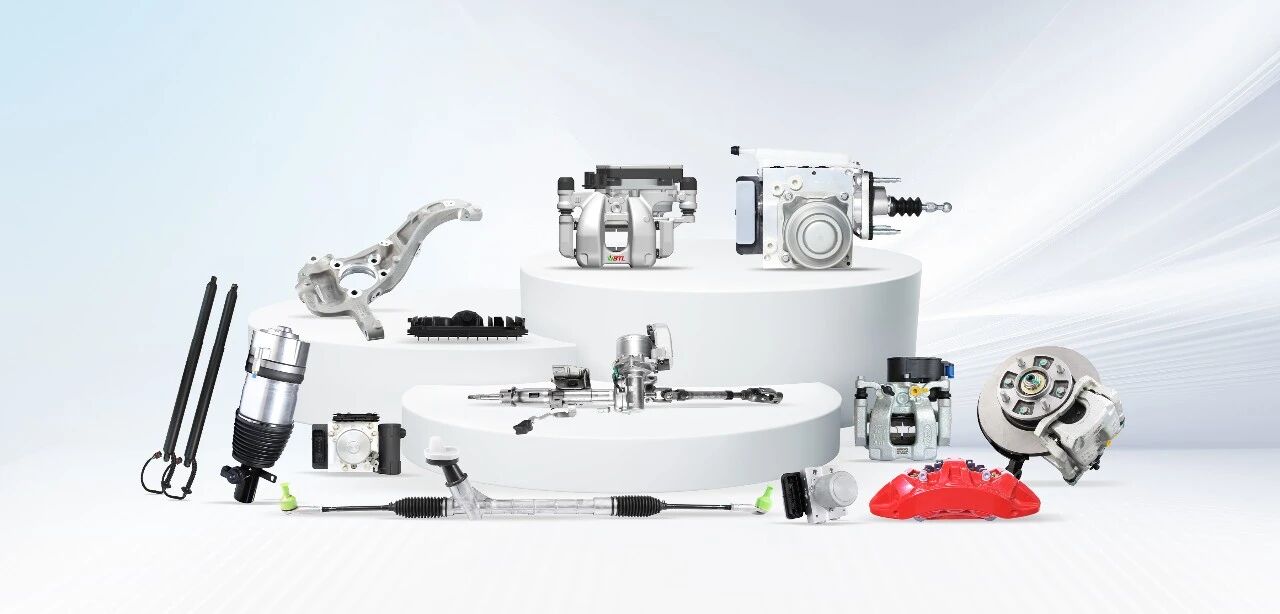
Bethel’s move to buy Yubei Steering is a critical step to bolster its steering business and accelerate its smart chassis layout. Yubei has long specialized in steering systems, covering hydraulic and electric power steering. This aligns closely with Bethel’s existing steering products in terms of technology, market reach, capacity, and supply chain.
Once the deal closes, Bethel will strengthen its electric steering capabilities, such as column-type EPS (C-EPS), and accelerate the R&D and validation of steer-by-wire and rear-wheel steering systems. The goal is to refine its business structure, broaden its product portfolio, and enhance overall supporting capabilities.
Source: Bethel
Both Meili Technology and its target are seasoned players in the parts supply chain with minimal client overlap. The acquisition gives Meili access to OEMs, specialized retailers, and distributors in Europe and North America, driving sales channel synergy, lowering customer acquisition costs, and increasing value per vehicle.
Lingdian Electronic Control spent 240 million yuan for a 30% stake in Anhui Ruineng to enter the battery management system (BMS) space and expand its control portfolio. Mingke Precision acquired a 53.25% stake in Anhui Shuangjun to extend its industrial chain toward system-level solutions.
The common thread here is clear: synergy paths are visible, resources are reusable, and the integration logic is sound. Acquirers know exactly what they want and what they are buying.
Roland Berger’s "Forecast 2026" report notes that competition in the parts sector is shifting from single-product breakthroughs to platform integration. While a single product once sufficed, the shift toward smart and electric vehicles now demands system integration capabilities. M&A offers a realistic path to build the platform needed to meet automakers' one-stop sourcing demands.
In other words, "completing the chain" via M&A is a response to a structural shift: OEMs are moving from buying "parts" to buying "systems." Only suppliers with multi-category, system-level capabilities will secure a place in the next round of competition. M&A is the fastest route to fill those capability gaps during this window of opportunity.
Yet not all companies are content with cultivating their existing turf. Some acquirers are choosing a riskier but potentially more rewarding path: cross-border mergers. The logic here differs from "piecing together" the puzzle—it is not just about fixing weaknesses, but about conquering new territory.
Weidi Shares exemplifies this approach. It plans to spend 1.10 billion yuan in cash to acquire roughly 91% of Jiuxing Precision, pivoting from electronic control products into precision metal components to create a dual-engine business model.
Weidi’s choice reflects the predicament of many small and medium-sized enterprises. When growth stalls in the core business and margins crumble, finding a new growth curve becomes imperative. Cross-border M&A is undeniably harder, posing challenges like a lack of technical depth, starting from scratch with clients, and the time needed for team integration.
But the flip side is that successful crossovers can help companies escape the low-margin trap of zero-sum competition and establish a beachhead in a new sector.
The paths differ, but the logic converges. Whether completing the chain or going all-in, both strategies address the same reality: in an era of stagnation, standing still is falling behind. The choice is between extending the current track or betting on a new direction while defending the core business. Yet M&A is merely a tool; the ultimate test is whether control can be converted into genuine competitiveness.
Why Now?
The surge in M&A activity is no accident. It is the result of multiple structural forces resonating at once.
First, there is profit pressure. Roland Berger analysts point out that the gross margin for A-share auto parts companies fell to roughly 18.5% in 2025, slipping another 0.5 percentage points from 2024. Despite the flurry of new energy and intelligent technologies, overall margins remain more than three percentage points below pre-2019 internal combustion engine levels.

Source: Visual China Group
They add that four persistent forces are crushing margins: continued price cuts driven by slowing vehicle sales; rising rigid costs for raw materials and labor; ballooning R&D spending forced by technological shifts; and eroding overseas margins due to currency fluctuations.
Together, these factors make it nearly impossible for the industry to restore profitability naturally without overhauling its business models and cost structures.
Another critical variable is the speed of technological iteration. The shift toward electrification and intelligence has outpaced expectations. Vehicle electronic and electrical (E/E) architectures are evolving from distributed control to centralized domain control, while core systems like chassis, body, and autonomous driving are rapidly integrating software and hardware. The demands on parts suppliers have fundamentally changed.
In-house R&D takes time. Building a team, developing technology, and validating products from scratch risks missing the market window entirely. M&A becomes the fastest route to acquiring core technology. There is no need to reinvent the wheel when you can simply buy the company that already has it.
Pressure to secure a position in global competition is also driving deals. By acquiring Hitched Holdings 3 B.V., Meili Technology gains a production base in Europe, creating a global network spanning China, Europe, and Mexico to boost capacity and supply capability.
Hengbo Shares’ bid for PT.OEM is aimed at entering the automotive instrument cluster sector and deepening its overseas footprint. The acquisition allows Hengbo to integrate local R&D and manufacturing capabilities in Southeast Asia, leveraging existing supply chains and networks to expand its business boundaries and competitiveness abroad.
Profit pressure, structural divergence, technological shifts, and global positioning have converged to make the first half of 2026 a dense window for M&A activity.
Roland Berger analysts emphasize that companies stuck in low-margin, low-growth segments should actively seek M&A opportunities to bolster scale and channel advantages. This is not just a shield against external pressure, but a critical path from passive endurance to active strategic layout.
The "Forecast 2026" report explicitly states that the core of industry competition in 2026 will shift to the capital arena. Rivalry is no longer limited to technology, products, or customers—it now extends to financial strength, cash flow management, and M&A integration efficiency. As the industry undergoes cyclical adjustment and accelerated reshuffling, capital liquidity and allocation efficiency will directly determine survival and growth, becoming the key variables reshaping the landscape in 2026.
This means the M&A wave of the first half of 2026 is just a prologue. The combined forces of profit pressure, technological iteration, and global positioning have opened a window for industry consolidation—and it will not close anytime soon.


