



Gasgoo Munich- The automotive sector serves as a pillar of the national economy, with a vast supply chain where upstream and downstream players are tightly bound. The health of small and medium-sized suppliers directly determines the resilience of this industrial ecosystem. Yet for years, excessively long payment terms and inflexible payment methods have been a persistent headache in the auto supply chain. They not only strain the cash flow of SMEs but also hide the risk of supply chain ruptures.

Image Source: VCG
In June 2025, 17 key automakers responded to the State Council's revised Regulations on the Payment of Funds to Small and Medium-sized Enterprises, collectively pledging to cap payment terms at 60 days. Eight months later, a special research report from the China Association of Automobile Manufacturers (CAAM) has just been released. It uses hard data to highlight the achievements of the reform while unflinchingly pointing out remaining shortcomings. Just how far has this reform, aimed at optimizing the supply chain ecosystem, actually progressed?
Significant Compression in Payment Terms?
On February 12, CAAM released a report on the implementation of payment term pledges by key automakers, conducting a comprehensive review of 17 major players. Judging by the data, the results of compressing payment cycles are indeed notable.
The most visible change is the drastic reduction in average payment cycles. The report shows that the vast majority of the 17 automakers have completed the compression, bringing the average cycle down to 54 days—10 days shorter than last year. Among them, four companies stand out with averages below 50 days, demonstrating significant success in fulfilling their pledges.
Optimizing payment methods has been another highlight of this reform. For a long time, non-cash instruments like commercial acceptance bills and electronic vouchers for accounts payable were common tools for automakers to effectively extend payment terms. If suppliers needed cash urgently, they had to bear additional discounting costs, further intensifying financial pressure.
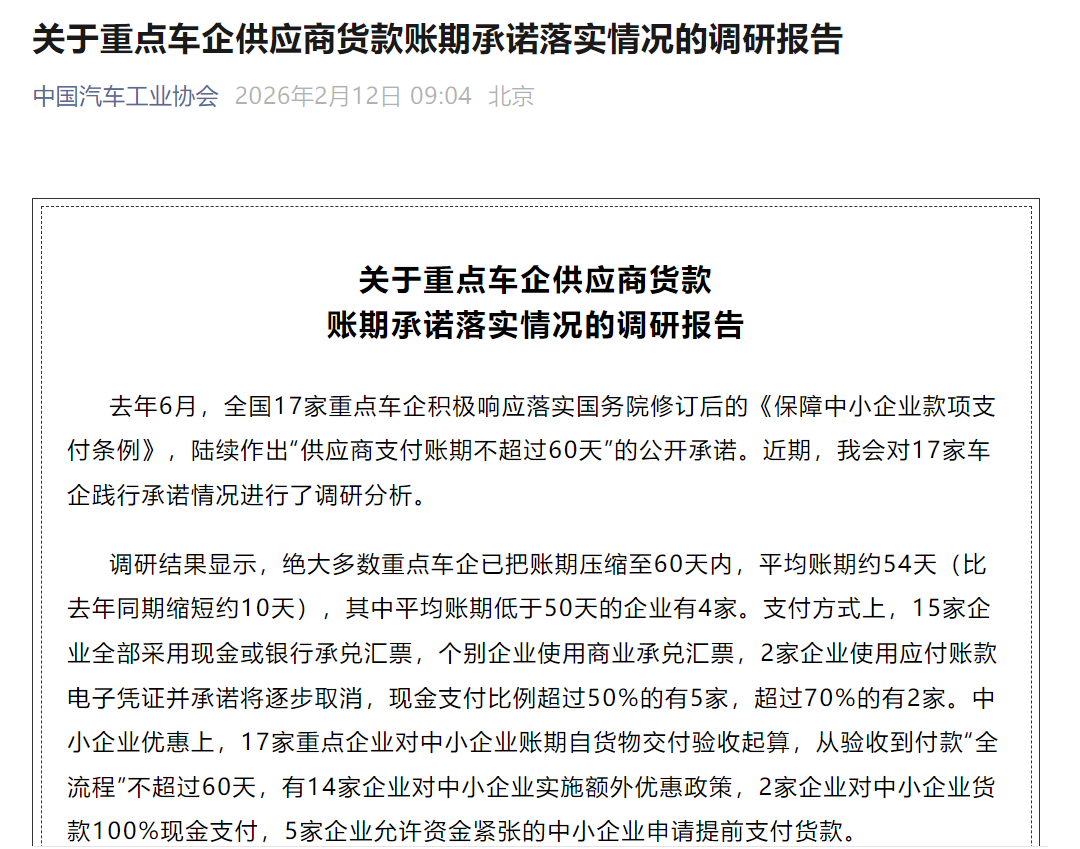
Image Source: Screenshot from CAAM report
The survey indicates that 15 companies have now switched entirely to cash or bank acceptance bills. Only a few still use commercial acceptance bills, while two companies that previously used electronic vouchers have explicitly promised to phase them out, reducing the occupation of supplier funds.
Support for SMEs has been particularly strong. All 17 automakers have ensured that payment terms for SMEs are calculated from the point of delivery and acceptance, with the entire process not exceeding 60 days. Among them, 14 have introduced additional preferential policies, two have achieved 100% cash payments for SMEs, and five allow cash-strapped SMEs to apply for early repayment.
The report notes that to ensure these pledges are met, all key automakers have established special implementation mechanisms. Many have set up dedicated working groups and issued institutional documents to adjust payment terms for existing contracts. Some have optimized financial processes and IT systems to enable regular automatic payments. Others have shifted the start date for terms to the delivery acceptance day and switched settlement frequency from monthly to every 10 days, significantly boosting efficiency. Several companies have also earmarked over 10 billion yuan in special funds to improve payment cycles.
CAAM specifically clarified that the surveyed payment terms are calculated from the starting point—such as acceptance or reconciliation—to actual payment. Due to differences in statistical scope, some financial report calculations may yield higher figures than reality. Additionally, bank acceptance bills are an industry standard and are widely accepted by suppliers because of their high credit rating and liquidity.
Lingering Problems Demand Attention
The report did not shy away from the bad news, explicitly pointing out current deficiencies in payment term management. More concerningly, feedback from many industry insiders reveals a gap with the survey data. "Good data, bad experience" has become a common sentiment among some suppliers, exposing unresolved pain points and loopholes in the reform's implementation.
The most glaring issue is the inconsistency in payment start dates, with some automakers effectively extending terms. The CAAM report notes that start points vary—some use delivery acceptance, others centralized reconciliation, invoice receipt, or loading verification. While nominally all are 60-day terms, the actual time from delivery to payment varies widely, and unstandardized process management allows for disguised extensions.
According to the revised regulations, the payment period should start from the date of delivery or passing inspection, and automakers must not delay acceptance. In practice, however, some automakers use tactics like "vague acceptance standards" and "cumbersome procedures" to artificially lengthen the acceptance cycle.
Even more insidious is the practice of using the invoice date as the start point while artificially delaying the invoicing process. Several industry insiders told Gasgoo that automakers are still suppressing invoices. One supplier bluntly described "offline invoicing"—where a vehicle rolls off the line—as a clever maneuver. "There’s infinite room for manipulation here. It used to be about 45 days from shipment to invoicing; now it's compressed to 35, but the invoices aren't finished. They leave 35% 'offline' to be invoiced next month.". Another supplier revealed some payments have gone uninvoiced for up to a year. Others reported receiving acceptance bills with six-month maturities or waiting three to four months for repayment.

Image Source: VCG
Although some companies confirmed that payment terms have indeed shortened compared to the past, the feedback above cannot be ignored. While not naming specific companies, these reflections are sufficient to show that payment term management at some firms remains unstandardized, and the practice of disguised extension has yet to be thoroughly eradicated.
At the same time, a minority of companies are using "shortened terms" as leverage to make unreasonable demands of suppliers. Against the backdrop of squeezed profit margins, some automakers have honored their term pledges but shifted costs to suppliers through other means. The most common is "trading terms for price cuts." A few even demand suppliers accept unfair clauses, such as covering R&D, testing, and mold development costs that should be borne by the OEM, or significantly increasing cost-sharing ratios.
"Hidden traps" in payment methods mean some suppliers haven't seen fundamental relief. While most automakers promised not to use commercial acceptance bills, a few still do. Others use bank acceptance bills but issue them with 180-day maturities. For suppliers needing cash, this means paying extra discounting costs.
Objectively, these problems stem from both irregular management and short-term profit-seeking by automakers, as well as the industry's objective difficulties. Over the past three years, amid a brutal price war, auto industry profit margins have steadily declined. To squeeze out profit, some automakers have had to pass pressure upstream to suppliers, creating obstacles for payment term reform.
Payment Reform Needs a Second Wind
Payment term reform is not a fleeting political stunt but a "protracted war" determining the resilience of the auto supply chain. The report card for the 17 automakers is impressive—average terms cut to 54 days, meeting the "under 60 days" pledge. But the complaint that "data looks good, but the feeling is bad" suggests the reform hasn't yet hit the real pain points of small suppliers. Clearing blockages in the chain requires multi-party coordination and precision, not just superficial efforts.

Image Source: VCG
First, regulators must bare their teeth and hold the bottom line. The core is implementing the payment regulations effectively so rules aren't "paper tigers." We need a unified start point for terms, clearly stipulating that only the "date of delivery and passing acceptance" counts, and strictly forbidding automakers from extending terms via "vague standards" or "deliberate invoice suppression."
The Ministry of Industry and Information Technology's online complaint window needs to speed up. For issues like payment delays or unfair clauses reported by suppliers, a "complaint-investigation-rectification-feedback" loop should be established, with violations publicly announced. Simultaneously, working with CAAM to introduce a unified procurement contract template—explicitly writing in payment methods and acceptance deadlines—will reduce room for backroom deals.
As the core of the chain, automakers must drop their "dominant mindset" and shoulder their share of responsibility. They can't just calculate their own short-term interests. They need to face management loopholes, simplify acceptance processes, clarify deadlines, and stop hidden violations like suppressing invoices. Payment methods must strictly adhere to promises: minimize commercial bills and prioritize cash for SMEs. Even when issuing bank acceptance bills, they shouldn't play the "180-day trick."
Crucially, stop the "terms for price cuts" game. Instead of shifting costs to upstream SMEs, automakers should save costs by optimizing their own supply chains and boosting production efficiency. Following the example of FAW and GAC—using special mechanisms and process optimization to achieve win-win outcomes with suppliers—is the only sustainable path.
Beyond this, industry and policy need to lend a hand to solve the practical dilemmas of reform. CAAM must act as a "bridge," continuously tracking implementation, promoting best practices, and calling out companies that fail to rectify issues—rather than just being a "nice guy." It should also work with financial institutions to launch accounts receivable financing products for SMEs, leveraging automakers' credit to ease cash pressure.
Given the reality of squeezed profit margins, relevant departments should also introduce supportive policies. Automakers that strictly keep their promises and actively support SMEs should receive preferential treatment in subsidies and project applications, helping to alleviate cost burdens and allowing payment reform to continue.
The resilience of the auto supply chain is never a "solo act" by one automaker, but a "chorus" of every upstream and downstream player. The core of payment reform is simple: get the "hard-earned cash" of small suppliers to them on time and create a virtuous cycle in the chain. The reform has only taken its first step. To truly solve the disconnect between "data and experience," we need unwavering regulation, responsible automakers, and a collective industry effort.


