



On January 22, Geely Holding Group unveiled a strategic roadmap in Beijing that lays out its ambitions through the end of the decade.
To be specific, by 2030, the Chinese automaker aims to sell more than 6.5 million vehicles worldwide and rank among the top five global carmakers by volume. New energy vehicle (NEV) models are expected to dominate the mix, accounting for roughly three out of every four vehicles sold, while overseas markets should contribute more than one-third of total sales.
Another key to this plan is the development of a new-generation global NEV architecture spanning A- to E-segment vehicle models, designed to cut average per-model development cycles and overall costs by more than 30%.
Geely has distilled the strategy into a single phrase: "One Geely, taking lead on all fronts." In practical terms, this signals a push to better integrate resources across the group and its partners, aligning brands, technologies and global operations to compete at the forefront of the industry rather than excelling in isolated areas.
Beyond scale: a fundamental shift in how Geely operates
In 2025, Geely Holding sold 4.116 million vehicles globally, surpassing the four-million mark for the first time and posting year-on-year growth of 26%. That performance placed the group seventh worldwide and made it the fastest-growing automaker among the global top ten. More notably, NEVs accounted for over half of total sales, with 2.293 million units sold, surging 58% from a year earlier—evidence that Geely has already cleared a major hurdle in its transition toward electrification.
Looking ahead, Geely's ambitions extend well beyond selling more cars. The group is seeking to reshape how it operates as a company, with changes playing out across several fronts.
First, the business model is evolving from a focus on vehicle manufacturing and sales toward a broader portfolio that includes mobility services and energy solutions.
Second, Geely Holding aims to move beyond traditional advantages of scale and cost efficiency, instead competing on intelligent technologies and low-carbon innovation.
Finally, the group wants to tighten coordination among its diverse brands—from Geely and Lynk & Co to Volvo Cars and Lotus Cars—so they can work in closer concert across global markets.
Brand portfolio and technology backbone: strengthening both pillars
To support these ambitions, Geely Holding has laid out a detailed roadmap covering both brand strategy and core technologies.
On the branding side, clearer positioning is a priority.
Geely and its Galaxy lineup are focused on the mass-market family car segment, while Lynk & Co and Zeekr target more premium customers seeking advanced technology and performance. Volvo and Lotus, drawing on their long-standing presence in Europe and North America, are expected to reinforce the group's footprint in the premium and luxury categories.
At the same time, Geely is exploring new forms of collaboration with international partners such as Renault, aiming to combine broad market coverage with the ability to pool resources when needed.
Technologically, Geely has identified seven strategic areas for sustained investment: intelligent driving, smart cockpits, electronic architecture, vehicle architecture, batteries, electric drive systems, and advanced hybrid powertrains. The goal is to build long-term competitive advantages across this entire stack.
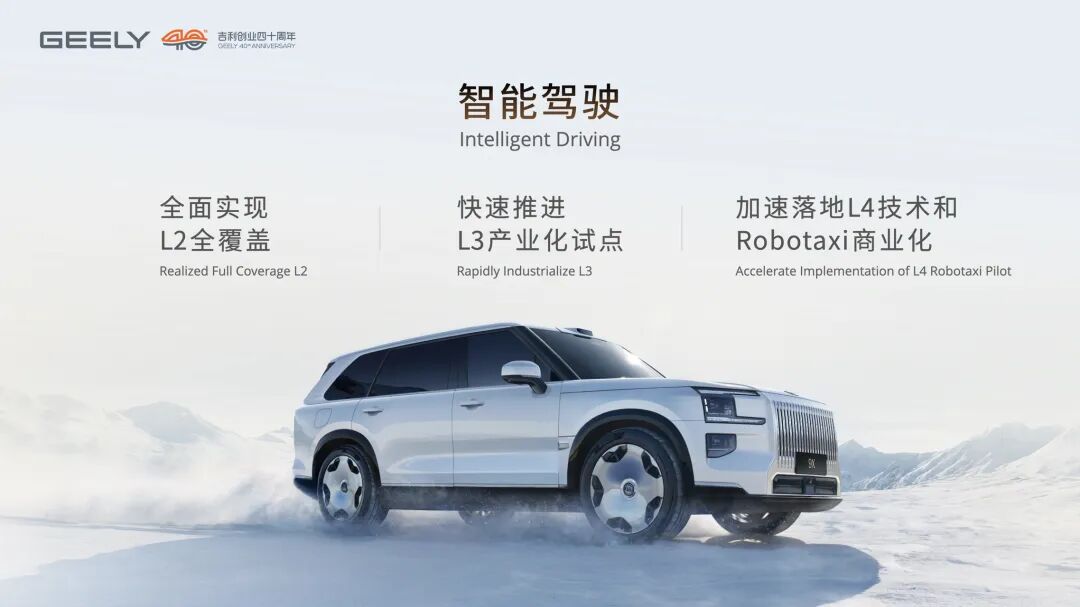
Image source: Geely Holding
As for vehicle intelligence, the group is positioning its "G-Pilot" platform as the foundation for future systems. Geely intends to make L2 driver assistance standard across its lineup, while pushing ahead with L3 pilot programs and accelerating the commercialization of L4 technologies, including Robotaxi applications.
Inside the vehicle, Geely is developing a next-generation operating system powered by AGI and agent-based technologies. This AI-driven OS is designed to make in-car systems more intuitive, adaptive and human-centric.
Safety remains a top priority. Geely is combining safety expertise from both its own operations and Volvo Cars to create what it describes as a "dual-pole" global safety framework, extending the concept of safety from the vehicle itself to the broader mobility ecosystem.
In battery safety, the group aims to turn its "Aegis Golden Brick" battery standards into an industry benchmark, while gradually introducing semi-solid-state and solid-state battery technologies.
Geely is also doubling down on PHEV-dedicated technologies. Its NordThor AI-powered hybrid engine, using new types of fuels and advanced combustion techniques, is targeting thermal efficiency of more than 50%. Meanwhile, the SEA super hybrid system is evolving toward higher voltage architectures, stronger performance and enhanced safety, underscoring the group's commitment to a diversified powertrain strategy as it charts its path to 2030.
Expanding beyond cars into new growth engines
Beyond vehicle manufacturing and sales, Geely is nurturing several new business lines that it believes could become important growth drivers over the next decade.
The first focuses on owner-centric services. Geely plans to roll out a comprehensive service ecosystem branded "Geely Unbounded," designed to cover the entire lifecycle of vehicle ownership. By making services more transparent, efficient and user-friendly, the company wants after-sales experience to become a competitive advantage in its own right, rather than a peripheral add-on.
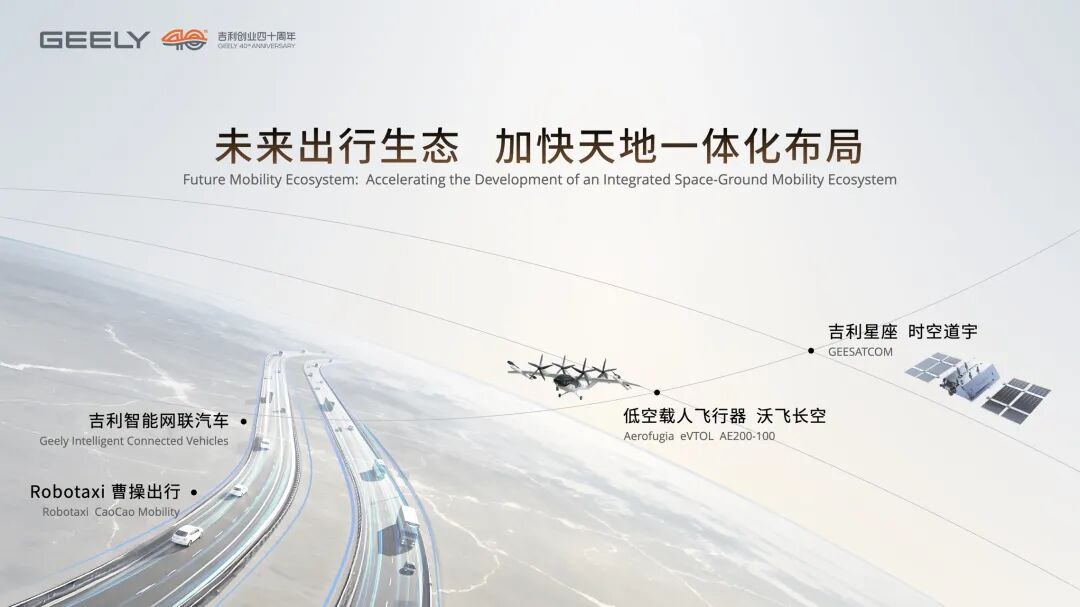
Image source: Geely Holding
The second pillar is future mobility. Geely is working to integrate vehicles, ride-hailing platforms, flying cars and even satellite networks into what it describes as a ground-to-air, three-dimensional mobility ecosystem. By 2030, the group aims to establish this capability in major Chinese cities and deploy up to 100,000 customized Robotaxis under its Cao Cao Mobility platform worldwide, moving automated mobility closer to large-scale commercial use.
The third area is methanol-based clean energy, a field Geely has explored for years. More than 50,000 methanol-powered vehicles are already in operation. The group now plans to extend this technology beyond passenger cars to applications such as shipping and construction machinery, while expanding refueling infrastructure to support broader adoption.
Talent and sustainability as long-term foundations
Geely acknowledges that ambitious strategies ultimately depend on people—and must be executed responsibly. To that end, the company is deepening its so-called "Talent Forest" strategy, strengthening partnerships with schools and universities to cultivate specialists in new-energy technologies and artificial intelligence. In some cases, tailored training pathways will begin as early as high school graduation for students with clear technical potential.
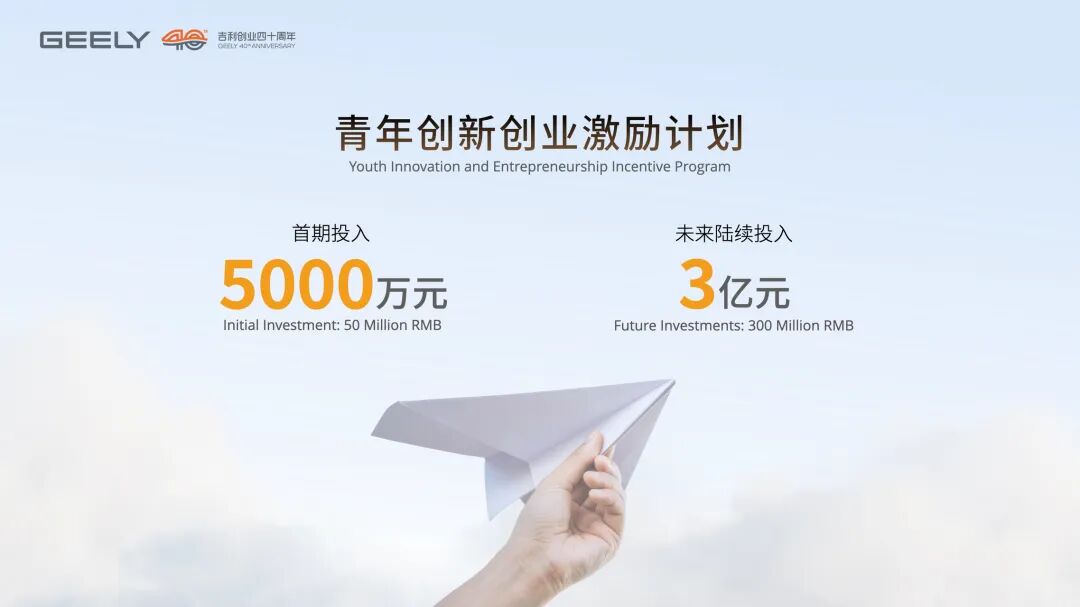
Image source: Geely Holding
Starting in 2026, Geely Holding plans an initial investment of 50 million yuan, followed by cumulative funding of up to 300 million yuan, to launch incentive programs aimed at encouraging youth innovation and entrepreneurship.
One notable initiative will see the group's subsidiaries directly recruit technically skilled high school graduates for targeted development, experimenting with new talent pipelines suited to the AI era and bridging secondary education, vocational training and industry needs.
At the same time, Geely views environmental and social responsibility as integral to its global expansion. The company has pledged to adopt greener materials and technologies across its products, reduce carbon emissions throughout production and usage, and encourage hundreds of suppliers to pursue more sustainable practices alongside it.
2026: a critical midpoint
The year 2026, which marks Geely's 40th anniversary, is being positioned as a key milestone to assess the progress of its long-term strategy. By then, the group expects to showcase tangible advances in artificial intelligence, diversified energy solutions, premium products and overseas market expansion.
Planned highlights include more advanced vehicle control systems, next-generation high-efficiency hybrid technologies and a new wave of upmarket electric models. Internationally, Geely intends to refine its approach, balancing deeper localization in individual markets with tighter global coordination.
Conclusion
Taken as a whole, Geely's 2030 roadmap makes clear that the company is no longer focused solely on competing through headline sales figures. Instead, it is constructing a broader ecosystem—integrating multiple brands, strengthening core technologies, incubating new businesses, investing in future talent and embracing global corporate responsibility.
The path ahead is complex and demanding, but each step points toward a more resilient and influential global automaker. For Geely, the next six years will be decisive in turning this ambitious blueprint into reality.


