



With the accelerated deployment of advanced driver-assistance systems (ADAS), vehicles' understanding of roads is evolving. In the past, maps primarily served as navigation tools, addressing the question of "how to get there." Today, with higher-level ADAS and urban Navigation on Autopilot (NOA) becoming increasingly common, maps are taking on a new role—enabling vehicles to anticipate road structures, traffic rules, and potential changes, making them a critical foundation for ADAS functionality.
As ADAS expands from highways to urban roads, rising environmental complexity is exposing the limits of real-time perception alone. ADAS maps are therefore evolving from an optional feature into essential infrastructure, enhancing system stability, safety, and driving comfort. Meanwhile, the industry is shifting away from traditional, heavy high-definition maps toward solutions with faster updates, richer semantics, and tighter integration with perception and decision-making, reshaping both technical approaches and the intelligent driving map landscape.
From a market perspective, the installation structure of high-definition (HD) maps has formed a clear tiered pattern. According to data compiled by the Gasgoo Automotive Research Institute, from January to October 2025 the HD map market showed a "leader-dominated, fast-following second tier" landscape. AutoNavi led with about 1.06 million installations and a 53.6% market share, maintaining a clear dominance thanks to early technology accumulation, broad OEM partnerships, mature products, and nationwide coverage. Tencent and Langge Technology followed as a stable second tier, with market shares of 12.4% and 12.2%, respectively. NavInfo ranked next with a 6.1% share, continuing steady progress in HD map capabilities. Other players together accounted for about 15.6% of the market, providing meaningful supplementation and leaving room for diversified competition.
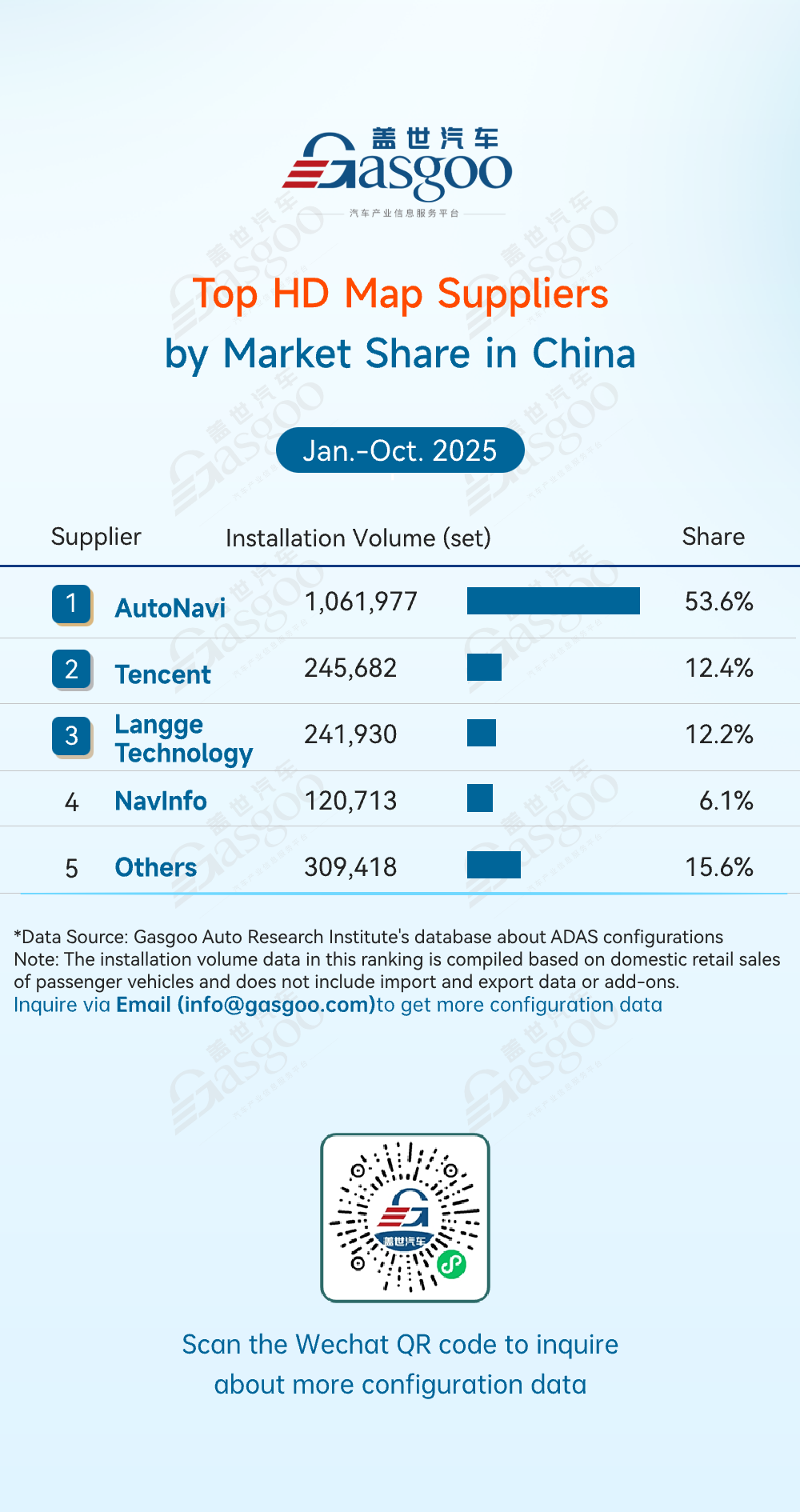
Overall, as advanced driver assistance expands into urban roads and more complex scenarios, automakers are raising their requirements for HD maps in terms of accuracy stability, update frequency, and scenario adaptability. Driven by scale effects, delivery capabilities, and long-term OEM partnerships, market concentration is likely to increase further. For smaller players, competing on general-purpose capabilities alone is no longer sufficient; long-term viability will depend on carving out positions in niche scenarios, regional strengths, or differentiated services.
On this basis, intelligent driving maps are undergoing several clear shifts. First is a move toward lighter and more semantic representations: instead of fully replicating roads, maps now focus on decision-critical information such as lane structures, traffic rules, and key control points. Second, dynamic capabilities are strengthening, as integration with onboard perception data and cloud platforms enables continuous updates and faster responses to road changes. Third, a platform-oriented trend is emerging, with intelligent driving maps increasingly embedded into vehicle software architectures as a core component of the ADAS stack, rather than functioning as standalone inputs.
From an application perspective, these changes have clear implications for the deployment of urban NOA and advanced driver assistance systems. In continuous driving scenarios spanning parking garages, urban roads, and highways, intelligent driving maps provide stable references in complex environments, reducing decision volatility caused by perception uncertainty and improving consistency in driving experience. As a result, intelligent driving maps have become a key enabling capability for many automakers advancing urban-level assisted driving.
The Gasgoo Awards served as a key platform for showcasing China's latest achievements in intelligent driver-assistance innovation, highlighting progress in technology development, mass-production deployment, and engineering practices. Beyond recognizing corporate innovation capabilities, the awards also reflect the growing maturity and diversification of China’s ADAS ecosystem.
Langge Technology's intelligent driving map is designed for L2–L3 scenarios, targeting urban NOA and nationwide scalable deployment. It is built on a complete technical framework combining a four-layer data model, crowdsourced intelligent updates, map–sensor fusion positioning, and an efficient architecture. Through its base, update, experience, and operation layers, the map enables nationwide road coverage, weekly updates, and OEM-oriented ODD and lane-level customization, allowing rapid adaptation across regions and system solutions. Leveraging large-scale crowdsourced data and cloud-based multimodal map foundation models, Langge delivers a city–highway unified, low-cost, high-freshness lightweight driving map, while fusion positioning enhances robustness and NOA stability in complex scenarios such as elevated roads and ramps. Meanwhile, the "sandwich architecture" map engine, with decoupled core modules and flexible interfaces, supports fast system integration and continuous OTA upgrades.
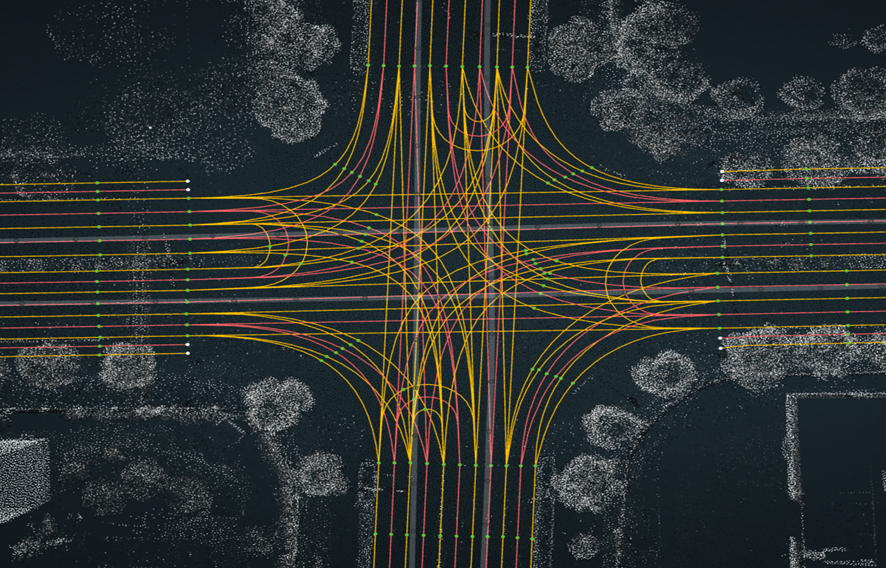
Photo Souce: Langge Technology
MXNavi offers a global navigation solution built around standardization, platformization, and modular design. Based on NDS data, the company delivers a unified global navigation engine that aligns with international standards while integrating the mature functional depth and user experience of China's navigation ecosystem. Through a modular "9-in-1" product framework, MXNavi integrates hybrid navigation, dead reckoning (DR), electronic horizon (EHP), lane-level and AR navigation, enabling flexible deployment across regions and regulatory environments. The solution enhances continuous positioning and lane-level decision support in complex scenarios, supporting large-scale deployment and long-term evolution for OEMs worldwide.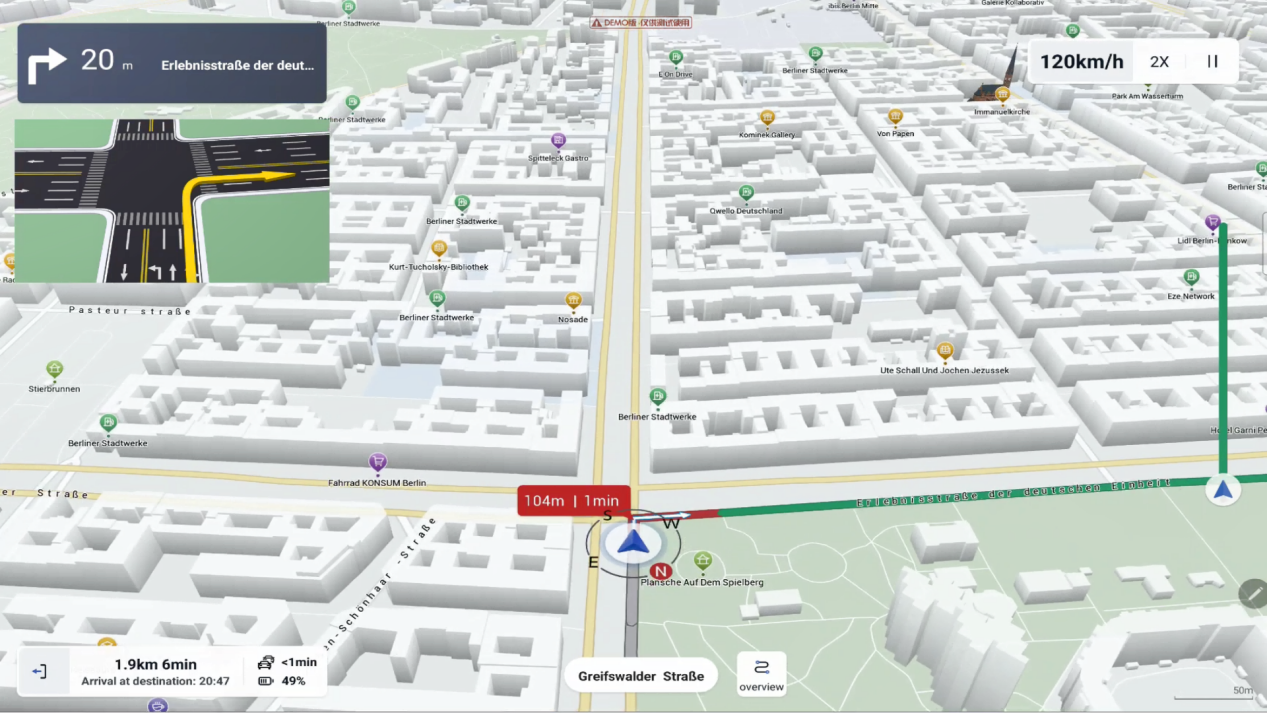
Photo Souce: MXNavi
Looking ahead, as intelligent driving expands into more complex scenarios, HD driving maps will no longer exist as a single, standalone form, but will be embedded into driving systems in more flexible ways. OEM–map supplier collaboration models will continue to evolve, while some automakers are also exploring in-house development or deep customization to better align with their algorithms and product roadmaps. Ultimately, driving maps are expected to work in close complement with perception systems in complex scenarios, jointly supporting the advancement of intelligent driving to higher levels.


