



Gasgoo Munich- On January 28, AI computing platform developer Black Sesame Technologies announced the launch of its FAD 2.0 open platform, according to a post on its WeChat account.
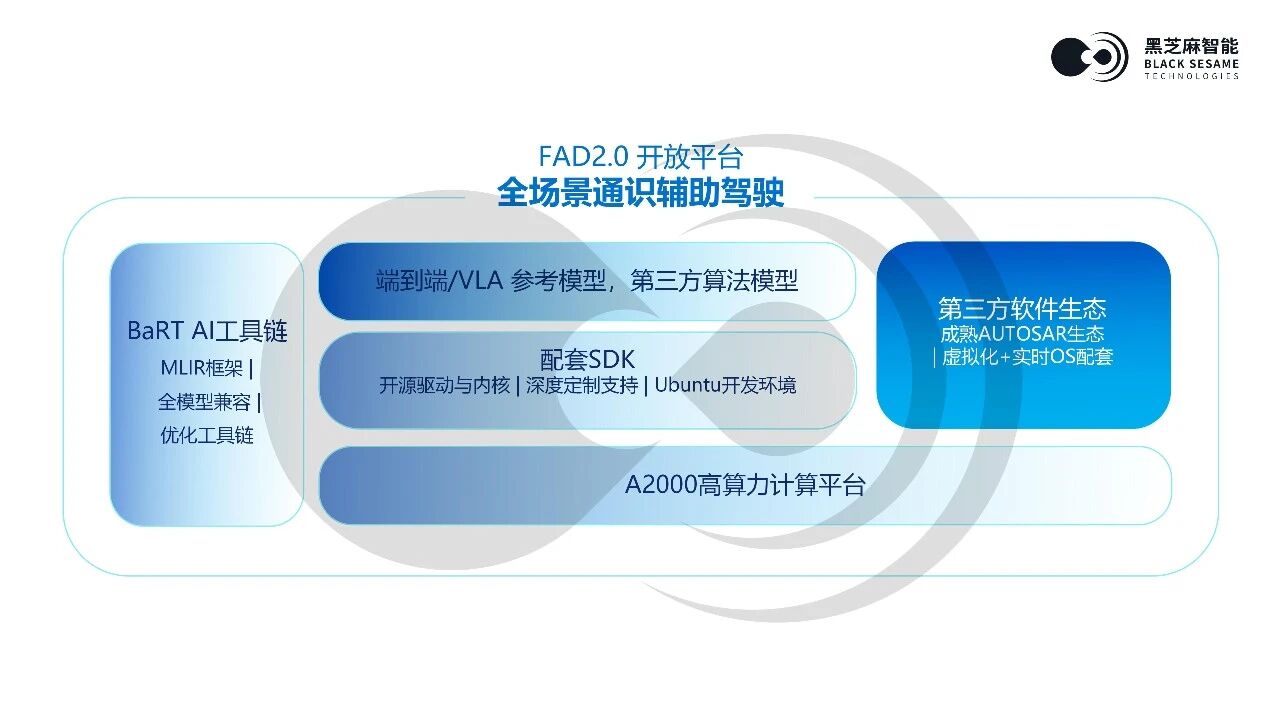
Image source: Black Sesame Technologies
The release follows regulatory clearance for its flagship Huashan A2000 high-performance, general-purpose assisted driving chip, which has passed relevant reviews by the US Department of Commerce and the Department of Defense, allowing it to be sold and deployed globally. Black Sesame Technologies is currently the only Chinese company to have secured such approval, a milestone that signals the A2000's entry into large-scale commercial deployment and positions it as a key computing backbone for the rollout of advanced driver-assistance systems.
Designed as a near-production-ready open platform for full-scenario assisted driving, FAD 2.0 integrates the A2000 high-computing hardware platform with a comprehensive software development kit, AI toolchains, reference models for end-to-end and VLA architectures, as well as third-party algorithm models. The platform is built to accommodate a stable and extensible third-party software ecosystem and is scheduled for official release in the first quarter of 2026. Black Sesame Technologies said the A2000 will add support for Open VLA and continue to adapt to emerging model architectures at the forefront of the industry.
From an implementation perspective, the A2000 computing platform is engineered to support both in-vehicle installation and prototype validation. By offering both desktop-grade and automotive-grade interfaces and adopting a scalable core-board architecture, it significantly reduces peripheral replacement costs and shortens system integration cycles. Its accompanying SDK provides open access to Linux kernel and driver source code, incorporates real-time patches, and enables flexible sensor selection and deep customization. The platform supports high-bandwidth inputs such as more than 24 camera channels and four 10-gigabit Ethernet links, while an integrated Ubuntu environment streamlines software iteration and debugging.
The AI toolchain is built on the industry-standard MLIR framework, enabling efficient deployment and optimization across a wide range of model architectures, including CNN, BEV, end-to-end, and VLA models. Enhanced tooling improves model quantization accuracy, sparse acceleration efficiency, and the ease of performance analysis and tuning. On the software side, FAD 2.0 integrates established third-party solutions such as Classic AUTOSAR and Hypervisor-plus-RTOS configurations, helping ensure automotive-grade reliability and readiness for mass production.
Safety has been embedded into the platform at the chip level. The A2000 chip complies with ISO 26262 ASIL-D functional safety standards and integrates a hardware security module, forming a safety foundation that meets the highest automotive requirements for advanced driver-assistance systems.
Through its open, tightly integrated hardware–software architecture, FAD 2.0 delivers a full-stack solution covering model deployment, system customization, and vehicle-level integration. Leveraging standardized toolchains and a production-ready ecosystem, customers can efficiently port and optimize cutting-edge models while completing automotive-compliant system development, substantially reducing development complexity and time-to-market for general-purpose assisted driving solutions.
The A2000 has also demonstrated rapid algorithm adaptation, completing its first model deployment in just 10 days. At the CES 2026, which concluded recently, Black Sesame Technologies showcased bench demonstrations of VLM and point-to-point (P2P) functions based on the FAD 2.0 platform, highlighting the maturity and usability of the A2000 chip, toolchains, and SDK in supporting VLA and end-to-end application development.
As the Huashan A2000 moves into global-scale deployment, Black Sesame Technologies is pursuing an open, collaborative technology strategy, working with partners across the value chain to accelerate the adoption and evolution of advanced assisted driving worldwide.


