Shanghai (Gasgoo)- On Jan. 5 in Las Vegas, as the global tech world turned to CES 2026, Geely Auto Group delivered a one-two punch that signals a new phase in China's shift to intelligent cars. Anchored by its globally debuted WAM — the World Action Model — Geely's Full-Domain AI has entered the 2.0 era, deeply fusing AI across every vehicle domain. In effect, automotive intelligence is no longer just a stack of features; for the first time, the car gains an evolving "worldview" and judgment.
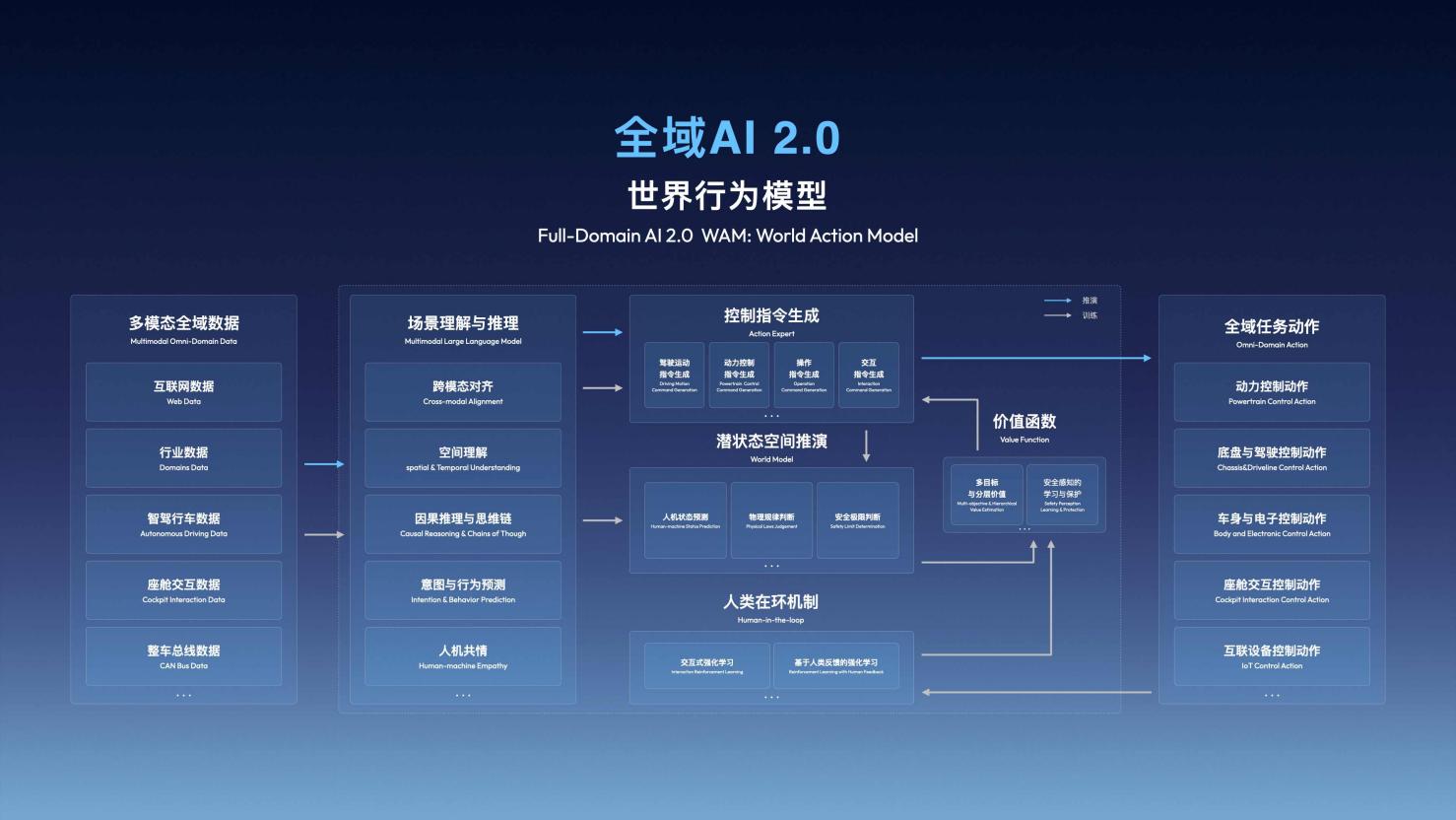
Image source: Geely
In tandem, Geely formally unveiled the English brand and software version name for its driver-assistance system — G-ASD (Geely Afari Smart Driving) — and brought heavyweight NEVs including the ZEEKR 9X, ZEEKR 009 Glory (Collector's Edition) and Geely Galaxy M9, along with the Aegis Goldbrick battery and the Flyme Auto smart cockpit. On the CES stage, Geely showcased the ambition and ecosystem of a "global leader in intelligent vehicles."
WAM model rewires AI's underlying logic
If Geely's first full-domain AI framework in 2025 opened the "AI+auto" chapter, the Full-Domain AI 2.0 debut at CES marks a decisive push — moving from the awakening era of environment interaction toward a freer phase of human–machine collaboration.
The engine of that shift is Geely's WAM (World Action Model), built to break a long‑standing challenge: siloed data and fragmented models across driving, cockpit, chassis and power domains, which have stymied cross-domain coordination and higher-level intelligence.
WAM establishes a unified "vehicle general brain." Four roles work in concert: a multimodal large language model (MLLM) serves as the decision brain, parsing complex instructions and planning macro tasks; an Action Expert acts as the execution cerebellum, turning intent into concrete control commands; a World Model functions as a predictive simulator, running millisecond-level physical simulations of action sequences; and a value function trained on human driving data — the "experience adjudicator" — selects the optimal solution, enabling end-to-end self-correction. The result: a car that understands, judges and evolves on its own.
On WAM, Full-Domain AI 2.0 makes two structural breakthroughs. First, "agentization," with a "1+2+N" multi-agent framework. "1" is Eva, a vehicle-level super agent that commands the whole system and centralizes interaction; "2" are domain agents for smart driving and the cockpit; "N" are specialized agents spanning the chassis, energy, body and more. A simple voice instruction can trigger complex, multi-agent collaboration. Second, "engine-ization," distilling perception, cognition, memory and decision into shared technical engines callable across domains — sharply raising coordination efficiency and iteration speed.
Eva agent evolves
Debuting in 2025 as the world's first hyper‑anthropomorphic emotional agent scaled for mass deployment, Eva gets a pivotal upgrade at CES. With All-Domain AI 2.0, Eva is rapidly moving beyond a capable cockpit assistant to a vehicle-level perception–decision–execution hub with memory and simulation.
Its evolution targets three dimensions: more human-like, more intelligent, more useful.
More human-like: with an upgraded end-to-end voice foundation model and dynamic memory, Eva aims for wake-word-free, high‑EQ conversation, progressively learning user preferences — a shift from "general AI" to "personal AI."
More intelligent: empowered by the World Model's common sense and strong tool-calling, Eva can interpret and execute fuzzy tasks such as "pick up my friend and find a restaurant that's good for conversation," handling the full chain from planning to execution.
More useful: through deep "cabin–driving" integration, users can entrust complete journeys to Eva. It also becomes an "ecosystem agent," orchestrating phones, smart-home devices and other cross‑platform systems to deliver complex everyday services.
That marks a shift in the role of in-car intelligence — from a function-executing module to a central orchestrator — providing the core vehicle for the car's evolution toward a "super‑intelligent lifeform."
G-ASD Debuts
If Eva embodies a car's IQ and EQ, the simultaneously announced Qianli Haohan G-ASD (Geely Afari Smart Driving) showcases Geely's hard-core strength in driving intelligence.
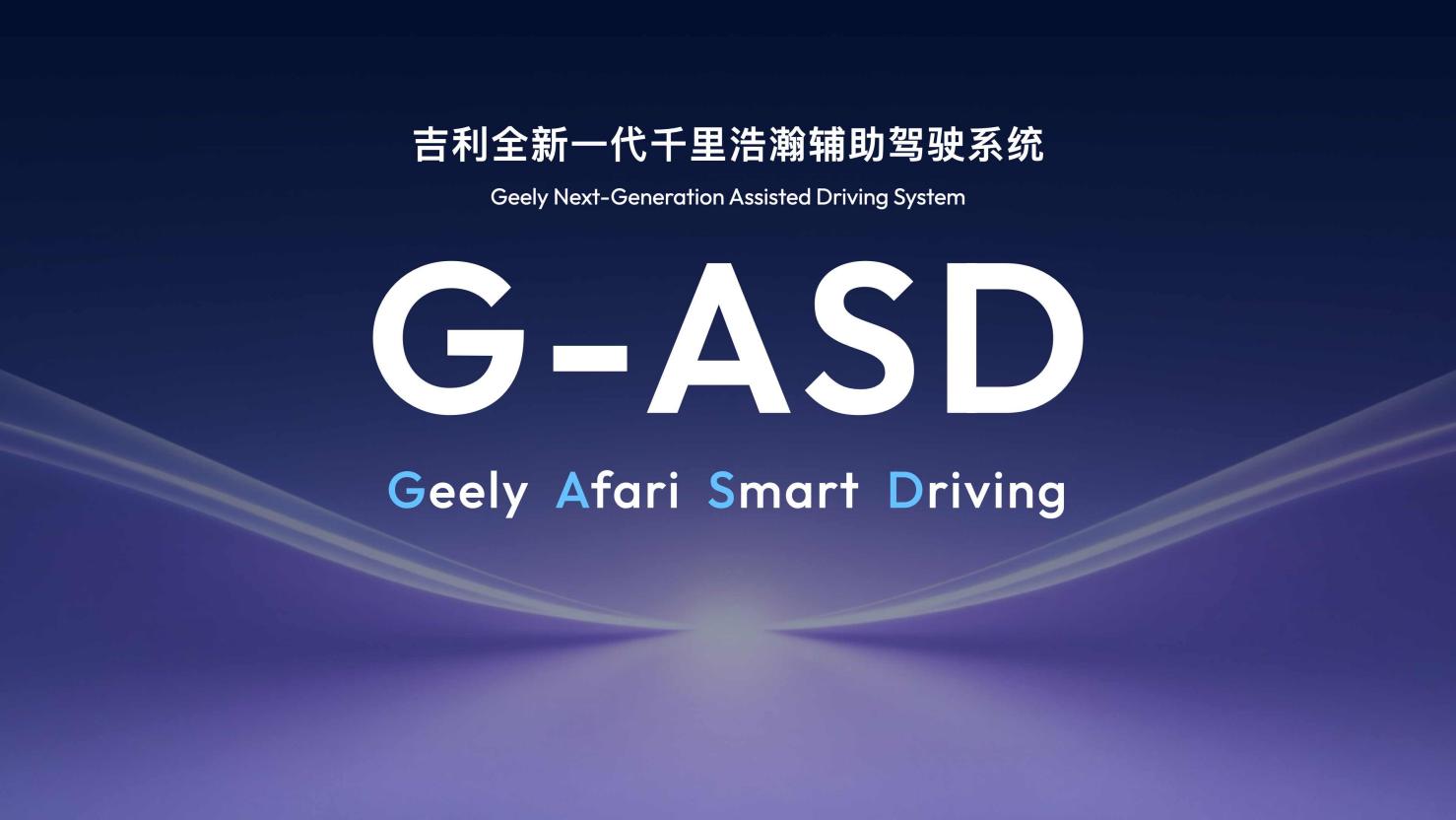
Image Source: Geely
G-ASD adopts an industry‑leading Smart AI Agent architecture and applies the WAM World Action Model end to end, making it one of the most model‑rich and cutting‑edge driver‑assistance systems globally. At the same time, thanks to ultra‑high model richness, ultra‑large datasets and an ultra‑strong hardware platform, G‑ASD has built a formidable technology moat.
Ultra‑high model richness: With the Jieyue Xingchen general AI foundation model, G‑ASD's cloud-side multimodal large model plus World Model reaches the 100 billion‑class parameter range, significantly boosting perception and reasoning. The system also upgrades its paradigm to generative, implements multimodal Diffusion, and integrates chauffeur‑grade driving behavior data — lifting human‑likeness, safety, comfort and traffic efficiency.
Ultra‑large datasets: industry‑leading driver‑assistance mileage data — cumulative 8.5 million vehicles and 10 billion km — paired with 25 million training video clips, plus a million‑scale vehicle accident safety dataset infused with Volvo's safety DNA, creating a powerful data flywheel.
Ultra‑strong hardware platform: from the H7 scheme's lidar plus 31 sensing elements to H9's five lidars delivering triple 360° coverage; from H7's Thor chip plus dual Orin to H9's dual Thor chips providing 1,400 TOPS of compute — hardware redundancy lays a solid foundation for higher-level intelligence.
On that foundation, G‑ASD maps a clear L2‑to‑L4 roadmap. Geely says that, subject to regulation, highway L3 and low‑speed L4 will roll out in 2026, alongside robotaxi operations. The first G‑ASD version is already available on multiple ZEEKR and Lynk & Co models.
In brief: On the CES stage, through All‑Domain AI 2.0, G‑ASD, the Eva agent and a slate of cutting‑edge products, Geely signaled it's no longer content to compete solely as a carmaker. It is stepping up as a "sky‑to‑ground" AI company, taking on top global players while accelerating toward its vision of "safe, green intelligent mobility that makes the world full of Geely."
In 2025, Geely Group's cumulative sales topped 3.02 million, with new‑energy sales near 1.69 million — up 90% year on year. In 2026, as All‑Domain AI 2.0 rolls out and roughly 10 new models launch, Geely's 3.45 million sales target underscores its ambition to reshape the global auto industry through intelligence.