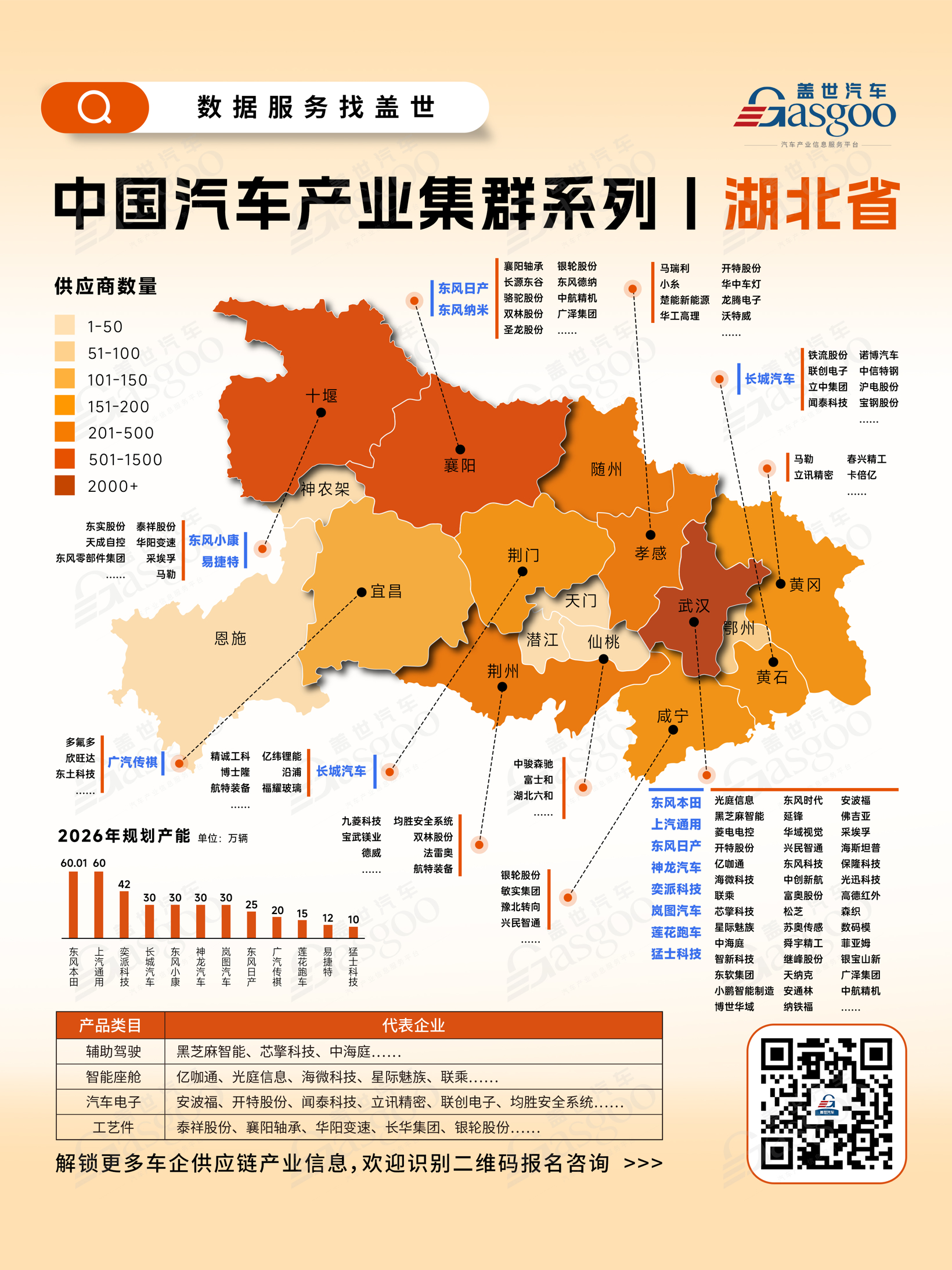
Gasgoo Munich- Statistics from Gasgoo Global Automotive Industry Big Data Center show Hubei has built a complete industrial cluster. It is driven by automakers and supported by a synchronized supply chain. With deep industrial roots and ongoing transformation, the province remains a pivotal player in the central region's automotive landscape.
Geographically, Wuhan stands as the undisputed core, hosting more than 2,000 suppliers. The city is home to major automakers like Dongfeng Honda, SAIC-GM, and Dongfeng Nissan, while also attracting tech-focused supply chain players such as Black Sesame and ECARX. This mix is fostering an ecosystem where vehicle manufacturing and intelligent components develop in tandem. Shiyan and Xiangyang serve as key pillars, each boasting between 501 and 1,500 suppliers. Shiyan anchors its operations around the Dongfeng Commercial Vehicle chain, whereas Xiangyang holds a solid foundation in both vehicle and parts production. Further out, cities like Xiaogan, Suizhou, and Jingzhou—each with 201 to 500 suppliers—focus on component manufacturing and niche segments, rounding out the regional supply chain.
In terms of production capacity, public planning data indicates that Hubei is set to maintain an annual capacity exceeding 3.5 million vehicles. The Dongfeng group accounts for the lion's share, with production bases for Dongfeng Honda, Yipai Technology (formerly Dongfeng Passenger Vehicle), Dongfeng Sokon, and Dongfeng Nissan scattered across the province. At the same time, the presence of Great Wall Motor and GAC Trumpchi has diversified the local manufacturing landscape. Broadly speaking, the industry reflects a dynamic where homegrown giants and external automakers grow side by side.
On the supply chain front, Hubei has cultivated a multi-tiered system spanning driver assistance, smart cockpits, automotive electronics, and traditional components. In the intelligent sector, companies like Black Sesame and SiEngine are advancing automotive-grade chips and related technologies. For smart cockpits, firms such as ECARX are delivering solutions to multiple automakers. Meanwhile, in traditional components, Xiangyang Bearing maintains a foothold in the domestic supply chain, alongside international players like Aptiv, which have established local production or R&D operations.
Overall, backed by a robust manufacturing framework and supply chain base, Hubei's automotive sector is steadily transitioning toward electrification and intelligence. As new-energy model production scales up and smart technologies expand, the province is poised to retain national influence. It serves as a vital bridge for regional industrial coordination.