From January to November 2025, China's passenger-car exports stayed resilient on a high base. Volumes held near record levels, while export structure and the regional mix showed sharper divergence. On the one hand, conventional internal-combustion passenger cars remain a key pillar, though some highly volatile markets saw notable pullbacks; on the other, exports of new‑energy passenger cars kept expanding — the main force lifting overall growth and opening new market space.
Differences across countries and regions in demand composition, growth pace and model preferences are pushing Chinese automakers to refine product portfolios, powertrain choices and go‑to‑market strategies. Against that backdrop, the combined performance of conventional and new‑energy exports is capturing a transitional shift in China's international automotive competitiveness.
Top 10 destination countries for China's passenger‑car exports (January–November 2025)
No. 1 Russia — 490,304 passenger cars exported in January–November 2025, including 59,517 in November; cumulative exports fell 47.7% year on year.
No. 2 Mexico — 451,966 passenger cars exported in January–November 2025, with 73,427 in November; cumulative exports rose 39.9% year on year.
No. 3 United Arab Emirates — 438,108 passenger cars exported in January–November 2025, with 50,739 in November; cumulative exports increased 60.0% year on year.
No. 4 United Kingdom — 269,900 passenger cars exported in January–November 2025, with 23,918 in November; cumulative exports climbed 54.0% year on year.
No. 5 Brazil — 267,342 passenger cars exported in January–November 2025, with 27,270 in November; cumulative exports grew 23.8% year on year.
No. 6 Belgium — 266,609 passenger cars exported in January–November 2025, with 11,107 in November; cumulative exports edged up 4.6% year on year.
No. 7 Australia — 230,084 passenger cars exported in January–November 2025, with 21,707 in November; cumulative exports jumped 61.2% year on year.
No. 8 Saudi Arabia — 218,885 passenger cars exported in January–November 2025, with 13,583 in November; cumulative exports rose 10.9% year on year.
No. 9 Iran — 191,837 passenger cars exported in January–November 2025, with 34,978 in November; cumulative exports decreased 19.7% year on year.
No. 10 Kazakhstan — 166,712 passenger cars exported in January–November 2025, with 17,373 in November; cumulative exports surged 77.7% year on year.
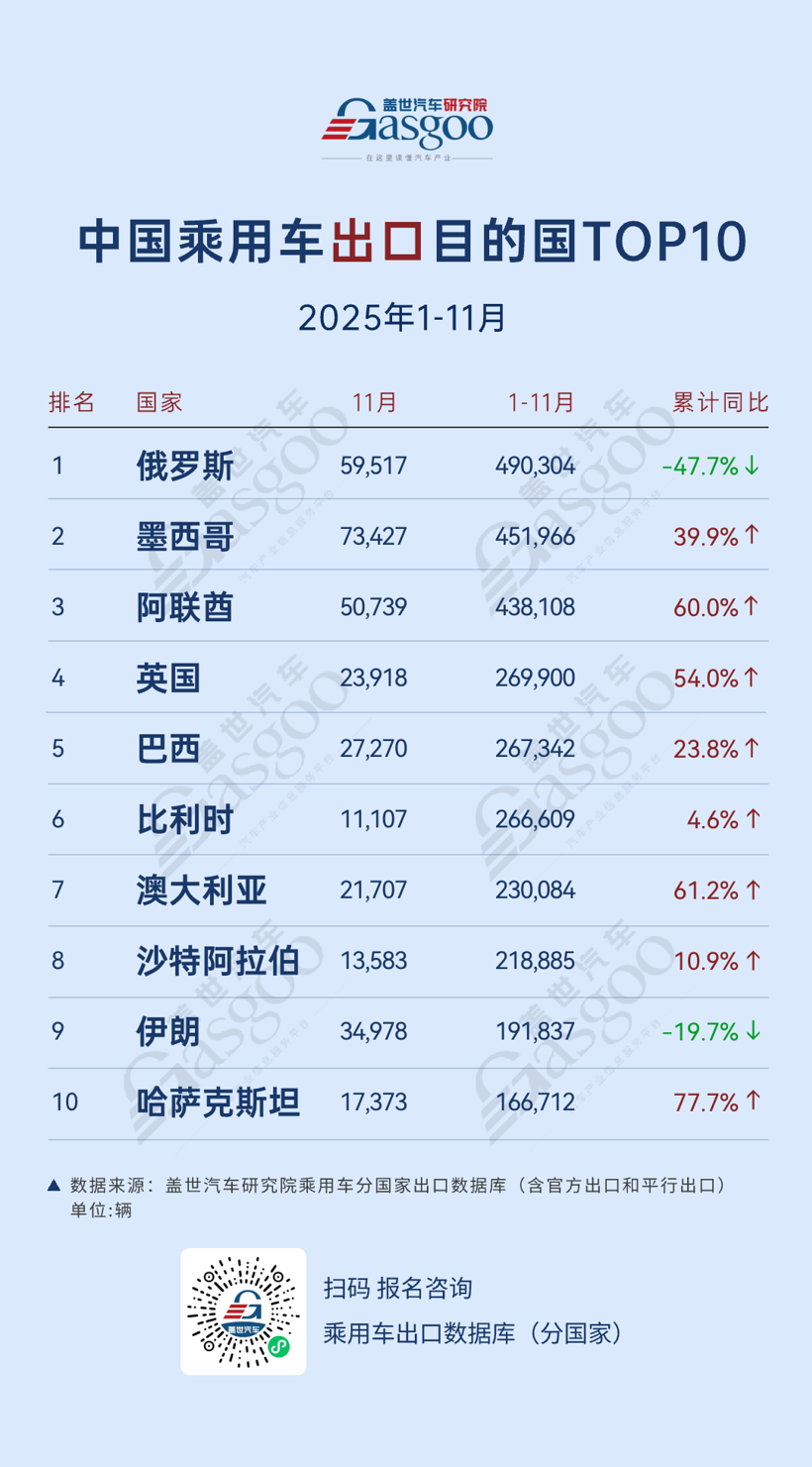
In aggregate, the January–November 2025 top 10 show structural divergence and a shifting regional center of gravity. Russia still leads at 490,000 units, yet the tally is down 47.7% year on year — a stark contrast with Mexico and the UAE. The picture suggests traditional high‑base markets are entering an adjustment phase, while emerging and replacement mature markets are scaling fast.
Russia and Iran's retreats stand out. Russia still shipped 59,517 units in November, indicating near‑term demand remains, but the near‑half slide on a cumulative basis reflects layered pressures from tariffs, anticipated scrappage levies and currency swings; Iran's 19.7% decline likewise underscores how policy and financial conditions are constraining export pace. Meanwhile, North America and the Middle East are doing the heavy lifting. Mexico, at 452,000 units, sits just behind Russia, up 39.9% year on year, with November alone at 73,427. Starting January 1, 2026, Mexico will raise tariffs on imported cars of Chinese origin to 50% from 20%. Some automakers front‑loaded shipments to beat the deadline, turning the policy window into a temporary boost for volumes. The UAE, with 438,000 units and 60.0% growth, continues to amplify its hub role in the Middle East, spilling demand into neighboring countries.
Europe and Oceania reflect steady expansion. The UK and Belgium ranked fourth and sixth, with year‑on‑year gains of 54.0% and 4.6% respectively; the UK's faster pace points to rising acceptance of Chinese brands. Latin America and Central Asia are gaining strategic weight: Brazil reached 267,000 units, up 23.8%, keeping a stable ramp‑up; Kazakhstan, smaller in absolute terms, jumped 77.7% — a bright spot that partly offsets the pullback in Russia. Taken together, China's passenger‑car exports are shifting from reliance on a single high‑growth market to balanced support across regions.
Top 10 destination countries for China's new‑energy passenger‑car exports (January–November 2025)
No. 1 Belgium — 255,915 new‑energy passenger cars exported in January–November 2025, with 10,375 in November; cumulative exports rose 6.0% year on year.
No. 2 United Kingdom — 188,753 new‑energy passenger cars exported in January–November 2025, with 17,886 in November; cumulative exports jumped 71.6% year on year.
No. 3 Brazil — 170,756 new‑energy passenger cars exported in January–November 2025, with 14,382 in November; cumulative exports grew 19.7% year on year.
No. 4 Mexico — 156,611 new‑energy passenger cars exported in January–November 2025, with 43,191 in November; cumulative exports surged 140.8% year on year.
No. 5 United Arab Emirates — 134,878 new‑energy passenger cars exported in January–November 2025, with 25,540 in November; cumulative exports jumped 104.1% year on year.
No. 6 Australia — 110,917 new‑energy passenger cars exported in January–November 2025, with 9,337 in November; cumulative exports increased 63.6% year on year.
No. 7 Indonesia — 98,964 new‑energy passenger cars exported in January–November 2025, with 17,131 in November; cumulative exports surged 143.0% year on year.
No. 8 Thailand — 90,687 new‑energy passenger cars exported in January–November 2025, with 8,366 in November; cumulative exports rose 35.9% year on year.
No. 9 Israel — 89,176 new‑energy passenger cars exported in January–November 2025, with 10,759 in November; cumulative exports increased 40.0% year on year.
No. 10 Spain — 77,057 new‑energy passenger cars exported in January–November 2025, with 4,627 in November; cumulative exports climbed 38.7% year on year.
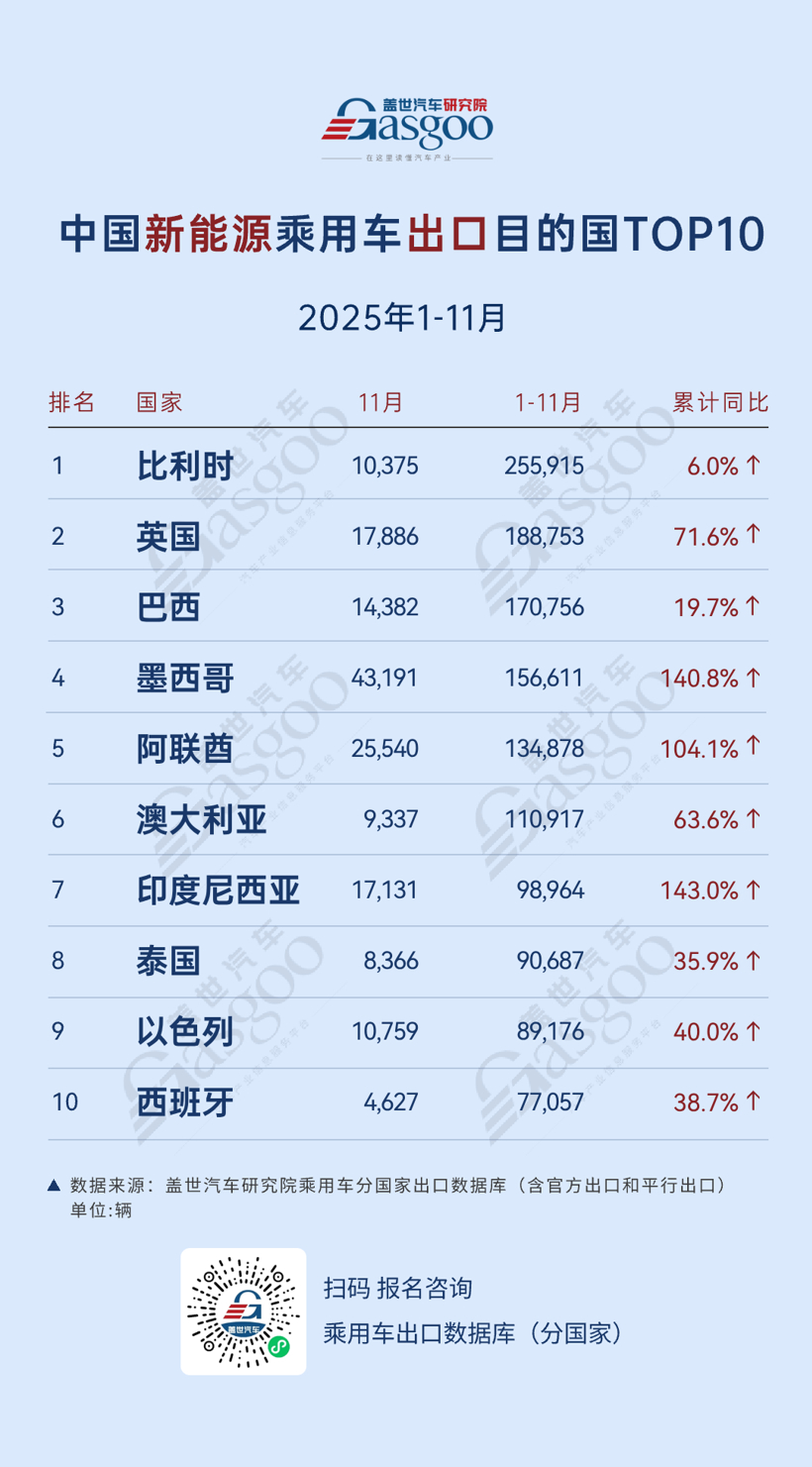
Structurally, destinations for China's new‑energy passenger cars show Europe holding steady alongside rapid gains in emerging markets. Belgium, with 255,915 cumulative units and 10,375 in November, remains No. 1. It primarily functions as Europe's distribution and transshipment hub — the foundation of China's new‑energy channel presence on the continent — though growth has clearly cooled as the market matures.
The UK and Brazil rank second and third, reflecting two different market dynamics. The UK, lifted by rising penetration and supportive policy windows, is sustaining high growth and has become one of China's core end‑markets in Europe; Brazil, benefiting from an early adoption phase and demand for mid‑ to lower‑priced models, is expanding steadily and more rationally. Explosive growth in Mexico, the UAE and Indonesia is worth watching. Mexico is both a consumer market and a potential manufacturing and transshipment node; the UAE and Indonesia, representing accelerated adoption in the Middle East and Southeast Asia, show high acceptance of Chinese brands and fast scaling — now major sources of incremental demand.
Overall, exports of China's new‑energy passenger cars have shifted from single‑point breakthroughs to coordinated expansion across multiple regions. Europe remains the scale and brand high ground, while emerging markets are supplying most of the incremental growth. Looking ahead, performance will depend more on local adaptation, channel depth, and the speed at which companies respond to changes in policy and trade conditions.