



On January 8, Firefly announced its formal entry into the Singapore market, with orders opening for its first right-hand-drive model. The brand's first showroom in Singapore is expected to open by the end of January.
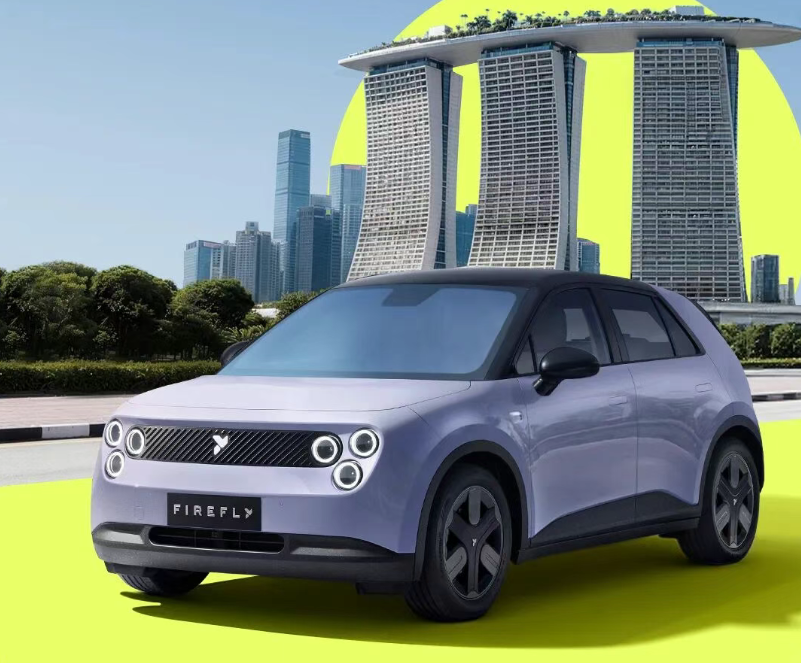
Image credit: Firefly Firefly
Earlier, in November 2025, Firefly said its right-hand-drive variants had entered mass production, with the first batch bound for the Singapore market.
At the time, the company said its global rollout was accelerating, completing its first delivery in Europe in under four months — the fastest overseas expansion on record for NIO. Deliveries have started in the Netherlands, Norway and Belgium, with test drives and deliveries set to begin in Denmark, Greece, Austria, Portugal and Luxembourg.
Firefly is NIO's third brand, introduced at the end of 2024 and positioned as a premium smart small EV. Its first model launched in China on April 19, 2025, offered in two design themes — Free and Glow — with starting prices of RMB 119,800 and RMB 125,800, respectively; deliveries began on April 29 the same year.
For reference, the China-market Firefly adopts a biomimetic design approach. Up front, a three-ring LED setup forms a“sound-light triple concerto”lighting system that creates a distinctive night-time signature; the side profile uses a floating two-tone paint scheme, with the C-pillar and roof in a unified color, paired with newly developed dense-spoke alloy wheels to heighten the car's finesse. Dimensions are 4,003/1,781/1,557 mm, with a 2,615 mm wheelbase.
Inside, the front center island armrest can be raised, enabling a through-space and easy access from both sides. A drawer sits beneath the front cup holders for flexible storage; a 50W wireless fast-charging bay features a slanted anti-slip groove. A magnetic anchor system supports accessories such as a tissue box, cup holder, glasses holder and storage box.
Powertrain-wise, the car packs a 42.1 kWh long-life battery with a CLTC range of 420 km, alongside a class-low 0.287 Cd drag coefficient. A self-developed six-in-one electric drive system delivers up to 90% overall efficiency, while energy use averages just 10.9 kWh per 100 km.


