



At XPENG's 2026 Global New Product Launch on January 8, Chairman He Xiaopeng announced that Robotaxi (autonomous taxi) equipped with the second-generation VLA (visual-language-action) large model is set to begin public-road testing.
He also predicted that 2026 will be the "true Year One of autonomous driving" for both China and the United States.
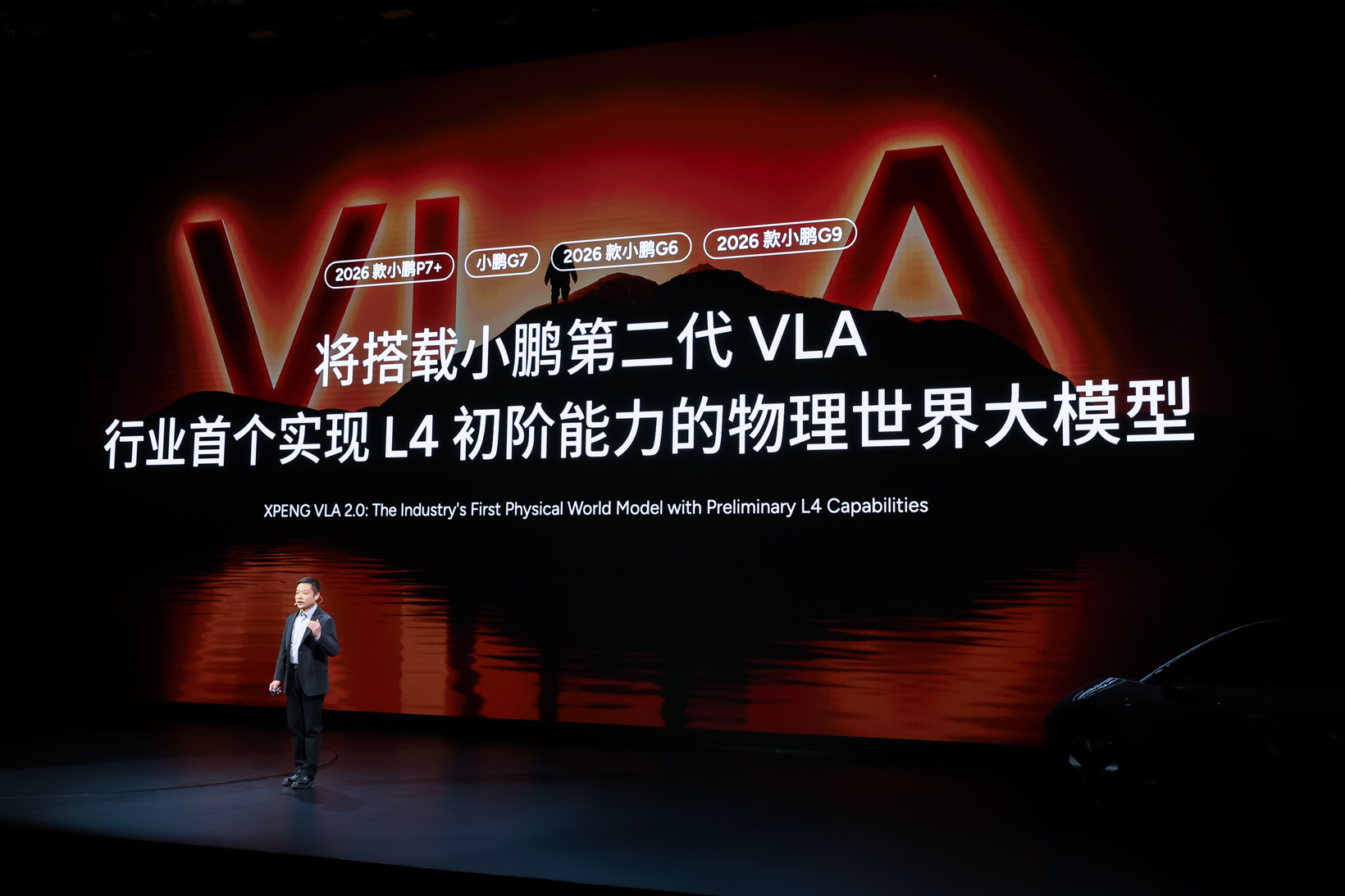
Image credit: XPENG
According to He, XPENG's second-generation VLA is billed as the world's first mass-produced physical-world large model. Its core is a break from traditional architectures: for the first time, it generates action commands directly from visual signals end to end, skipping the intermediate "language" translation. Trained on massive real driving video and featuring 72 billion parameters, it aims to understand the physical world like a human and serves as a full-scenario solution for Level 4 autonomous driving.
Compared with industry approaches, XPENG's second-generation VLA prioritizes factory-fit mass production, stronger scene generalization, and operation without geo-fencing — covering complex settings including narrow streets and campus or industrial park environments.
Under the plan, XPENG will push the second-generation VLA to users of Ultra models in the first quarter of 2026. In the broader smart mobility ecosystem, the company aims to launch 3 mass-produced Robotaxi models in 2026 and begin pilot operations.
Its Robotaxi will use a pure-vision setup, without relying on lidar or high-definition maps, and will carry 4 Turing AI chips, delivering onboard compute of up to 3,000 TOPS. Amap has become its first global ecosystem partner, and the two will jointly build a Robotaxi service network.
XPENG also updated progress under its "physical AI" strategy: the new-generation IRON humanoid robot is slated to reach scaled mass production by end-2026, while its flying car from the Huitian/AeroHT unit has entered the countdown to mass production. With the second-generation VLA as a unified intelligent base, XPENG is looking to extend its core intelligent-driving capabilities to robots, flying cars and other frontier domains — building a layered future mobility technology ecosystem.


