



At the start of 2026, XPENG held a global launch in Guangzhou packed with information. It wasn't just a product show — it was a technical manifesto and a strategic pledge.
Chairman and CEO He Xiaopeng took the stage with four new models, XPENG’s second-generation VLA foundation model, the Tianji AIOS 6.0 system, and the "one car, two power sources" Kunpeng Super Extended-Range technology — sketching a clear blueprint for XPENG's shift from an "intelligent EV company" to a "Physical AI company."
As competition in intelligent EVs enters the second half, XPENG is showing the ambition and confidence to lead change — backed by a system-level product lineup, a full-stack in-house tech ecosystem and a deeply global view.
Four models at once, two tracks in parallel
XPENG unveiled four models at this launch, covering the mainstream price band from CNY 170,000 to 280,000, divided into two clear lines: a global "Super Extended-Range" series and a refreshed "AI smart BEV" series. The lineup speaks directly to diversified demand and the challenges of going global.
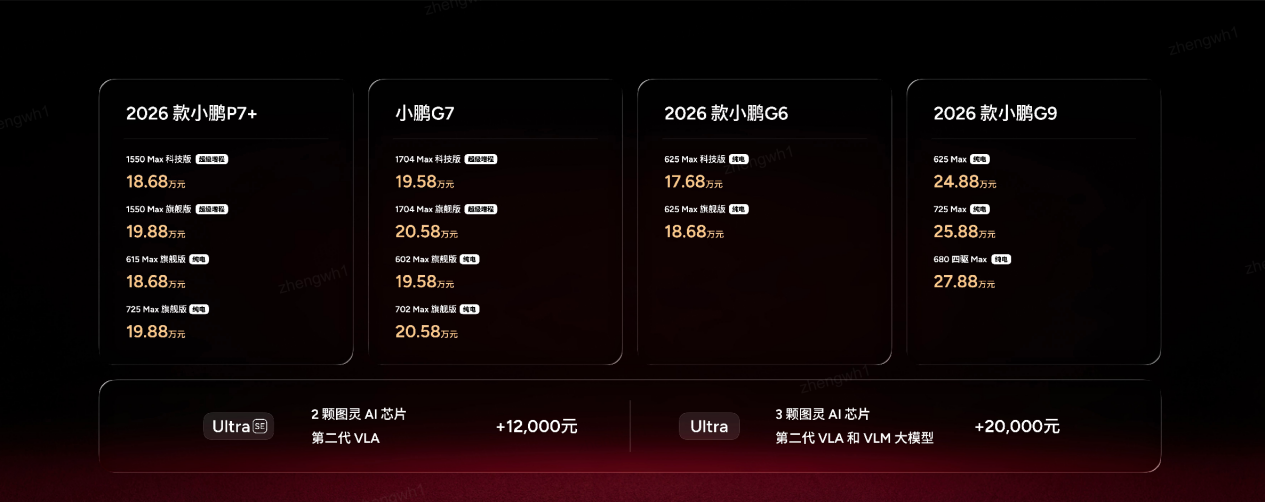
Source: XPENG
The 2026 XPENG P7+ is the company's first true "global car," set to debut across 36 countries simultaneously. Its significance goes far beyond a routine annual refresh. It carries XPENG's resolve to "build great cars for families worldwide" and serves as a key test of its global R&D, manufacturing and standards system.
The P7+ tackles a classic coupe-sedan trade-off. With a coupe-like stance, it delivers "space monster" practicality: front and rear rows each offer "one-meter" seating space, a 725-liter trunk as standard and up to 2,221 liters with seats folded — upending what shoppers expect from the segment. Underneath are a 109 mm ultra-thin 800V battery pack and structural optimizations that showcase deep engineering.
Equally notable for a global model is its "safety redundancy." It meets five-star safety standards in both China and Europe, uses a 16,000-ton one-piece gigacast rear floor, a 2,000 MPa ultra-high-strength cage body, and a 5C ultra-fast charging battery designed not to ignite for 24 hours after thermal runaway — together forming a "mobile five-star safety fortress." In markets where self-driving rules aren’t harmonized, top-tier passive safety is the first trust marker.
If the P7+ sets the globalization benchmark, the XPENG G7 Super Extended-Range is built squarely around local needs. Its CLTC combined range of 1,704 km and pure-electric range of 430 km set a high bar in today’s market. He stressed this isn’t simple parts-stacking, but rooted in insights into real long-distance family trips.
The G7’s real edge is a blend of "seamless BEV-like experience" and "range confidence anywhere." 800V 5C ultra-fast charging adds 314 km in 12 minutes, while ENC+RNC active noise cancellation and an imperceptible start-stop range extender aim to match a BEV’s quiet and smooth feel. A 779-liter trunk, 38 storage cubbies, a zero-gravity front passenger seat, rear tray tables and an entertainment screen — more than 20 comfort features — push family travel convenience to the max. It targets large families who want a smart EV experience but still worry about long-haul range and charging access.
The 2026 XPENG G6/G9 refresh is all about a smarter "brain." Both switch to XPENG’s in-house Turing AI chip and come standard with Tianji AIOS 6.0 — an overhaul from compute at the bottom to interaction at the top.
The G6 reinforces its "six-in-one" label — high compute, strong intelligence, ultra-fast charging, real-world range, high safety and big space — building a sturdy value moat in the 200,000-yuan BEV SUV segment. The G9 continues to deepen its "AI intelligent luxury SUV" positioning, leveraging the Turing chip, second-gen VLA, an AI predictive chassis and dual-chamber air suspension to chase a top-tier balance of handling, comfort and smarts.
The refresh signals XPENG’s intelligence is being systematically cascaded and popularized — its "technology for everyone" idea in action. Users don’t need the top trim to enjoy a leading smart cockpit and continually evolving driver-assistance capabilities.
Technical architecture overhauled
Powering the full-model renewal are XPENG’s second-generation VLA (Visual-Language-Action) big model for the physical world and the Tianji AIOS 6.0 system.
Unlike traditional module-stitching of perception–decision–execution, XPENG’s second-gen VLA removes the "language translation" step, generating vehicle control commands end-to-end directly from visual signals. In effect, it behaves more like a seasoned driver acting on instinct and experience than a machine executing code.
In on-site test clips, the car autonomously replans around temporary roadworks, even briefly borrowing the opposite lane; in unprotected left turns, it judges right of way, decelerates defensively and negotiates passage; it can even interpret hand signals from road workers. The way it handles these scenes points to striking generalization and human-like decision logic.
Just as crucial is its co-evolution with Robotaxis. XPENG said Robotaxis running the second-gen VLA software have passed third-party closed-course tests and are about to begin public-road trials. Production cars and Robotaxis will share the same model backbone and upgrade path.
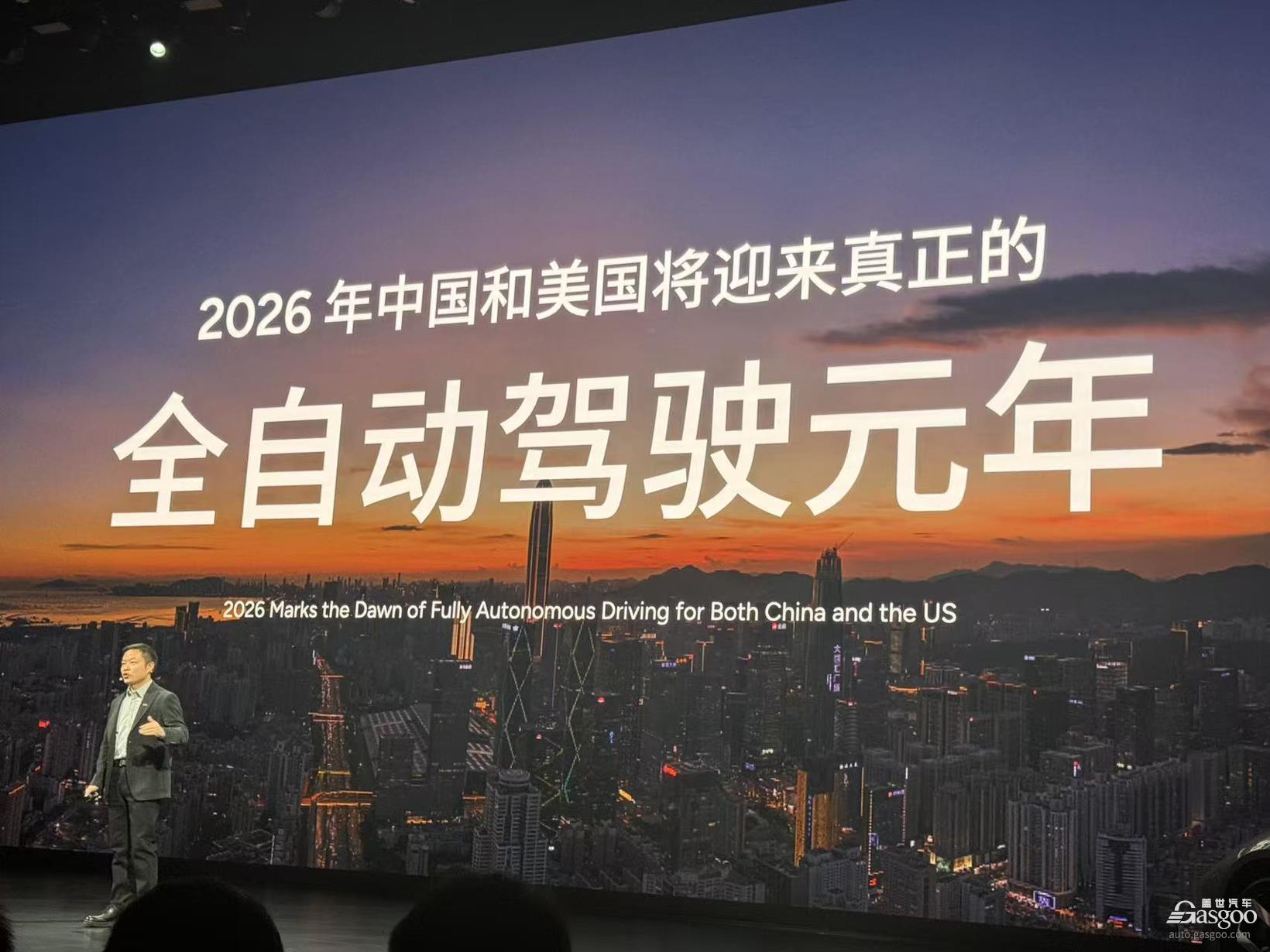
He predicts 2026 will be "year one of full autonomy," with XPENG targeting August 2026 to deliver advanced intelligent driving across China’s complex road network. Tightly binding frontier research to mass production gives XPENG a distinctive data-and-engineering loop for rapid iteration.
If VLA drives the car, then Tianji AIOS 6.0 and the VLM (Vehicle Language Model) power the "service and interaction." The UI gets a visual overhaul with the Yuguang design language and 3D lane-level SR navigation, but VLM’s proactive assistance is the real soul of the system.
VLM acts as a local, perceptive AI butler. It proactively suggests routes, adjusts ambient lighting and starts massage based on time, location, schedules and habits; it supports multi-turn conversations and understands complex command chains; it identifies landmarks outside and explains them. Crucially, XPENG says it adheres to strict privacy standards, with data processed on device.
He disclosed that VLM shares its technical base with XPENG’s humanoid robot, laying the groundwork for AI services to flow across devices and scenarios. Turning cabin AI from a "tool" into a "partner" changes not just interaction, but the philosophy of product definition.
As He repeated on stage: "In the last decade, XPENG stood for intelligent EVs; in the new decade, XPENG stands for Physical AI plus globalization." "Physical AI" is the new label he’s pinned on the company.
It’s a sweeping concept: VLA-led intelligent driving; VLM and AIOS-led intelligent cockpit; plus the humanoid robot and flying car teased at the event. All are software–hardware entities that must perceive, decide and interact in a complex physical world — XPENG’s Physical AI map.
To support that, XPENG has built a complete tech triangle: in-house foundation models (algorithms), in-house Turing chips (compute), and a CLIPS dataset with tens of millions of samples (data). He even claimed that, thanks to in-house chips and compiler optimizations, 2,250 TOPS of compute can deliver performance comparable to a rival’s 4,500 TOPS. Mastery of the core stack underpins XPENG’s confidence to declare a "Physical AI emergence moment."
While its pure-EV push is well established, XPENG is now championing Super Extended-Range for a clear reason: paving the way for globalization. He noted that in many countries, charging infrastructure lags China and networks can be unstable. The dual-energy "one car, two power sources" approach is therefore a necessary choice for diverse global markets.
In post-event interviews, He said: "There’s still plenty of room for extended-range models. In 2026, XPENG will stick to the dual-energy route, and we’ll launch four SUVs this year."
Physical AI and globalization as twin engines
Through its products and technology, XPENG’s two strategic pillars for 2026 come into view: embrace Physical AI to secure the core advantage of the next decade, and push deep globalization — shifting from exporting products to exporting the whole operating system.
With a high 2025 base and subsidy roll-offs in play, will the NEV market feel pressure this year? He responded: "Years ago I advised friends not to build cars — it’s hard. Some NEV makers may feel pressure now, but the worst moments are also the best. XPENG will get VLA right and nail globalization."
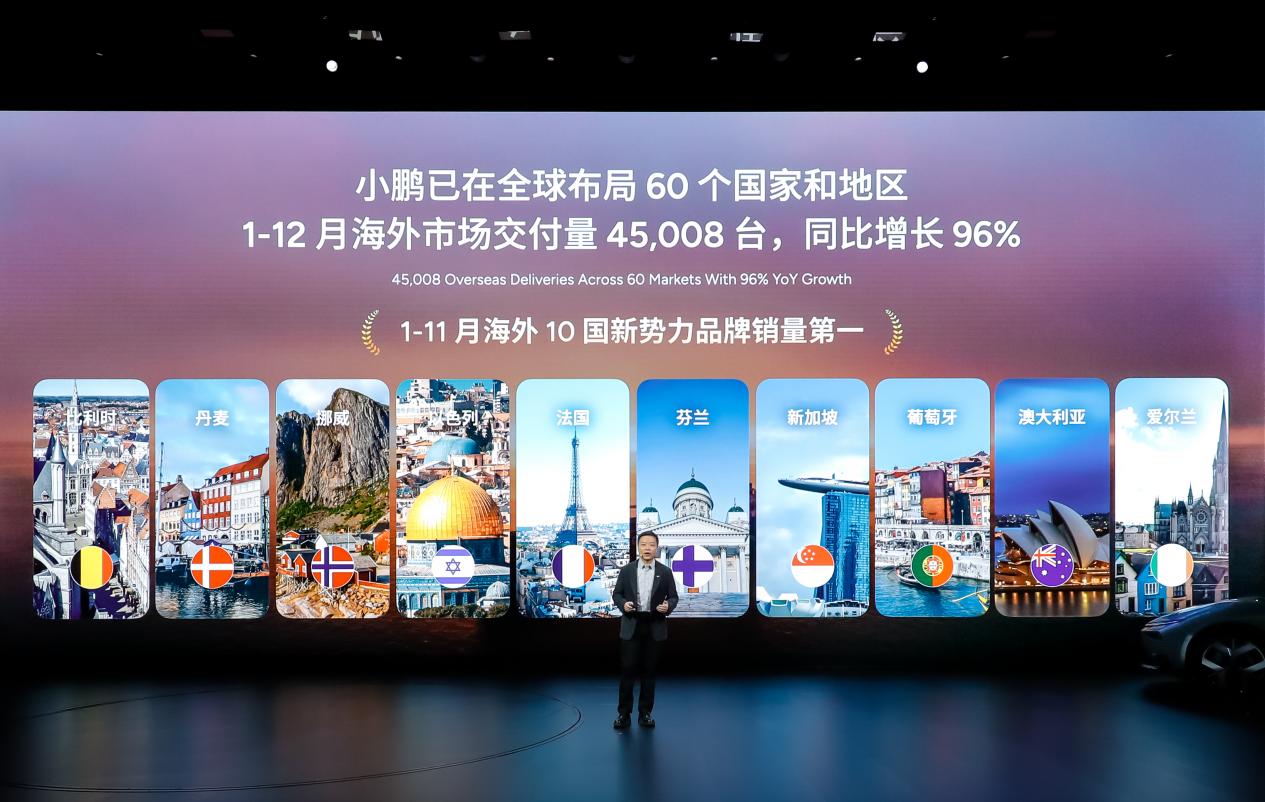
Source: XPENG
In 2025, XPENG delivered 429,445 vehicles, up 126% year on year. Overseas deliveries reached 45,008 — a 96% jump — lifting overseas share above 10% of total.
XPENG has already moved beyond simple product exports. In 2025, its cars entered 60 countries and regions; in 10 countries it ranked No. 1 among Chinese EV startups; and it has set up overseas production bases in Austria, Indonesia and Malaysia. The plan for 2026 is to roll out its proprietary ultra-fast charging network across Europe, Asia and the Americas.
He did not disclose a 2026 sales target or overseas share, but said on stage: "This year is a pivotal year for XPENG’s globalization." Of the four models unveiled, the 2026 XPENG P7+, G6 and G9 are global cars. The 2026 P7+ will launch in Brussels, Belgium, at 16:00 on Jan 9.
As the first model developed and launched globally in sync, the 2026 P7+ marks XPENG’s shift into a new phase of exporting an end-to-end system — R&D, manufacturing, sales and service.
He said in interviews: "For XPENG, 2026 is the first year of products and technologies emerging globally — a big beginning. We’ll keep growing fast, and I believe overseas will outpace China. Over the next three, five and ten years, I hope our overseas sales, partnerships and enablement can reach 1:1 with domestic or even surpass it."
XPENG’s 2026 opener is loud, but the road ahead is still demanding.
First, the balance between scale and profit. Pricing on the four models is aggressive — especially with extended-range versions near pure EV price points — underscoring XPENG’s push for share while raising the bar for cost control and supply chain discipline. The test is how to pair "technology made accessible" with sustainable economics.
Second, delivery of tech promises on time and at quality. Second-gen VLA, VLM and other advances draw an appealing map, but whether the experience is as smooth as demoed — and robust in complex real-world scenarios — requires validation at scale. Intelligent driving, in particular, must adapt to varying rules, roads and cultures worldwide — a systems challenge tougher than the technology alone.
Third, localization within globalization. In mature markets such as Europe, XPENG will face heavyweights including Tesla, Volkswagen and Stellantis. Brand awareness, channel buildout, after-sales service and cultural integration will each demand long-term investment.
Even so, the clarity of strategy, depth of the tech stack and product execution give XPENG a favorable starting position for the next stage of the smart-car contest at home and abroad. It's no longer about isolated strengths in electrification or intelligence, but an ecosystem built around Physical AI and staged on a global arena.
As He said near the close: "I believe more than ever... in the new decade, software and AI will take a bigger share within Physical AI." The 2026 global launch is the starting gun for that belief — declaring XPENG’s entry into the second half of the smart-EV race, a deep-water contest over AI integration, global systems and ecosystem definition.


