



Gasgoo Munich- On Feb. 26, Gasgoo learned that Kyoto University has unveiled a robotic monk, aiming to address the shortage of Buddhist priests amid a shrinking workforce and an aging population.
The robot utilizes hardware from China's Unitree and is integrated with ChatGPT. It moves with the deliberate gait of a monk, performing gestures such as joining palms and bowing. By using deep learning on Buddhist texts, it generates dialogue to interact with believers in real time—offering spiritual guidance and answering life's questions.
Kyoto University noted in a statement that, in the future, this robot could assist—or even replace—humans in performing certain religious ceremonies.
From the non-generative AI "Buddha robot" of 2021, to the introduction of AR technology in 2022, and now the addition of a physical form, this five-year project has finally made the decisive leap from virtual symbol to physical existence.
This is more than a technical iteration; it is an experiment in "existence." When a wisdom originally focused on detachment and introspection is given a body made of chips and servos, how will it sway the human heart—and how will tradition define it?
How Technology Shapes Faith
The newly released "Buddha Robot Plus" demonstrates a remarkable degree of technical integration. At its core, it represents a deep fusion of "large language models" and "embodied AI" within a specific cultural context.
In terms of the "brain," it is no longer limited to the 1,000 fixed response patterns of the 2021 version. Instead, by machine-learning vast amounts of original Buddhist texts and leveraging ChatGPT's generative power, it can produce answers that align with Buddhist doctrine yet remain accessible—tailored to specific questions about suffering and desire.
In a public demo, when asked about the struggle of quitting alcohol, the robot replied: "Stay away from what harms your body, uphold the precept against drinking, and cultivate good deeds—this is the path to true peace." Faced with a question about impatience and lack of focus, it advised: "Do not seek quick success. Dwell in the present, observe what you encounter one by one, discern what your heart truly needs, and handle it gently. Clarity will follow naturally."
This immediacy—wisdom generated on the fly from a corpus of text—lends the dialogue an unpredictable kind of "vitality."
Yet, what sets this robot apart is its "body."
The development team chose Unitree, a Chinese leader in humanoid robotics, as the hardware base. But more critical than the hardware is the injection of a "soul." The team specifically designed "solemn movements" for it. This means it doesn't just move mechanically; it has learned the measured steps unique to monks, the angle of a bow, and the curvature of the arms when palms are joined.
At the unveiling in Kyoto, the robot smoothly performed the gesture of joining palms inside a temple, achieving a coordination of language and body. As the team put it, while AR and VR enable audiovisual communication, only the acquisition of "physicality" can establish a true "physical presence" in a face-to-face setting, making the exchange feel less cold.
Born for the Unspeakable: The Social Experiment of the Electronic Monk
The birth of "Buddha Robot Plus" is far more than a mere technology showcase. It reflects the profound practical needs and humanistic concerns of Japanese society.
The project keenly captures the dilemma facing modern religion: on one hand, a severe shortage of monks due to aging and falling birth rates; on the other, rising anxiety among modern people—especially the youth—who often feel significant barriers against confiding in living, breathing priests.
This robot is cast in the role of a "tree hole"—a safe space—for things that are hard to say.
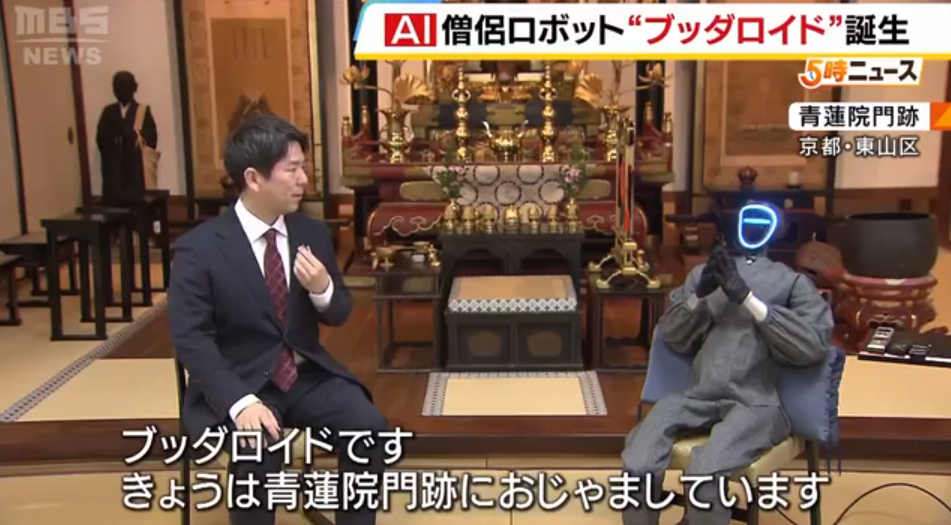
Image source: Screenshot from MBSNEWS website video
Facing a non-human listener, the confessor might shed the baggage of social status to confront their desires and pain more authentically.
At the same time, it serves as a practical supplement: performing simple religious rituals where human labor is scarce, or providing spiritual companionship for those living alone. In caregiving settings, where robots are already commonplace, having them handle the initial communication with believers seems like a natural extension.
Even more speculative is this: when a robot has read all the scriptures, remains forever calm, and holds no attachments, is it perhaps better equipped to convey the true essence of the "Dharma" than a human monk—who is susceptible to fatigue and emotion?
This concept touches the frontier of religious communication: Does wisdom require a physical form? If so, can this silicon-based body evoke the same awe and serenity in the hearts of believers as a carbon-based one?


