



A recently released mandatory national standard—seemingly niche but capable of solving major driver headaches—has been officially published. The "Safety Technical Requirements for Automotive Door Handles" (GB 48001-2026) will take effect on January 1, 2027.

Image source: MIIT WeChat (see bottom of article for full content; same below)
Once a showcase for "cutting-edge" features like hidden designs and electric pop-ups, this small component has exposed fatal hazards in multiple accidents. Now, the standard draws a hard safety line for all automakers with strict rules: doors must open even after power loss and remain functional after a crash. It marks a rational return to "safety-first" design in China's auto industry.
Packed with Detail! Mandatory Standard Turns Door Handles into "Lifelines"
Dubbed the "door handle safety manual" by the industry, this standard avoids empty slogans. Instead, it delivers specific requirements that hit key pain points, building a complete safety protection system from the outside in.
The core requirement mandates "mechanical release redundancy" for every door (excluding the tailgate). No matter how smart the vehicle or how extensive its electric features, a physical opening method must be retained. Even in extreme scenarios like battery thermal runaway or airbag deployment, occupants or rescuers must be able to open the door via a single or repeated mechanical operation—without tools. This directly addresses the fatal issue where electric handles fail to open after a power cut, trapping passengers inside.
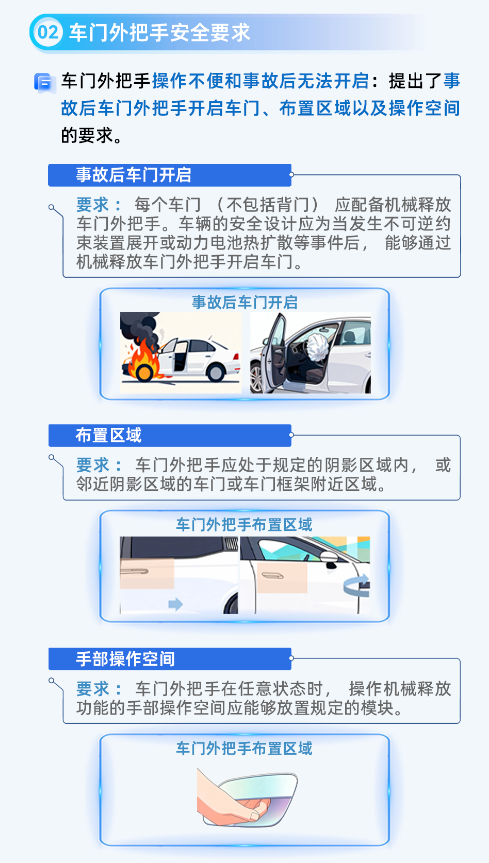
Strength requirements are even stricter: exterior door handles must withstand a force of no less than 500N (roughly the weight of a 50kg object). Even if crushed in a collision, they cannot fracture or detach, and must still function normally after the test.
Installation positions are also strictly regulated: handles must be located within designated body shadow zones or adjacent areas on the door or frame. The operating space must accommodate a standard test module, preventing designs so compact that a hand cannot reach in during an emergency.
If the outer handle is a passage for rescuers, the inner handle is the occupant's "self-rescue switch." The standard imposes extreme requirements on its "accessibility" and "identifiability." Each door (excluding the tailgate) must have at least one independently operated mechanical inner handle that can open the door even if other functions fail. Installation is based on ergonomic calculations: unobstructed, intuitively visible, and located on the door or within 300mm of the door edge. When the lock is on the door, the longitudinal center of the mechanical release handle must be positioned ahead of the R-point of the adjacent seat row, with its vertical center between 0mm and 680mm above the R-point.
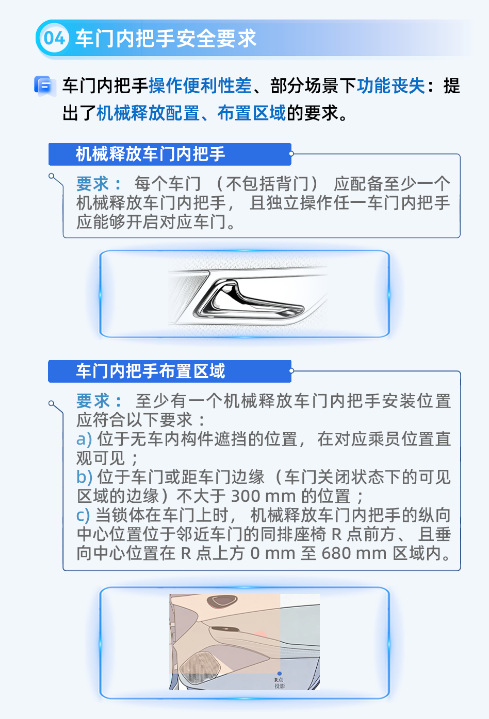
To address poor visibility and usability, the standard requires permanent graphic labels measuring at least 10mm by 7mm with high contrast against the background, ensuring clarity even in dark conditions like night. Accompanying instructions in Chinese or diagrams must have text no shorter than 6mm in height, preventing delays caused by illegible or tiny labels. Strength requirements vary: non-electronic button handles must withstand 200N of force, while electronic buttons must endure 50N, ensuring they don't break when pulled frantically in a panic.
Design requirements alone aren't enough; the standard includes a comprehensive testing system to ensure every rule is enforced. For vehicles with electric release locks, for instance, a static power-off test (simulating battery failure) and a dynamic collision test (replicating body deformation) are both required. In both scenarios, the door must open via mechanical means.
From Controversy to Regulation: Industry Shift and Safety Awakening Behind the Standard
The drive for this standard stems from the concentrated outbreak of safety hazards brought by vehicle electrification. Since 2020, hidden door handles have quickly become a "standard feature" in new energy vehicles for reducing drag and adding a high-tech feel. But behind the aesthetics, problems have gradually surfaced.
Data from the National Automobile Accident In-depth Investigation System (NAIS) shows traffic accidents caused by door handle malfunctions jumped 47% year-on-year in 2024, with hidden handles accounting for 82% of the total. Even more concerning are cases where collisions triggered battery fires, yet doors remained sealed because electric handles failed, resulting in tragedy. These grim lessons have made the industry realize: no amount of flashy technology justifies sacrificing safety. Establishing a unified mandatory standard has become urgent.
The creation of this standard is the result of collective industry effort. From the project announcement on May 8, 2025, to the official release on January 28, 2026, the Ministry of Industry and Information Technology organized over 40 automakers, parts suppliers, and testing institutions—including Geely, BYD, and Volkswagen China—to collaborate with more than 100 experts in repeated discussions.
Implementing this mandatory standard will bring comprehensive changes to the auto industry, with every car owner ultimately benefiting. For automakers, short-term costs are inevitable to modify existing models, but in the long run, it will significantly reduce recall risks triggered by handle safety issues.
For parts suppliers, this represents a new market opportunity. Demand for mechanical release devices, high-strength materials, and high-visibility labels will surge, giving a boost to companies focused on safety components.
More importantly, the standard will reshape industry design philosophy and consumer perception. In the past, "handle-less designs" and "automatic pop-ups" were core selling points; in the future, "mechanical redundancy" and "post-collision accessibility" will become key metrics for vehicle safety. When buying cars, consumers will shift focus from "looks and specs" to safety guarantees in extreme scenarios.
In terms of road safety, the value of this standard is immeasurable. By regulating opening performance and ease of use, the new standard buys critical time for rescue operations and saves more lives. Additionally, the standard uses labeling to guide consumers in using the "Dutch Reach" or "two-stage opening" methods, extending protection from hardware safety to usage habits for a dual layer of defense.



