



The newly unveiled Apollo is positioned as a standardized solution for harsh industrial environments. According to Wang Hongtao, founder of MirrorMe Technology, the robot addresses specific pain points in power line inspections, factory operations, and high-risk emergency scenarios.
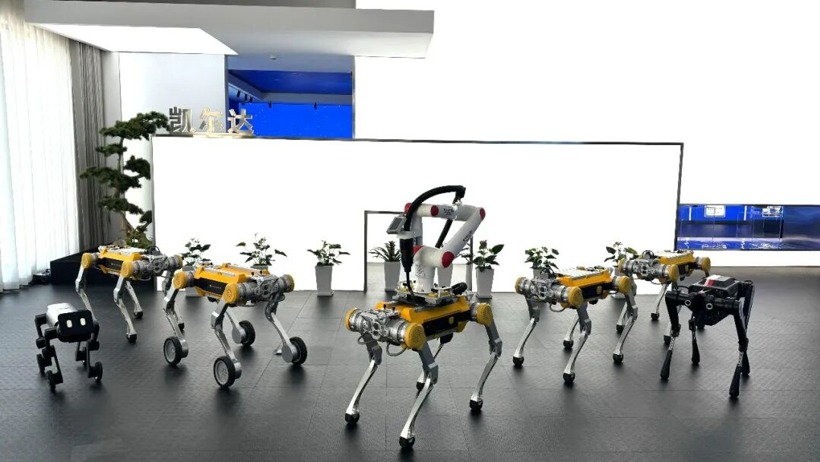
Image Source: MirrorMe Technology
Technically, Apollo employs a multimodal perception system and a modular motion control architecture. Its quadruped configuration navigates complex terrain like continuous staircases and rubble, boasting full IP67-rated waterproofing. Meanwhile, the wheel-leg variant balances high mobility with a 70-kilogram payload capacity. Design-wise, modularity is central: the robot supports rapid integration of various operational peripherals, aiming to create a closed "perception-decision-execution" loop.
Yet, transforming stable lab prototypes into mass-produced, consistent industrial products remains a stubborn challenge across the robotics sector. That reality underpins the logic of this partnership. MirrorMe Technology brings deep expertise in AI and robotic control algorithms, while Kaierda Welding Robot—a listed industrial robot player—contributes a mature high-end manufacturing system, supply chain management, and full-process quality control. By signing this agreement, the two aim to fuse smart control with scalable manufacturing, seeking to solve the persistent hurdles of reliability, consistency, and cost control that often stall the journey from technology to product.
For MirrorMe Technology, the alliance with Kaierda Welding Robot represents a critical step in commercializing its technology. Born from a top-tier academic institution, the company previously demonstrated its technical potential with the high-dynamic "Black Panther" quadruped. The launch of Apollo marks a clear extension of its product lineup toward industrialization and practical application.
Prior to this, MirrorMe Technology had primarily introduced three products: the consumer-grade, dual-form robot BAOBAO; the industrial-grade, modular quadruped Apollo; and the high-mobility "Black Panther II," designed for education and research markets.
Viewed from a wider angle, this partnership may reflect a broader trend in the robotics sector: the commercialization of frontier technology is becoming increasingly dependent on deep integration with high-end manufacturing. Standalone innovation or manufacturing strength is no longer enough to build a solid moat. Instead, the rapid feedback loop between technological iteration and manufacturing verification is emerging as a critical competitive factor.


