According to data compiled by the Gasgoo Automotive Research Institute, while China's passenger vehicle exports continued to expand in scale in 2025, clearer differentiation has emerged in both export destinations and product mix. On one hand, markets such as Russia, the Middle East, and Latin America remain the backbone of export volumes, supporting overall shipment scale. On the other hand, new energy vehicle (NEV) exports are accelerating penetration into Europe, Southeast Asia, and selected emerging markets, becoming a more dynamic growth segment within the export structure. Overall, China's passenger vehicle exports are gradually entering a stage characterized by multi-regional and multi-technology pathways operating in parallel, with increasing diversification and stronger resilience to volatility.
Top 10 destination countries by China's passenger vehicle exports
Russia: 65,077 units in December and 555,381 units in 2025 (–46.1% YoY)
UAE: 101,604 units in December and 539,712 units in 2025 (+74.3% YoY)
Mexico: 38,827 units in December and 490,793 units in 2025 (+44.2% YoY)
UK: 50,934 units in December and 320,834 units in 2025 (+70.3% YoY)
Brazil: 32,661 units in December and 299,943 units in 2025 (+34.6% YoY)
Belgium: 22,939 units in December and 289,548 units in 2025 (+4.5% YoY)
Arabia: 31,584 units in December and 250,465 units in 2025 (+11.2% YoY)
Australia: 16,105 units in December and 246,189 units in 2025 (+59.3% YoY)
Kazakhstan: 20,253 units in December and 186,965 units in 2025 (+74.3% YoY)
Iran: 9,426 units in December and 164,110 units in 2025 (–31.6% YoY)
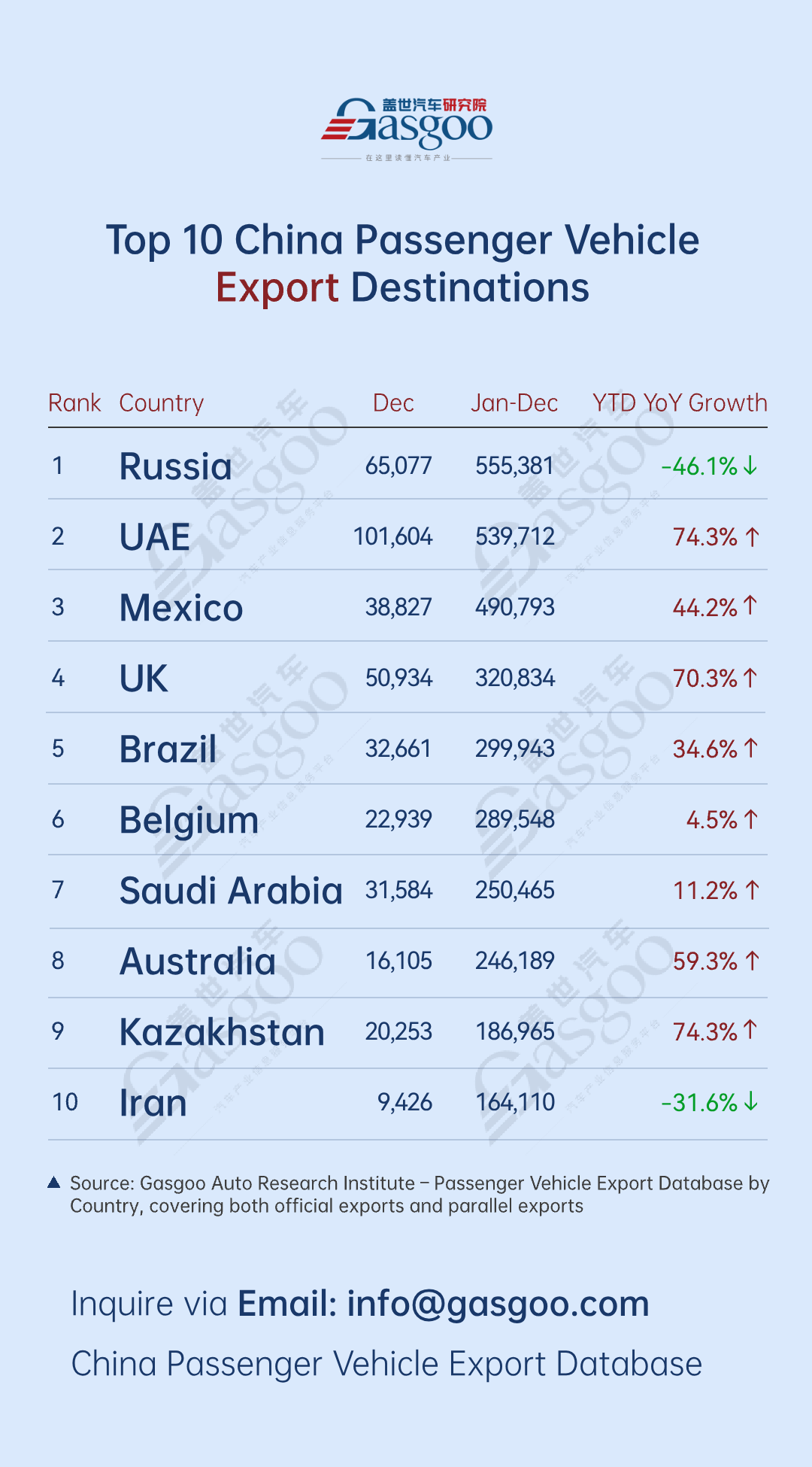
From the perspective of export destination structure, China's passenger vehicle exports in 2025 remined relatively concentrated, with Russia, the UAE, and Mexico ranking as the top 3 markets. Annual export volumes to each of these destinations approached or exceeded 500,000 units, together forming the core of total export scale. Among them, Russia ranked first with 555,381 units. Despite remaining the largest single market, exports to Russia declined by 46.1% YoY, suggesting that both the export structure and demand cycle are adjusting toward a more stable, normalized level.
By contrast, the Middle East and selected emerging markets demonstrated stronger growth resilience. Exports to the UAE reached 539,712 units in 2025, up 74.3% YoY, with monthly shipments surpassing 100,000 units in December. This reflects rising acceptance of Chinese brands in the Middle East, supported by demand from both NEV and internal combustion engine (ICE) models. Markets such as Saudi Arabia and Kazakhstan also recorded positive growth, highlighting continued demand for cost-competitive models across energy-based economies and neighboring emerging markets.
Performance in Europe and other English-speaking mature markets also warrants attention. Exports to UK recorded 320,834 units in 2025, up 70.3% YoY. Shipments to Belgium approached 290,000 units; while growth was relatively modest, export volumes remained stable, allowing the country to continue serving as an important logistics and distribution hub. Australia recorded annual exports of 246,189 units, representing nearly 60% YoY growth, indicating rising acceptance of Chinese brands in right-hand-drive markets.
Latin American markets continued to play a role of steady volume expansion. Mexico and Brazil ranked third and fifth, respectively, with combined exports approaching 800,000 units. Growth rates remained in the 30%–45% range, providing a relatively stable source of incremental volume for China's passenger vehicle exports, despite NEV penetration and local industrial integration not yet being fully developed.
Top 10 destination countries by China's new energy passenger vehicle exports
Belgium: 21,942 units in December and 277,857 units in 2025 (+5.7% YoY)
UK: 35,789 units in December and 224,542 units in 2025 (+91.5% YoY)
Brazil: 19,622 units in December and 190,378 units in 2025 (+32.2% YoY)
UAE: 52,725 units in December and 187,603 units in 2025 (+148.8% YoY)
Mexico: 17,882 units in December and 174,493 units in 2025 (+155.7% YoY)
Australia: 10,066 units in December and 120,983 units in 2025 (+66.8% YoY)
Indonesia: 19,152 units in December and 118,111 units in 2025 (+172.1% YoY)
Thailand: 20,475 units in December and 111,162 units in 2025 (+56.6% YoY)
Israel: 7,492 units in December and 96,668 units in 2025 (+50.1% YoY)
Spain: 9,753 units in December and 86,810 units in 2025 (+42.9% YoY)
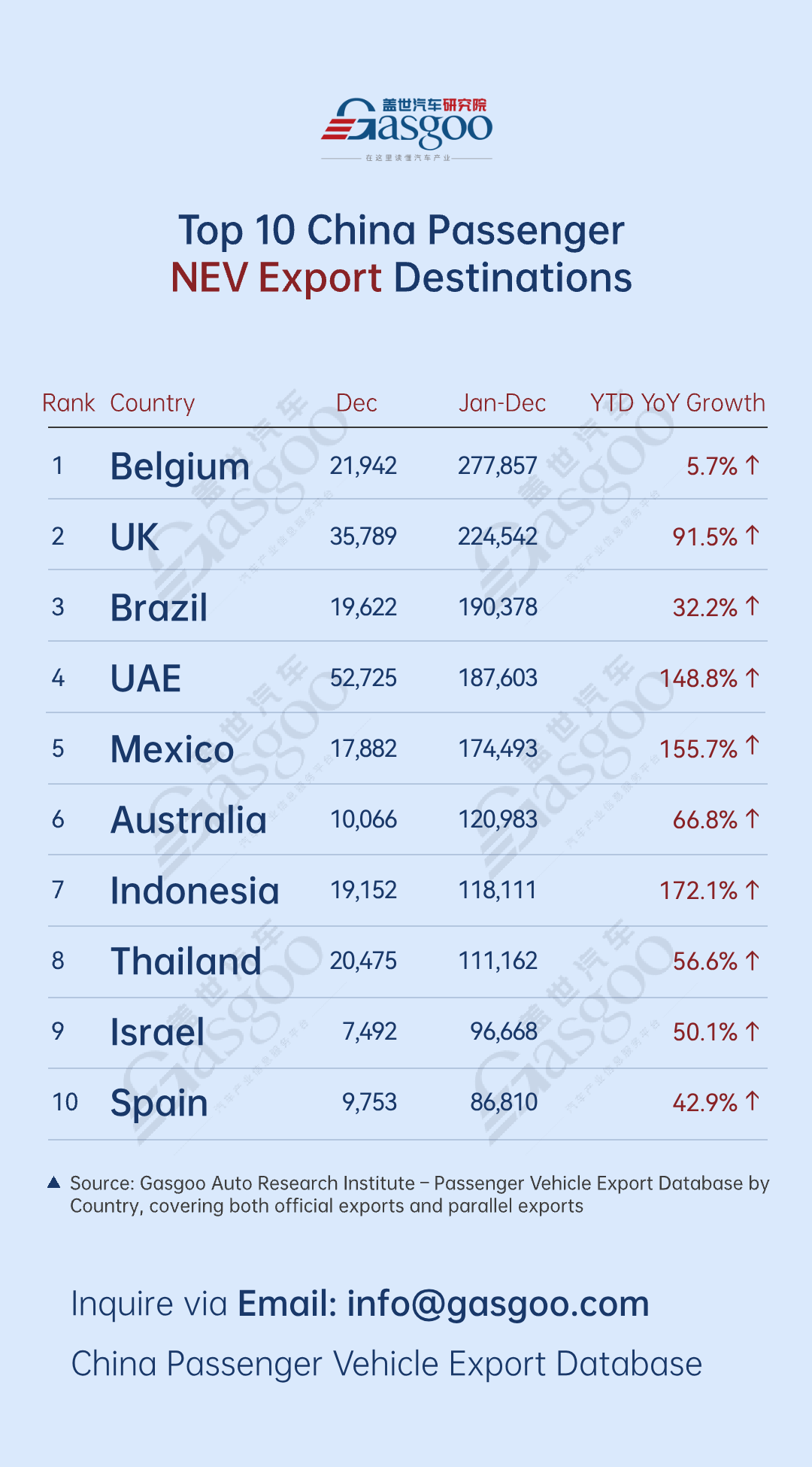
From the perspective of NEV export destinations, 2025 exhibited a structural pattern characterized by "stable absorption in Europe and high-growth volume expansion in emerging markets." Belgium ranked first with 277,857 units, with relatively moderate annual growth, reflecting its role as a key hub for the aggregation and redistribution of NEVs within Europe. The United Kingdom ranked second with 224,542 units, posting a sharp YoY increase of 91.5%, indicating that its NEV consumer market is accelerating and that acceptance of Chinese NEV models continues to rise.
Emerging markets have become the main driver of NEV export growth. YoY growth exceeded 140% in markets such as the UAE, Mexico, and Indonesia, with UAE exports recording 52,725 units in December alone. The Middle East is entering a rapid expansion phase for NEVs, supported by gradually improving infrastructure and a relatively favorable policy environment. Southeast Asian markets also showed strong activity, with Indonesia and Thailand both ranking among the top 10, reflecting steadily increasing penetration of NEVs in the region.
Exports to Latin America and right-hand-drive markets demonstrated a pattern of "scale and growth moving in parallel." Brazil recorded 190,378 units for the year, achieving over 30% YoY growth while maintaining a high base. Australia exported 120,983 units, up nearly 67% YoY, reflecting the gradual maturation of product adaptation and channel development for NEVs in right-hand-drive markets. Within Europe, end markets such as UK, Spain, and Israel continued to see expanding export volumes, with growth rates ranging from 40% to 90%, indicating that Chinese NEVs are steadily deepening their presence at the consumer end across Europe and surrounding regions.