



Gasgoo Munich- "Is April 16th some kind of auspicious day?" Seeing yesterday's lineup of new car launches, an industry insider asked.
Last night was likely a sleepless one for many automotive journalists. A rough count shows that around 7 PM on April 16, five brands were simultaneously launching new vehicles. These were not just fillers; they were major models: the Leapmotor D19, UNYX 08, IM LS8, Aion N60, and Geely Galaxy Star Yao 7. Such a dense cluster of top-tier launches in a single day is rare, even as the pace of new model debuts accelerates across China.
This scheduling conflict is no mere coincidence; it is a microcosm of the intensifying competition within China's auto industry. As the market shifts fully to a zero-sum game and consumer sensitivity to new cars diminishes amid information overload, automakers seem to have only one move: launch products more densely and aggressively. The goal is to capture every bit of attention and orders within a limited market space.
Yet, behind the noise of this multi-model clash, a deeper question is surfacing: Does the Chinese market really need so many cars? Are the hundreds of new models launched each year creating value, or merely wasting resources? As the marginal returns of the "volume strategy" diminish, the industry may need to rethink what kind of competitive logic can truly support the qualitative leap from a major automotive nation to a global powerhouse.
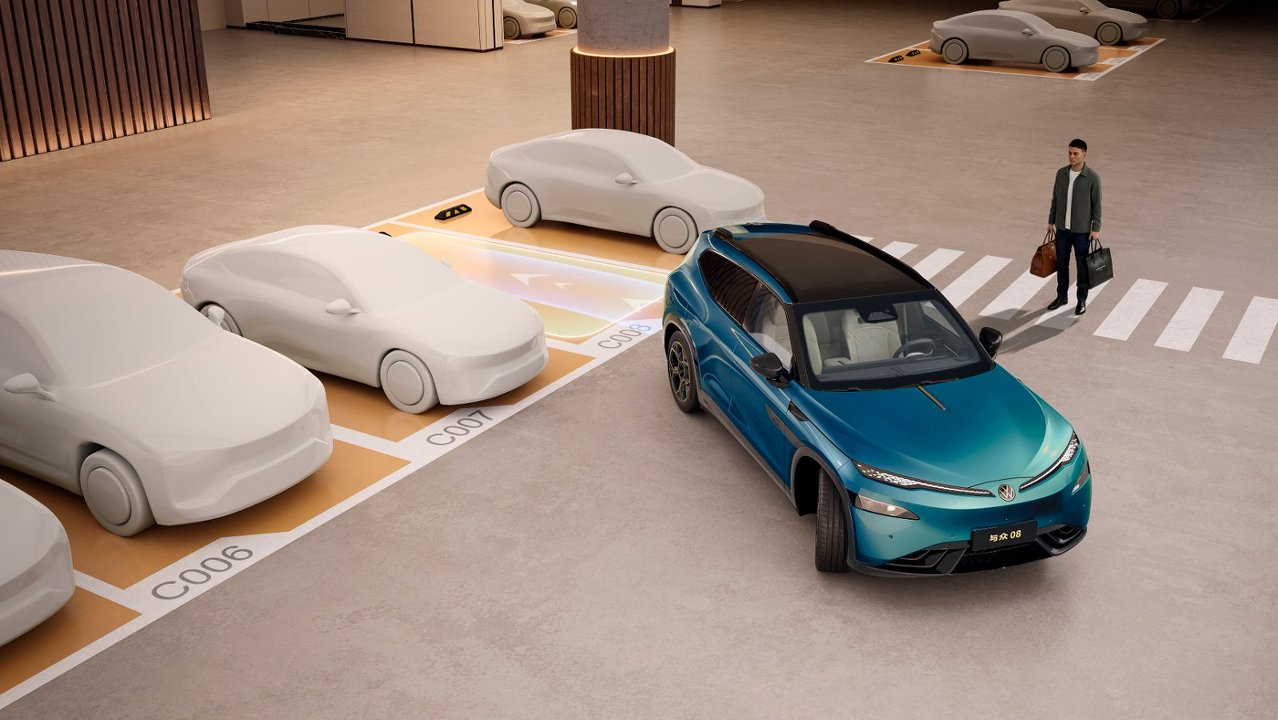
Image source: Gold Label VW
Ice and Fire in a Saturated Market
The spectacle of five new cars arriving at once can easily obscure a cooler fact: China's total auto market base is shifting from expansion to stagnation. Data from the China Passenger Car Association (CPCA) shows retail sales in March reached 1.648 million units, down 15% year-on-year. While that marked a rebound from February's Lunar New Year slump, the first quarter's cumulative retail sales of 4.226 million units—an annual drop of 17.4%—clouds the full year's outlook.
The logic of the growth era was to expand the pie; if the product was not flawed, everyone got a slice. The logic of the era of saturation is to divide the pie. The rise of one model often means the loss of market share for another—or several others.
This structural shift is first evident in market polarization. A few top players, armed with deep technological depth, complete supply chains, and strong cost controls, are expanding their market share. Meanwhile, a vast number of mid-to-lower-tier brands are seeing sales decline continuously, even as they roll out new products.
At the same time, the trade-off between new energy vehicles (NEVs) and internal combustion engine (ICE) vehicles continues. Internally, the NEV landscape has moved from a flourishing of diverse players to survival of the fittest. The days when a single selling point or capital backing could guarantee a foothold are over. Now, the test is comprehensive system capability—from platform R&D efficiency and core "core electric" technologies to smart manufacturing levels, intelligent experiences, and channel services. No aspect can be overlooked.
Another easily overlooked polarization is happening between price bands. Although overall market growth is slowing, demand in the mid-to-high-end segment remains relatively resilient. Consumers are still willing to pay for products with genuine technological leadership, unique design, and brand premium. Conversely, the low-end market—especially entry-level models lacking core competitiveness—faces mounting survival pressure. This contradiction between consumer upgrades and total contraction means new cars can no longer rely solely on low prices or loaded features. They must capture the real needs of their target audience and make trade-offs in product definition.
Even more striking than the price band split is the extreme distribution of model sales.
Data compiled by Gasgoo Institute on sales figures for models on sale in China in 2025 shows that of the 953 models available last year, as many as 378 sold fewer than 5,000 units. For a new model requiring massive R&D investment, such sales volume is almost certainly loss-making. While many of these are not brand-new models, keeping them on the market consumes resources. Such inefficient resource allocation might have been masked by rapid growth during the industry's ascent, but in the current zero-sum game, it inevitably weighs down corporate survival.
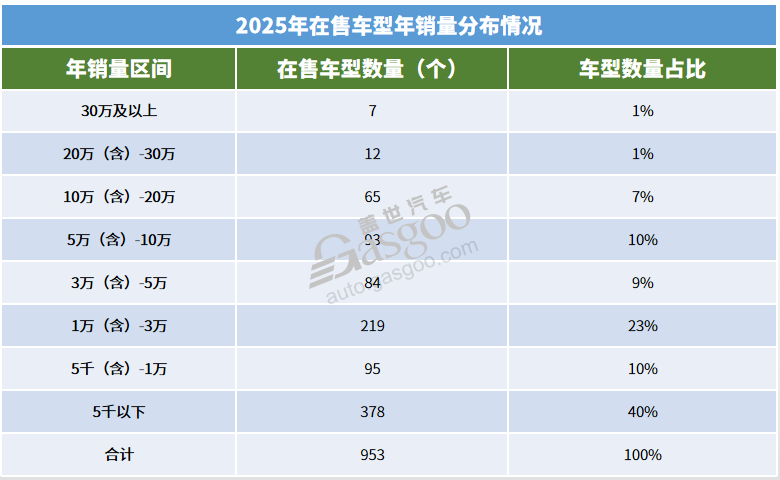
Additionally, 95 models sold between 5,000 and 10,000 units, and 219 models sold between 10,000 and 30,000 units. In other words, in 2025, models with annual sales of less than 30,000 units accounted for a staggering 73% of the total. This means nearly three-quarters of products failed to achieve even the most basic threshold of scale.
This cannot be summed up simply as "fierce competition." It is essentially the inevitable result of oversupply, demand convergence, low efficiency, and decision-making bias. For the industry, the biggest lesson from this data is clear: the era of quantity expansion is over. Quality competition and value creation are the only way forward. For automakers, the lesson is equally urgent: the market's ultimate reward is never given to the most frequent launchers of new cars, but to the long-term players who best understand user needs.
The Glut of New Cars and the Efficiency Trap
The prevalence of the "volume strategy" in the current domestic market certainly has its own industrial logic.
On the tech front, electrification and intelligence have not just changed the powertrain; they have remade the vehicle architecture. Standardization and modularity of parts have improved significantly, compressing development cycles from the five to six years of the ICE era to a matter of months. On the market front, Chinese consumers objectively have a habit of preferring the new over the old, so constant innovation helps maintain appeal. On the competition front, with the mainstream price band (100,000 to 250,000 yuan) having almost no gaps, many brands are forced into a "volume strategy," trying to cover a wider market range by rolling out more products.
But viewed from the R&D side, developing a next-generation model usually takes five or six years and requires considerable volume to amortize huge costs. If new cars are launched frequently without sales volume taking off, the product lifecycle shortens, driving up costs and wasting resources. From the manufacturing side, production line retrofits, mold development, and supply chain adjustments also push up production costs and lower capacity utilization. In marketing, every new launch requires significant expenditure. When launch frequency skyrockets, consumer attention is scattered, inevitably diluting the communication impact of any single model.
Worth noting is that as the density of new product releases increases, the release cycle itself is stretching. A rough tally shows that for many models today, the journey from the first technical warm-up to official delivery involves a series of technology brand events—dissecting batteries, assisted driving, and chassis. Then comes the unveiling, revealing interior and exterior. Next is the pre-sale conference to gauge market pricing. Only then comes the official launch with final pricing, followed potentially by delivery ceremonies, teardown reviews, or long-term test drives.
This explosion in the number of events is not just internal corporate marketing rivalry; the deep motivation is the fierce battle for users' limited attention in a saturated market. When market supply explodes, product iteration accelerates, and tech updates become frequent, automakers can only ensure they are not drowned out by maintaining a denser communication rhythm.
Against the backdrop of capped growth for overall domestic auto market expansion, a widening divergence has formed between over-expansion on the supply side and weak growth on the demand side. This structural contradiction dictates that the simple "volume strategy" can no longer bring significant incremental growth to enterprises; instead, it may accelerate the ineffective consumption of resources. The cluster of five launches on the night of April 16 was not purely a marketing battle between automakers, but a head-on clash around market share—whose product definition is more precise, whose pricing is more aggressive, whose specs are more "loaded." Those are the players more likely to seize a spot in the limited market space.
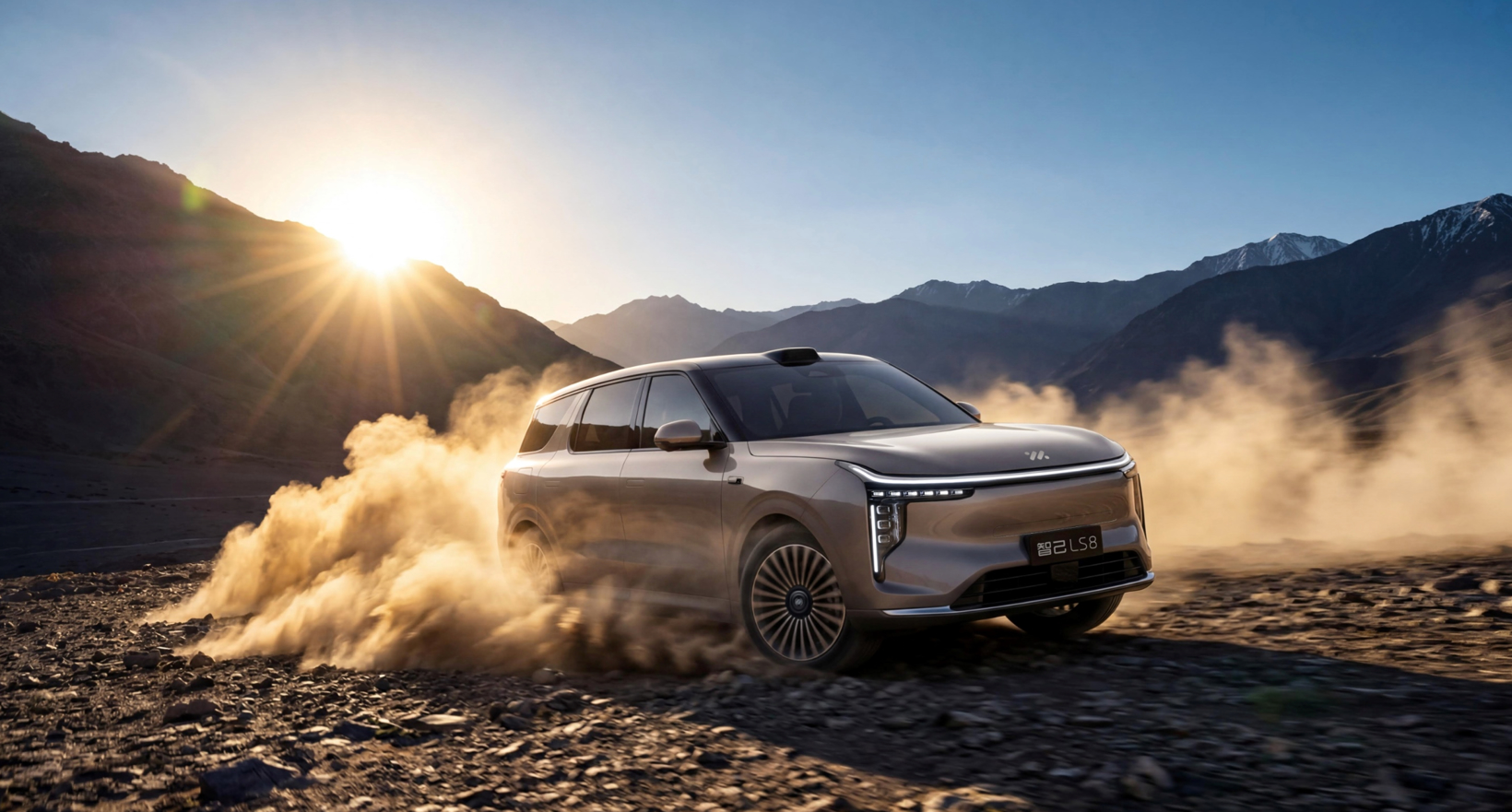
Image source: IM Motors
From Price War to System Capability Competition
Looking at the positioning, the five new cars launched last night each targeted different market segments.
Five cars, five strategies. Their common opponent is not each other, but a saturated market that is increasingly picky and unforgiving of mistakes. Against the backdrop where over 70% of models sell fewer than 30,000 units a year, every new car must answer a fatal question from the moment of project approval: What makes you think you can be one of the top 30% of "survivors"?
Facing the pressure of competition in a saturated market, the five new cars offered their own solutions. While product positioning and price bands differ, a clear common trend emerges from their pricing and configuration logic: automakers are shifting from pure price competition to a value reconstruction centered on "standardization equates to full specifications."
The Aion N60 starts at 115,800 yuan, with standard LiDAR driver assistance, zero-gravity passenger seat, and five-link suspension, attempting to redefine value standards in the pure electric SUV market under 150,000 yuan. The Geely Galaxy Star Yao 7 enters the mid-size hybrid market with a pre-sale price starting at 112,800 yuan. Equipped with the NordThor AI Hybrid 2.0 system and a 4WD version that hits 100 km/h in 5.4 seconds, it offers mid-size dimensions at a compact price, directly targeting the price band with the highest concentration of sales in China. The IM LS8 starts at an effective price of 249,800 yuan, offering as standard the Star Range Extender, steer-by-wire four-wheel steering, and Agile Lizard Digital Chassis 3.0, championing the slogan "Flagship from the start, fully equipped as standard." The Leapmotor D19 is priced between 219,800 and 269,800 yuan, featuring dual Qualcomm 8797 chips. In the full-size SUV market under 300,000 yuan, it attempts to break the premium pricing pattern of traditional luxury brands with the logic of "flagship quality at a non-flagship price." The UNYX 08 starts at 229,900 yuan, coming standard with a VLA end-to-end large-model assisted driving system and 800V fast charging technology. Amid the shrinking market share of joint venture NEVs, it aims to rebuild competitiveness with a combination of "German quality + local intelligence."
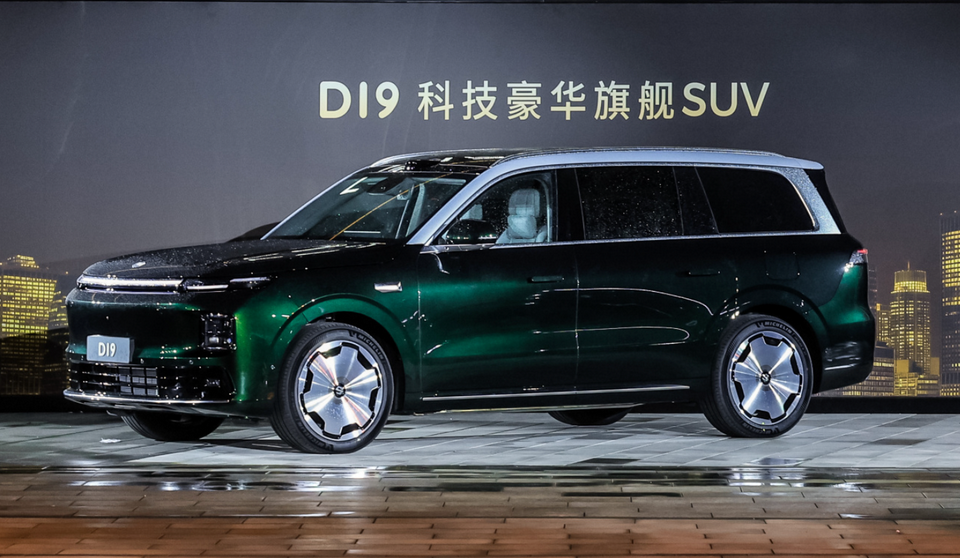
Image source: Leapmotor
The common feature of these new cars is their attempt to establish a value benchmark that is hard to replicate in their respective price bands by "loading standard specifications."
The deep logic here is that in a saturated market, the dividends of price competition are fading fast. Simply cutting prices is no longer enough to sustain consumer attraction. Especially given that the gross margins of most NEV makers are in the single digits or even negative, enhancing competitiveness by adding configuration rather than lowering prices has become a more sustainable path.
Meanwhile, the dimension of competition in the Chinese auto market is upgrading from product rivalry to system capability. What truly creates differentiation is no longer leadership in a single technological advantage, but a comprehensive contest of platform and modular capability, depth of cost control, software-hardware integration, and organizational efficiency and decision speed.
Summary: From a macro perspective, China's auto industry is at a critical juncture transitioning from scale expansion to quality and efficiency improvement. The domestic NEV market has fully shifted from policy reliance to being driven by end-user choice and market mechanisms. However, the high penetration rate of NEVs has not fully translated into sales growth; instead, it has intensified competition among enterprises in technology, cost, and channels.
The concentrated launch of five new cars on a single day is essentially a microcosm of the intensifying competition as the Chinese auto market enters the deep waters of market saturation. Against the backdrop of capped growth, oversupply, and an accelerating elimination race, every participant is searching for a new survival space.
For consumers, this undoubtedly means more choices and higher product value. But for the industry, the real question to answer may not be which of these new cars will become a hit, but when the marginal effects of the "volume strategy" will bottom out, and what kind of competitive paradigm can truly support the qualitative transformation of China's auto industry from big to strong.


