



"The Dreame ecosystem will become the first 100 trillion USD corporate ecosystem in human history."
With the 2026 CES in Las Vegas barely over, Dreame Technology founder Yu Hao posted that line on his WeChat Moments.
What does 100 trillion USD even mean? Roughly 22 times NVIDIA's market value today; or three times the combined market cap of Apple, Microsoft, Google, Amazon, Tesla and Berkshire Hathaway.

Image credit: Starry Sky Project
What seems to underpin his view is a high-profile crossover show Dreame staged in Las Vegas just last week. From an ultra-luxury all-electric concept car — nicknamed by some the "Dreame Bugatti" — to products like the Cyber X stair-climbing robot, the company tried to declare its leap from cleaning appliances to a "people–car–home" ecosystem.
More intriguingly, he stressed this wasn't drunken bluster but a "very rational inference," adding that the logic is so complex "it can't be explained in a few words — I'll write a book later."
That moment inevitably called to mind another name: Jia Yueting. The same grand story, the same vows to disrupt, the same ecosystem blueprint — only this time the protagonist is smart hardware rather than the internet, and the stage is Dreame rather than LeEco.
But here's the rub: if you sell a lot of robot vacuums, does that mean you can build a good car?
Is 30 Billion in Revenue Enough to Shake Up the Auto Industry?
Yu Hao's "100 trillion USD ecosystem" is essentially a market-cap extrapolation model grounded in how tech firms grow. He divides corporate evolution into three generations: traditional manufacturing, internet platforms, and what he terms "intelligent-ecosystem enterprises."
Sci‑fi as it sounds, Dreame does have cards to play.
In the first three quarters of 2025, revenue hit 22.5 billion yuan, with a year-end push toward 30 billion — a surge against the tide in a sluggish cleaning-appliance market. Dreame ranks third globally in robot vacuums, and even tops Europe. Online chatter claims cash flow is strong enough that it handed each of its 18,000 employees 1 gram of gold as a year-end bonus.
Dreame calls this a win for "technology democratization": putting industrial-grade high-speed motor tech into vacuums and robot cleaners to boost performance while keeping prices in check.
Behind the fast growth, though, the cleaning-appliance market has hit a plateau of single-digit expansion. Much of Dreame's sprint stems from consolidation as the sector reshuffles. When rivals like ECOVACS and Roborock regain their footing, will the battlefield tighten again?
More to the point, the distance between selling robot vacuums and building a dependable car may not be a river — it may be an ocean.
Put a robot vacuum's motor into a car?
That brings us to the most puzzling part: whether this much‑touted technology transfer is even feasible.
As of June 2025, Dreame had filed 6,379 patents worldwide. Its in‑house high-speed digital motor boasts a power density of 2.5 kW/kg — said to be twice that of mainstream automotive‑grade motors.
In Yu Hao's telling, Dreame's accumulation in high-speed motors and AI algorithms can "seamlessly" migrate to cars and robots.
It sounds compelling. Reality is less kind.
Traction motors in cars and motors in robot vacuums are different beasts. High RPMs matter, but so do high torque, power density and rock‑solid reliability. While both rely on electromagnetic induction, they diverge almost entirely in materials, thermal design, control algorithms and more.
Automotive‑grade motors must withstand high temperatures and voltages while meeting stringent reliability targets, with lifespans of 15 years or 200,000 km and defect rates measured in parts per million.
A look at Midea's Guangdong Welling Motor Manufacturing Co., Ltd. shows more than 2,000 patents across compressors, motors and chips — yet the company has been notably cautious in entering autos.
"Home appliances and autos are both electrifying and becoming smarter, and the underlying technical logic is similar. But the real challenge is building a complete automotive‑grade quality management system and aligning with customers' quality expectations in a systematic way," stressed Chen Jintao, general manager of Midea Welling Automotive Components.
"Safety first" isn't a slogan in the auto business. A motor failure in an appliance might mean a replacement; in a car, it can mean a safety incident.
As for Dreame's concept hypercar, it hasn't disclosed detailed specs, but the rumored "four motors, 0–100 km/h in 1.8 seconds" invites comparisons to a certain brand's performance models that have seen repeated accidents in recent years. The industry is already reflecting: as EVs get quicker, have our safety systems kept up?
And car‑making is about far more than transplanting technology.
It demands a wholly different supply chain, quality standards and manufacturing processes. A car has tens of thousands of parts behind it — a vast industrial system and complex supply‑chain management. This is not a matter of scaling up a robot vacuum.
Is making cars really that simple?
Yu Hao's ambition is clear: build a full‑scenario ecosystem connecting "people–cars–homes–the wider universe." Car‑making, in his view, is the key lever to pry that vision open.
Anyone in the trade knows the leap from robot vacuums to cars is a far riskier cross‑over than fighting for share within cleaning appliances.
In August 2025, Dreame formally announced its car push — and shot for the ceiling from the start: the first model to benchmark the Bugatti Veyron, the second to target the Rolls‑Royce Cullinan, with sales slated for 2027.
Then came a tsunami of claims: "over 15 billion yuan in orders," "first funding round closed in 20 days," "signed with 54 overseas distributors," "building a plant in Germany 1.2 times the size of Tesla's Berlin factory" …
Such dizzying figures and plans trigger déjà vu. LeEco? Evergrande? Or Skyworth?
Back in 2016, Jia Yueting unveiled the FF 91, packing then‑non‑automotive‑grade Qualcomm chips and lidar into the slides, and insisted on first‑quarter 2018 deliveries. That year brought no FF 91, but it did bring Evergrande Auto's cash‑splashed entrance: ten plants in one go and a target of 1 million units of capacity in three years — ambitions that outstripped BYD and Geely at the time.
Skyworth, another home‑appliance crosser, followed a path closer to today's Dreame: leveraging global channels to push overseas. Years on, its auto business still needs profits from appliances and photovoltaics to keep the lights on.
Consider a more recent, traffic‑grabbing example: Xiaomi Auto. Lei Jun announced the car venture in 2021, invested over 10 billion yuan, and after three years of grinding got the first model — the SU7 — into mass production. Even so, it drew flak from users in 2024 over delivery issues. Autos burn cash, technology and time; there are no shortcuts.
Even Xiaomi, after exhaustive fieldwork and a crash course, has been dogged by thin vehicle‑manufacturing experience, system integration and validation hurdles.
For Dreame, the more fatal challenge may lie in market choice.
It is entering the ultra‑luxury EV niche — a tiny circle with fewer than 100,000 sales a year globally. A telling reference is BYD's Yangwang. Backed by BYD's multi‑million annual sales, strong tech reserves and a mature supply chain and manufacturing base, Yangwang's climb upmarket is still anything but straightforward.
Yangwang's cumulative sales only topped 10,000 in April 2025. In this market, scale effects are hard to come by — never mind the heft needed to support a 100 trillion‑USD ecosystem.
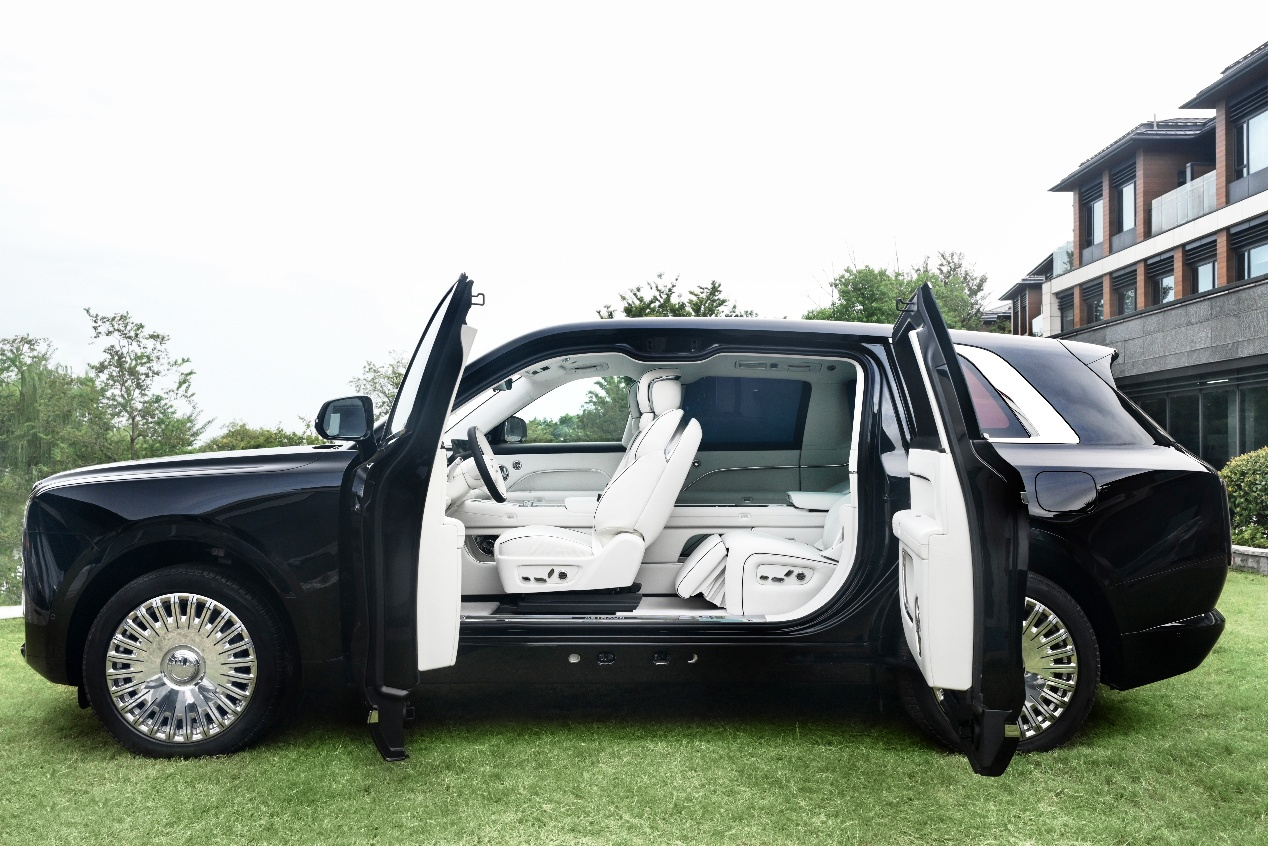
Image credit: Dreame Auto
The concept car now in the open has left many engineers shaking their heads. "With such an ultra‑low beltline, how do you guarantee the driver's visibility?" "No B‑pillar — how do you pass side‑impact tests?" For these most basic safety questions, Dreame's glossy "mobile smart living space" narrative offers no clear answers yet.
"A mobile smart living space" has become standard patter for tech companies making cars. From Huawei's smart cockpit to NIO's "second living room," the stories are strikingly similar.
With competition already a red ocean by 2026, Dreame faces a sharper question: where, exactly, is your differentiation?
The deeper issue may be the mirage of "ecosystem synergy." Even Xiaomi's sprawling Mi Home ecosystem hasn't birthed a must‑have, irreplaceable scenario tying cars and homes together. Dreame is talking synergy before it even has a car — which sounds like building castles in the air.
100 trillion USD? Do the math first
Yu Hao's 100 trillion boast detonated debate in and beyond the industry. Some admire the boldness, arguing that "those who think he's crazy are limiting themselves." More voices, though, are skeptical or snarky: "Those who insist they're sober are often the drunkest," one joked. Others drew a straight line to Jia Yueting.
Set emotions aside and run a reality‑check.
Global GDP is roughly 100 trillion USD; the total US stock market is about 70 trillion USD. A 100 trillion USD ecosystem would be 1.4 times the entire US market — or equal to 22 NVIDIAs today.
That number alone strains conventional business imagination.
Even for icons Yu Hao admires — Jensen Huang and Elon Musk — taking company values to 8–10 trillion USD would require epochal tailwinds such as the AI revolution or space exploration. For Dreame, no business pillar of that magnitude is visible yet.
Let's run an extremely optimistic scenario:
Cleaning appliances: suppose Dreame ultimately captures 30% of the global market (about 12% today). With a market size near 50 billion USD, Dreame would book 15 billion USD in revenue. Give it a generous 3x sales multiple for hardware, and you get a 45 billion USD valuation.
Autos: assume a 5% share of luxury EVs (already very optimistic) in a 500 billion USD market — that's 25 billion USD in revenue. At a 1x sales multiple typical for mature carmakers, it's about 25 billion USD in value.
Other businesses: robots, smart home and the like — add another 30 billion USD in value.
In total, you're around 100 billion USD. Between that and "100 trillion USD" lies a three‑order‑of‑magnitude abyss.
Bridging it would require Dreame to conjure an entirely new mega‑market that doesn't exist today — or to monopolize several major industries at once.
That calls not for technology, but for magic.
An analyst in finance who asked not to be named told Gasgoo that tech valuations rest on growth stories — but there must be a bridge between story and reality. Dreame's 100 trillion target demands at least five high‑difficulty assumptions all come true: existing businesses keep exploding; the car effort succeeds on the first try; robotics achieves breakthroughs; cross‑business chemistry materializes; and margins far exceed peers. Statistically, that's close to impossible.
The deeper contradiction is a lesson business history repeats: sprawling "do‑everything" ecosystems rarely outlast "focused and excellent." LeEco and Evergrande are cautionary tales. Even Apple's revenue and profits still rely heavily on a few lines like the iPhone.
Of course, Dreame can argue predecessors failed for lack of resolve or weak tech. But why should Dreame be the exception?
A worrying possibility is that this sweeping, disruptive narrative is a financing script tailored for today's market.
Car‑making and robotics are cash black holes — far beyond what a robot‑vacuum business can bankroll. Sketching a 100 trillion‑USD future attracts capital and paves the way for massive follow‑on funding.
This "valuation first, performance later" playbook is hardly rare right now.
From earlier car‑making waves to the recent embodied‑AI craze, plenty of companies have told stories faster than their technology could run. Dreame does have real operations, but if it leans too hard on grand targets, it could slide toward the edge of a bubble.
Conclusion:
Yu Hao's 100 trillion declaration brought a burst of attention to a sleepy tech sector. Yet fireworks fade. When the noise subsides, one fundamental question comes into sharper focus: in business, what truly supports a grand narrative?
Ambition is never scarce. Musk's Mars colonization and Bezos's push into space are grand goals — backed by Tesla and Amazon's solid businesses and steady technical advances.
By contrast, growth ceilings in cleaning appliances are already visible; cross‑boundary challenges are tougher than expected; and core technologies lack sufficient commercial validation. Those are realities you can't sidestep.
For Dreame, the urgent task isn't drawing ecosystem blueprints but returning to business first principles: either shore up core competitiveness in cleaning appliances to lift profitability in a saturated, stock‑driven market; or focus on one or two adjacent tracks and concentrate resources — avoiding multi‑front campaigns that scatter attention.
The cross‑industry paths of Xiaomi, Huawei, and giants like Midea Welling and Hisense already show that tech companies grow through long‑termism — and by respecting technology and industry rules.
Car‑making doesn't need another Jia Yueting‑style narrative. What it needs, beyond the blueprints, is the sobriety to admit the road must be walked step by step — and a basic, unpretentious respect for industrial manufacturing.


