



On a Harmony lntelligent Mobility Alliance (HIMA) livestream on December 9, half of China's auto industry seemed to be in the room. From SERES, the earliest deep collaborator, to a raft of mainstream automakers now aboard, Huawei's automotive "friend circle" is expanding at a pace you can see.
For the "first-generation" partners that tied up with Huawei from the start, fortunes have diverged — some have risen with the tide, others are feeling the squeeze as competition resets.
SERES, riding Huawei's express lane
At the Shanghai Auto Show in April 2021, SERES and Huawei unveiled their first Huawei Smart Selection model — the SERES Huawei Smart Selection SF5 — marking the first mass-produced car to be sold through Huawei's retail channels.
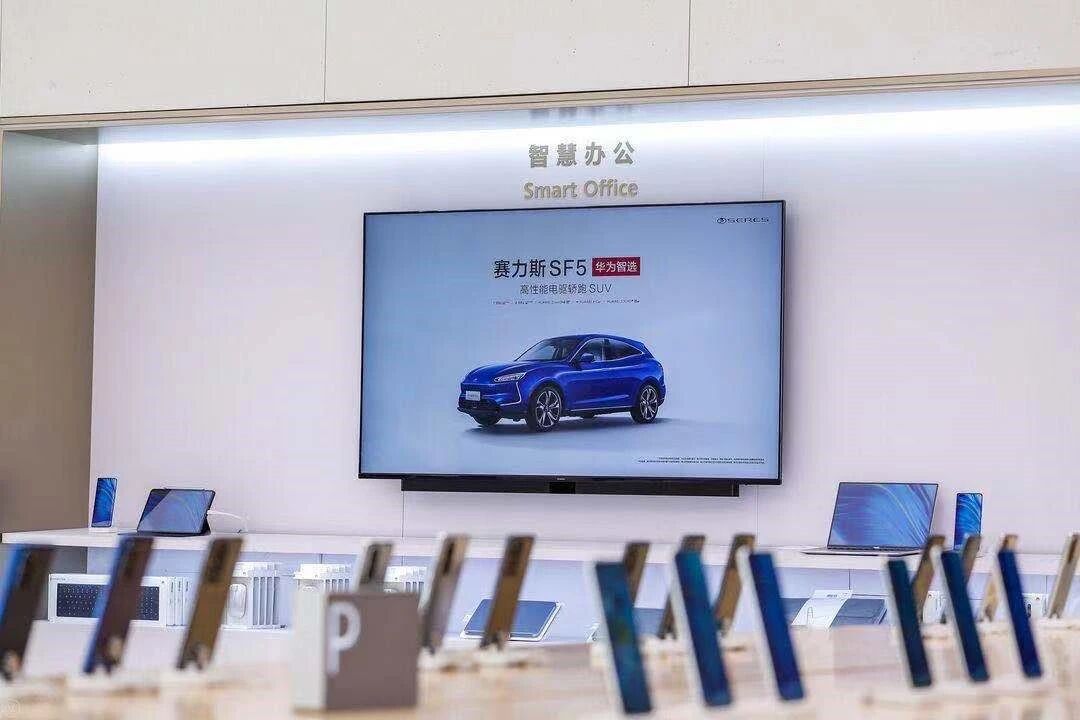
Image source: SERES Group
Back in January 2019, SERES signed a comprehensive cooperation agreement with Huawei to deepen collaboration in new-energy vehicles and explicitly build intelligent EVs for SERES. In March 2021, the two sides formalized a memorandum of deeper cooperation in Chongqing. The deal extended beyond technology to open up channels, allowing the SERES SF5 into Huawei stores and creating the "Smart Selection" model. Even so, the debut SF5 fell short of SERES's expectations, with a muted market response.
By late 2021, the partnership went further with the joint launch of the new AITO brand. After deliveries began in 2022, the first model, AITO M5, kept scaling — topping 10,000 cumulative deliveries in 87 days. The M7 and M9 followed, each carving out share in their segments. In the premium tier, the M9 stood out: average monthly sales topped 10,000 over the past half-year, including 15,481 deliveries in May, ranking first for several months in China's above-500,000-yuan price band.
As brand momentum climbed, SERES's financials flipped. According to its 2024 annual report, full-year revenue reached 145.176 billion yuan, up 305.04%; net profit attributable to shareholders was 5.946 billion yuan — a return to the black. More notable is how growth is changing: in the first half of 2025, even as sales declined year on year, net profit attributable to shareholders still rose 81.03%, driven mainly by a more premium product mix.

The Huawei tie-up, while beneficial, comes with trade-offs. Under Smart Selection, Huawei leads product definition, design and sales channels, while SERES focuses on R&D, manufacturing, deliveries and service. That division has long earned SERES the "contract manufacturer" tag, and the question of "where the soul belongs" remains a point of external criticism.
Analysts also note that as a technology licensor and channel provider, Huawei takes a sizable slice from the vehicle price, directly squeezing SERES's net margin. At the same time, SERES may face long-term risks from technology dependence.
Early on, SERES was Huawei Smart Selection's "only child," enjoying Huawei's full tech halo and channel resources. As the model proved out, Huawei's circle widened fast. Chery's LUXEED, BAIC's STELATO, JAC's MAEXTRO, and SAIC Motor's SAIC joined the Harmony lntelligent Mobility Alliance camp, and Huawei stores shifted from exclusively showcasing AITO to selling multiple "Jie" brands side by side. The once-exclusive traffic and marketing resources, in turn, were quickly diluted.
SERES's share of Harmony lntelligent Mobility Alliance sales slipped from above 85% in 2024, and by November 2025, AITO's share had fallen to 63%.
Confronted by internal and external pressure, SERES moved to shore up its position. In July 2024, it purchased the "AITO" IP, aligning product and brand recognition in the market. It then invested in Huawei's Intelligent Automotive Solution BU — Yinwang — via an equity stake, aiming to secure more say and profit-sharing through capital ties.
Meanwhile, SERES is pushing further toward "self-reliance." In its Hong Kong listing plan, the company announced major investment in a self-built R&D center and said it aims to lift core technology self-sufficiency from about 30% to 70% within three years — a key step to funding in-house development. Still, with annual R&D spend in the single-digit billions of yuan versus mainstream rivals' budgets in the tens of billions, SERES faces dual challenges of scale and efficiency on the road to core-tech autonomy.
Pioneers on the timeline, taking Huawei ties to the next level
Beyond SERES, BAIC, Dongfeng and Changan were also among Huawei's early collaborators.
Huawei's cooperation with BAIC began in 2017, with the ARCFOX Alpha S Huawei HI Edition built under the HI model. Market reception, though, fell short under that approach. BAIC made a critical pivot in 2023: going all-in on the "Harmony lntelligent Mobility Alliance" model — Huawei's most involved framework — to co-create a new premium brand, STELATO. BAIC Group Chairman Zhang Jiayong framed it as "ALL IN STELATO," signaling top-priority allocation of R&D, production and supply-chain resources across the value chain.

Image source: STELATO
STELATO S9 went on sale in August 2024. Powered by the "BAIC manufacturing + Huawei technology" combo, it made a solid start in the premium segment, but momentum has faded. Over the past half-year, average monthly deliveries have hovered around 1,750 units, sliding from 4,215 in June to under 1,000 in October and November.
To meet Huawei's quality standards, the STELATO super factory holds key body contour precision within ±0.3 millimeters, employs a "blue-light inline measurement" system to scan hundreds of critical points, and runs a "dual quality inspection" regime executed by both teams. As Zhang Jiayong has acknowledged, the collaboration has compelled BAIC to "rebuild and innovate, from organizational structures to technical logic."
BAIC faces mounting pressure nonetheless. Its main NEV arm, BAIC BluePark, has run losses for years, with cumulative deficits since 2021 exceeding 23 billion yuan. The new Huawei-backed brand STELATO is expected to lead the group's NEV business to profitability, yet whether that ticket can carry BAIC's electric unit through losses and internal friction remains to be seen.
Dongfeng, by contrast, has taken a deeper strategic path with Huawei. The two signed a strategic pact in 2018 and have moved through multiple phases of cooperation. In January 2024, Dongfeng and Huawei signed an HI-model strategic cooperation agreement, with Dongfeng's existing brands — VOYAH and M-HERO — adopting Huawei's QianKun intelligent driving and HarmonySpace to positive feedback. Deeper integration springs from the "DH project" initiated in 2023, which in 2025 incubated a new brand, "Yijing."
The DH project's hallmark is a "dual-leadership" joint team. The two sides co-define, co-develop and co-market across the chain — collaborating deeply and making decisions together. They not only established co-located joint teams but also unveiled a joint innovation lab in September 2025 focused on in-vehicle software and AI scenario applications. Internally dubbed the "HI Plus" model, its core aim is not only to build next-generation intelligent vehicles but also to use the DH project as a lever to drive Dongfeng's R&D and production systems toward intelligent transformation.

Image source: Yijing Auto
The challenges are just as stark. As a new brand, "Yijing" must start from zero against Huawei-affiliated rivals with established recognition such as AITO and AVATR, a tough climb. Meanwhile, Dongfeng already runs multiple NEV brands — VOYAH, M-HERO and Yipai among them. Clarifying Yijing's premium intelligent positioning, coordinating resources and avoiding brand cannibalization will test Dongfeng's internal governance.
Changan, for its part, piloted the HI model with Huawei via the AVATR project as early as 2019. In August 2024, AVATR and Huawei signed a deal to acquire 10% of Huawei's carved-out car BU — Shenzhen Yinwang Intelligent Technology Co., Ltd. — for 11.5 billion yuan, making AVATR a strategic investor and the No. 2 shareholder. The auto industry saw the move as buying a "ticket to the intelligent-car era." Through capital ties, Changan not only locks priority access to Huawei's cutting-edge smart technologies but also, as a shareholder, shares in the future returns of Huawei's intelligent automotive solutions.
Beyond AVATR, in the mid-to-high-end core market, Changan's DEEPAL L07, S07 and S09 adopt Huawei's QianKun ADS and other modular solutions; in the mainstream, the Changan QIYUAN Q07 carries Huawei's QianKun assisted driving, and QIYUAN also connects to Huawei HiCar for ecosystem integration. Together, this combination has lifted the intelligent competitiveness of Changan's brands efficiently and in sync.
Even so, AVATR and DEEPAL models inevitably go head-to-head with brands more tightly bound to Huawei — AITO and LUXEED among them. Staying distinctive within this "in-ecosystem competition" isn't easy.
Among Huawei's early partners, BAIC is trading manufacturing-system overhaul for a shot at the premium tier; Dongfeng is probing the limits of strategic autonomy through deeper fusion; Changan is leveraging capital to secure a favorable spot in the tech ecosystem. Their experiences suggest the Huawei relationship must move beyond basic tech procurement to touch strategy, organizational flow, R&D systems and even corporate governance — all to fortify their competitive stance.
Sailing the Huawei swell: how do automakers navigate?
In October 2025, models equipped with Huawei's QianKun intelligent driving system topped 100,000 units in monthly sales; as of November 19, 2025, Huawei QianKun ADS had logged over 5 billion km of cumulative assisted driving, with Harmony lntelligent Mobility Alliance's assisted-driving system reaching 1.67 billion km in six months. By end-2025, Huawei QianKun had partnered with 14 automakers across 33 mass-production models. These span pure electric, range extender, hybrid and fuel powertrains, with prices from 150,000 yuan up to the million-yuan bracket.
Behind the phenomenon lies a deep-seated anxiety: avoiding homogeneity, preserving brand independence and keeping strategic control. Automakers aren't standing still — they're rolling out a series of responses.

Image source: Changan Automobile
Changan and SERES, for instance, have pursued "interest binding" through capital. Changan, via AVATR, invested 11.5 billion yuan to buy 10% of Huawei's car BU; SERES completed a transaction of the same scale. The shift from "pay to use" to "become a shareholder" not only secures long-term priority on technology but also a seat at the table for core decisions — plus a share of ecosystem profits.
Balancing technologies is another common play. BYD's FANGCHENGBAO BAO 5 offers both its in-house "Tianshen Eye" and Huawei's advanced QianKun ADS for users to choose; Changan, while deploying Huawei's QianKun ADS in DEEPAL, is also investing heavily in its own "Tianshu intelligent driving assistance."
For partners, the most immediate upside of working with Huawei is a ticket into the intelligence race — and a precious window to catch up, plug capability gaps and seize demand. Joining Huawei's ecosystem can reduce R&D risk and tap shared supply-chain and data-iteration advantages.
Yet the tug-of-war over the "soul," alongside margin pressure, is real. AVATR, upgraded to the "HI Plus" model with Huawei's full-stack tech, must vie in channels with Harmony lntelligent Mobility Alliance brands such as AITO and LUXEED. SERES, under Smart Selection, enjoys Huawei store traffic but remains heavily reliant on Huawei for core tech in assisted driving and the cockpit.
The partnership's first half is about leveraging Huawei to catch the intelligence window; the second will hinge on whether automakers can build, atop Huawei's powerful base, a distinct brand ethos, scenario-driven experiences and user ecosystems.

Image source: @Huawei QianKun Intelligent Automotive Solutions
For the industry, Huawei's broad cooperation has most clearly accelerated the spread of intelligence and lowered costs. As high-level assisted driving enters the 150,000–200,000 yuan mainstream price band, it's shifting from a premium add-on to everyday standard — with scale directly pushing technology costs down.
Huawei's role in autos is evolving toward "China's Bosch," likely filling the ecological niche for a homegrown high-end auto-parts giant. Its work with international brands such as Audi also signals growing global recognition for China's intelligent-vehicle solutions — and the potential to shape future industry standards.
Of course, Huawei's wide entry — while fast-tracking intelligence — brings new challenges. Multiple brands adopting similar tech can converge experiences, inviting price wars and infighting. If consumers encounter near-identical driving logic and cockpit interaction across badges, differentiation gets harder. Over time, over-reliance on a single external stack at the expense of in-house or alternative routes could narrow the diversity of innovation.
Smart driving already shows a "one dominant, many strong" Matthew effect — Huawei in the lead, with newcomers and suppliers strong in niches. Concentration can help set standards, yet may also, to a degree, restrain exploration of diverse technical paths.
Conclusion:
In China, more than one in four new cars offering urban navigation assist now use Huawei's solution; in the premium market above 350,000 yuan, that share is more than half. Huawei is pushing its intelligent driving toward real-world Level 3 highway testing.
Facing the choice between "soul" and "body," automakers are responding with capital commitments, tech balancing and brand separation. As QianKun's cumulative assisted mileage surpasses 5 billion km, a new order in China's smart-car industry — built on a unified technical base and competing on high-end experience and business-model innovation — is taking shape.


