



On January 1, Voyah announced its full-year 2025 sales of 150,000 units — an 87% increase from a little over 80,000 the year before. The surge ties to stronger product capability and deeper collaboration with Huawei, among other drivers.
On the intelligence front, Huawei and Voyah first put their partnership into practice on the Voyah Dreamer. After the model adopted Huawei ADS and a HarmonyOS-based cockpit in 2024, market attention rose sharply: orders topped 50,000 within 110 days of launch, and December alone surpassed 10,000 units — momentum that helped lift Voyah's 2024 full-year sales to 85,000 units.
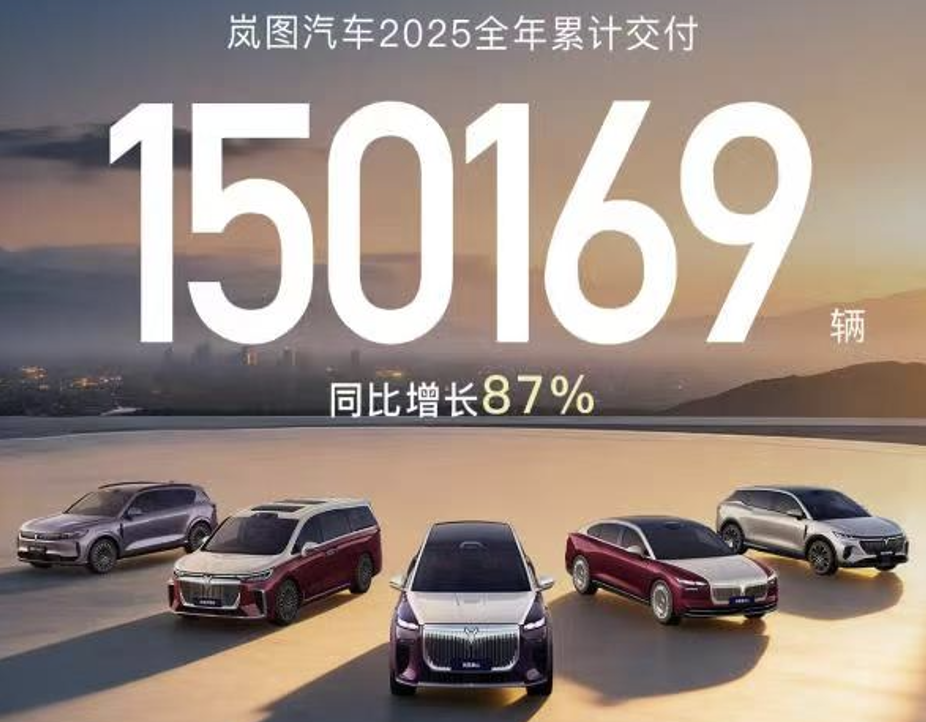
Image source: Voyah
In 2025, Voyah is pushing its “Huawei across the lineup” strategy further. From the Dreamer to Zhiyin, the new FREE+, and Zhuiguang L, its core models now incorporate Huawei’s intelligent solutions, forming a cohesive smart product matrix.
In battery–motor–control technologies, new platform architectures and upgraded “three-electric” systems are also rolling out, significantly boosting Voyah's product strength. Its in-house ESSA native intelligent EV architecture underpins that push: the design decouples software and hardware and supports full-domain OTA, enabling driver-assistance systems to control the chassis and e-drive more precisely.
Voyah's “Smart Magic Carpet” chassis integrates air suspension, CDC adaptive damping and rear-wheel active steering. With a road-preview system, it can pre-adjust suspension stiffness and ride height to keep the body steady over bumpy surfaces.
The “three-electric” system likewise shows intelligent integration. The Zhuiguang L, for instance, uses an 800V high-voltage platform with ultra-fast charging and a large-capacity battery; pure-electric range reaches 410 km, while combined range can hit 1,400 km.
Voyah has released its Level 3 smart architecture — the Tianyuan Smart Architecture — whose underlying Kunpeng system already leverages data fusion and analytics to optimize the on-board large model.
Seamless intelligence across the chain — from intelligent driving and cockpit to chassis and the e-powertrain — is becoming the trend in vehicle manufacturing. That approach gives Voyah a differentiated edge, moving it away from a path that relies solely on“hardware stacking.”
On profitability, Voyah CEO Lu Fang has disclosed: “We are committed to a high-quality development path. We started posting quarterly profits in 2024, and profitability was steadier in the first half of this year — the fastest in the industry.” In other words, Voyah is nearing its break-even point.


