



Here are this week's major developments in embodied AI and assisted/autonomous driving:
U.S. delays new tariffs on Chinese chips
According to Bloomberg, the Office of the United States Trade Representative (USTR) has released findings from a probe into China's chip sector that lasted nearly a year. The U.S. will hold off on imposing additional tariffs on Chinese chip imports at least until mid-2027.
While Washington stopped short of an immediate hike, it signaled further action remains possible. A Federal Register notice said the initial tariff rate will stay at zero for 18 months, then begin rising on June 23, 2027, with the specific rate to be announced at least 30 days before that date.

Image source: The White House
The decision to delay new tariffs is the latest sign the Trump administration is seeking to steady U.S.-China ties and cement the accord the two sides reached in South Korea in October. Under that deal, both agreed to shelve steep tariffs and ease export curbs on technology and critical minerals.
The notice primarily targets "foundational chips" made in China — legacy or mature-node semiconductors. They are less advanced than the high-end chips powering AI, yet are ubiquitous across autos, aircraft, medical devices and telecoms. That breadth has amplified U.S. and European regulators' concerns over China's outsized influence in the legacy chip supply chain.
Products covered in the proposed tariffs include diodes, transistors, virgin silicon and integrated circuits. For now, end devices such as computers and smartphones that contain Chinese chips appear to be excluded.
Xiao Zhi take: A tariff "breather" with a firm timetable is, in effect, a stress test for the legacy chip supply chain — and a window for strategic maneuvering.
Lotus secures a $23 million strategic investment from ECARX
On the evening of Dec 29, ECARX said it had signed a share subscription agreement with Lotus Technology to buy about 16.79 million newly issued ordinary shares at $1.37 apiece, for a total of $23 million. The company announced the agreement that night.
Image source: ECARX
Under the agreement, ECARX will subscribe for roughly 16.79 million newly issued ordinary shares of Lotus at $1.37 each, for a total investment of $23 million.
Once the deal closes, Lotus gets a much-needed cash injection, while ECARX pins an important label on itself — the ability to supply intelligent technologies to a global luxury brand.
Xiao Zhi take: A $23 million transaction, at heart, is a trade between a high-end brand's need for cash flow and a smart-tech supplier's need for a "calling card."
He Xiaopeng: Level 4 full driving autonomy will truly arrive in 2026
On Dec 30, He Xiaopeng posted a long note on his Weibo account, sharing the "shock" from a four-hour, deep-drive experience of Tesla's FSD V14.2 in the U.S.
He argued that if Tesla's FSD at the start of 2024 was still "a decent L2 driver-assistance," the current version clearly points to "L4 autonomy being within reach."
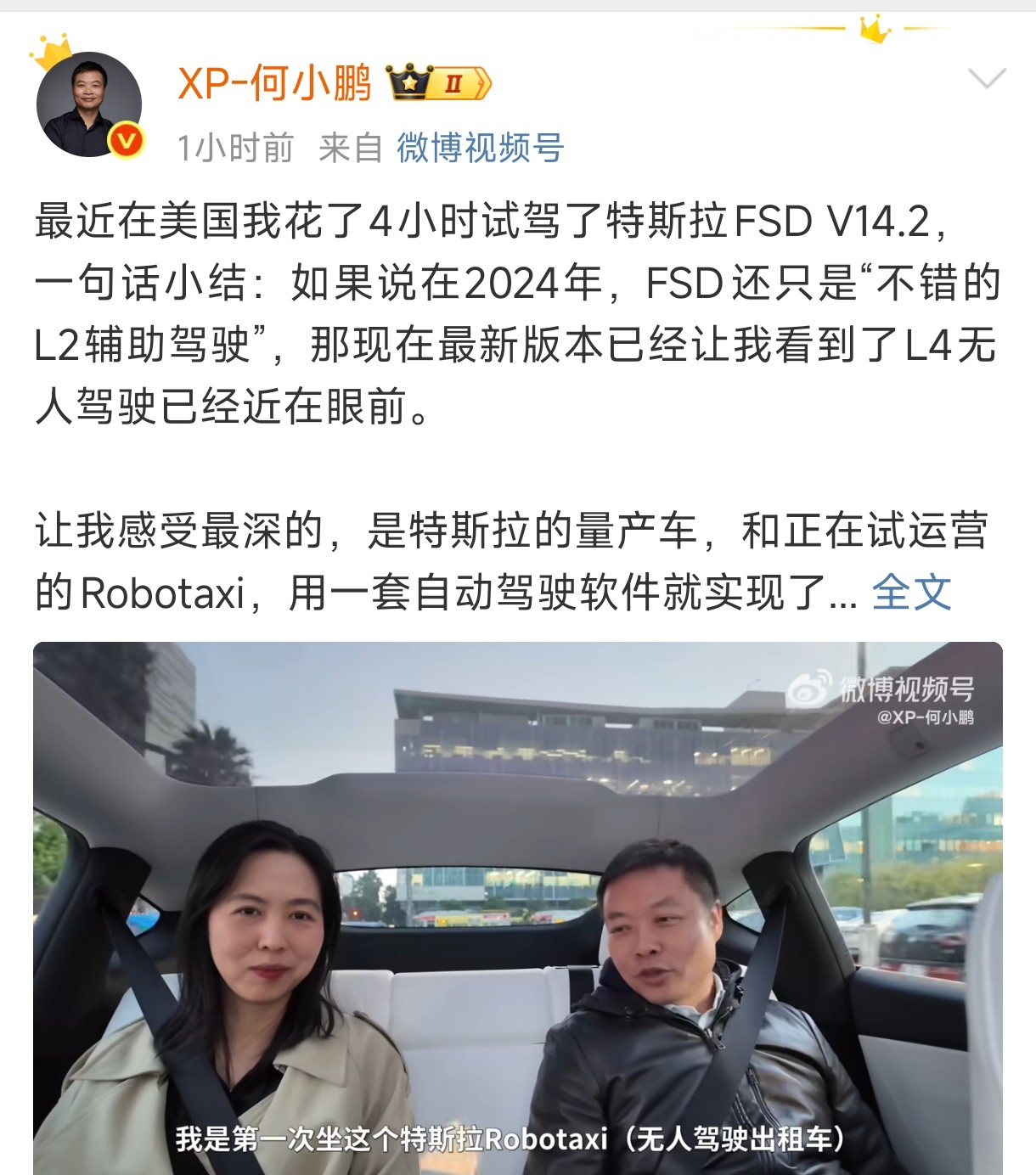
Image source: He Xiaopeng on Weibo
Drawing on that experience and his company's R&D progress, He made a bolder call: by 2026, in both the U.S. and China, "the next generation of true, fully autonomous driving will arrive," jumping "directly from L2 to L4 (with L3 skipped)."
He added that XPENG's upcoming "Ultra" version aims to achieve that generational leap to full autonomy, using "the same model" to support future robotaxi operations. The view challenges the industry's widely accepted, incremental path through L3 (conditional automation) and signals the start of an endgame over competing tech routes.
Xiao Zhi take: Betting on "skipping L3 to go straight to L4" is both an aggressive prediction of a technological leap and a stress test for how fast regulation and infrastructure can keep pace.
Deepal chairman: next-gen L3 product under development, aiming to cap cost increase at 30,000 yuan
Deepal Chairman Deng Chenghao told media the company's next-generation L3 autonomous-driving product is in development, with a goal to keep the added cost within 30,000 yuan. Because L3 requires redundant chassis and control systems, he said, costs remain high for now; but if sales reach the millions — even tens of millions — the cost uptick could drop to the "several thousand yuan" range.
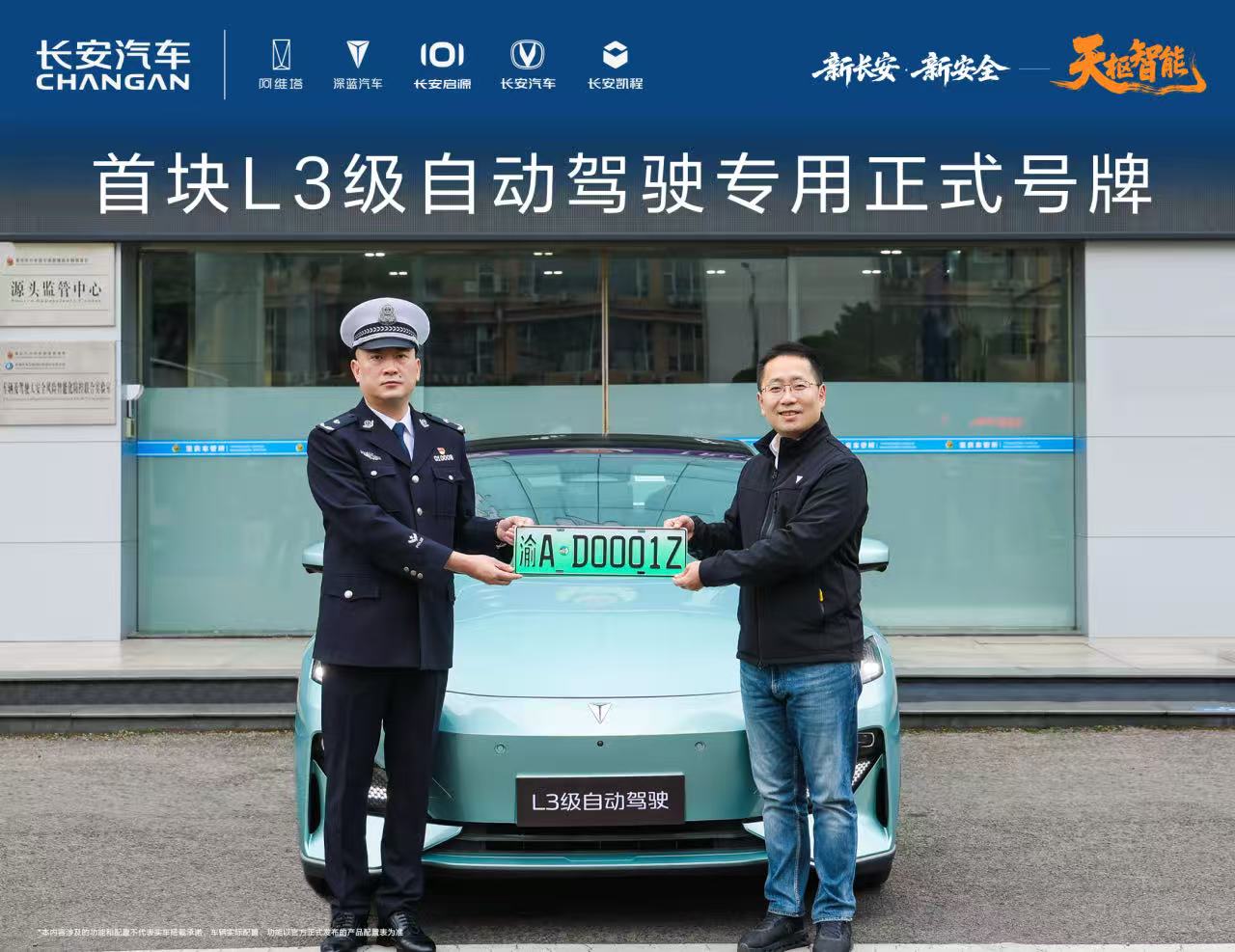
Image source: Changan Auto
Deng noted L3 is not yet open to ordinary consumers; vehicles still must carry professionally certified drivers. Broader adoption will require stronger laws and oversight frameworks before it can gradually move to the consumer market.
Deepal's second-generation products are slated to hit the market in 2026, with plans to roll out 30 models by 2030. The shift from L2 to L3 is a critical technical leap, he said, clarifying who bears responsibility and significantly raising safety standards.
Xiao Zhi take: Reducing L3's "three core questions" — liability, safety, regulation — to a quantifiable 30,000-yuan cost target is a pragmatic path to commercialization.
Swancor enters the personal robotics track, formally unveils "Qiyuan Q1"
On Dec 31, Swancor Chairman Peng Zhihui unveiled the world's first small humanoid robot with full-body force control, "Qiyuan Q1," and said the company will enter the personal robotics market under the "Swancor Qiyuan" brand. The robot breaks new ground in joint design, overall size and application scenarios, compressing lab-grade humanoid capabilities into a backpack-sized package.

Image source: Swancor Qiyuan
Qiyuan Q1's core breakthrough is solving the industry challenge of miniaturizing high-performance humanoid joints. Through coordinated innovation in materials, structure and control algorithms, Swancor Qiyuan shrank its QDD quasi–direct drive joint to a volume smaller than an egg, while preserving the force-control performance and high dynamic response found in full-size machines. Full-body force control means every joint carries force sensors to perceive external forces in real time and respond compliantly — laying the groundwork for safe physical human-robot interaction.
Positioned for research, creation and home use, Qiyuan Q1 offers a full SDK and HDK for researchers, paired with drop-resistant, low-wear hardware to serve as a portable platform for embodied intelligence. For enthusiasts, its modular design supports 3D-printed customization and behavior-logic editing, lowering the barrier to robot creation. For families, natural language interaction and compliant impedance control enable services such as English practice and Q&A companionship. The design cuts R&D trial-and-error costs and narrows the sim-to-real gap.
Xiao Zhi take: Squeezing lab-grade force-control into a backpack marks an ideal leap from industrial to personal use — though the road to practical, everyday utility remains long.
Holding 80% of the global market, LinkerBot raises new funding
On Dec 29, LinkerBot announced it had closed a Series A++ round. The round was co-invested by Sequoia China, CCV (China Creation Ventures), GF Qianhe and Pufeng Capital, with proceeds earmarked for product R&D, capacity expansion and — most critically — data accumulation for dexterous manipulation in embodied intelligence.
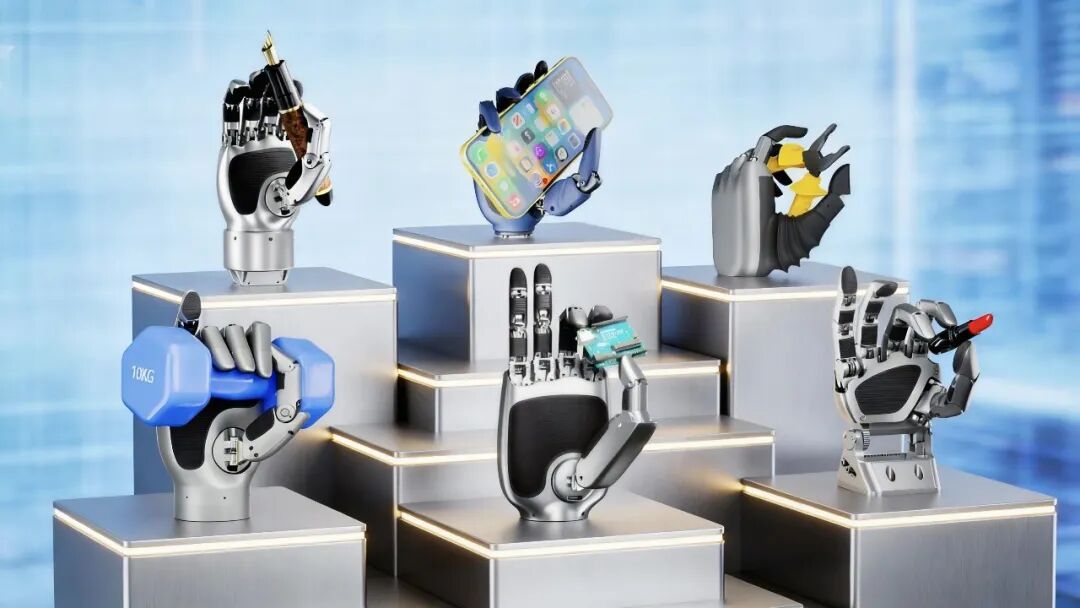
Image source: LinkerBot
Alongside the news, the company set an aggressive mass-production target: delivering 50,000–100,000 dexterous hands in 2026.
Today, monthly shipments have only just topped 1,000 units, implying a sharp scale-up next year. The industry unicorn is moving to turn its market and technology lead into scale — seizing the robot "hand" as a key stronghold to shape the pace of the embodied-intelligence sector's evolution.
Xiao Zhi take: The jump from "80% global share" to "100,000 units a year" signals a move from "key component" to "ecosystem-defining." Data, more than capacity, will form the deeper moat.


