



This week's big moves in embodied intelligence and driver assistance:
AgiBot tops global humanoid robot shipments
According to Omdia's latest General Embodied Robot Market Radar report, global humanoid robot shipments are expected to reach 13,000 units in 2025, with Chinese manufacturers leading the pack.
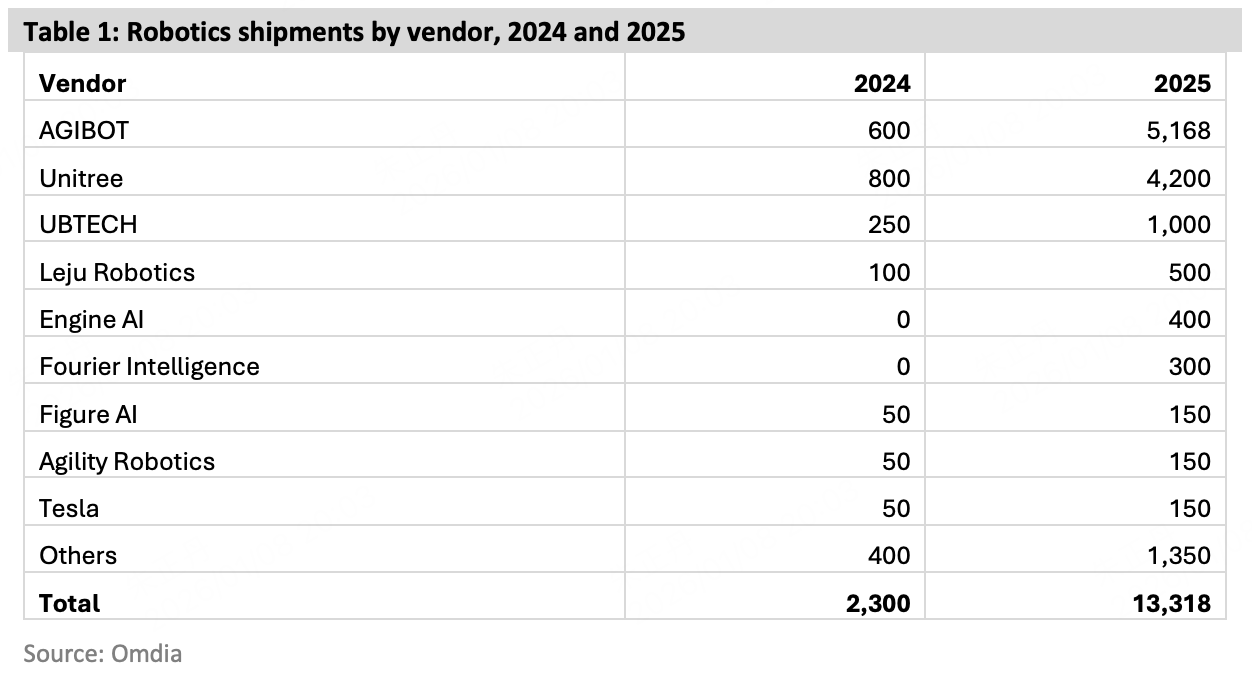
Image: Omdia
AgiBot is set to take first place worldwide — both in shipments and share — with more than 5,100 units and a 39% slice of the market. Unitree Robotics and UBTECH follow, at roughly 4,200 and 1,000 units in 2025, corresponding to shares of 32% and 7%.
So far, AgiBot has rolled out several humanoid models, including Yuanzheng A2, Lingxi X2 and Jingling G2, building a product matrix that spans full-size, half-size and wheeled formats. Commercial deployments are already underway across core scenarios such as entertainment performances, tour guiding and retail assistance, smart manufacturing, research and education, as well as data collection and training — marking a step-change from tech validation to batch deliveries.
Omdia projects exponential growth over the next decade, with global shipments of humanoid robots potentially reaching 2.6 million units by 2035.
XiaoZhi's take: AgiBot's rise reflects a near-term win for value and scalable scenario fit. But behind the "No.1 in shipments" halo, its technical moat and long-term profitability still face real tests.
Boston Dynamics unveils production Atlas
On Jan. 6 local time, Boston Dynamics introduced a new all-electric Atlas humanoid robot. It stands about 1.9 meters tall, weighs 90 kilograms, offers 56 degrees of freedom, and can carry loads of roughly 50 kilograms. Arm reach height is about 2.3 meters.
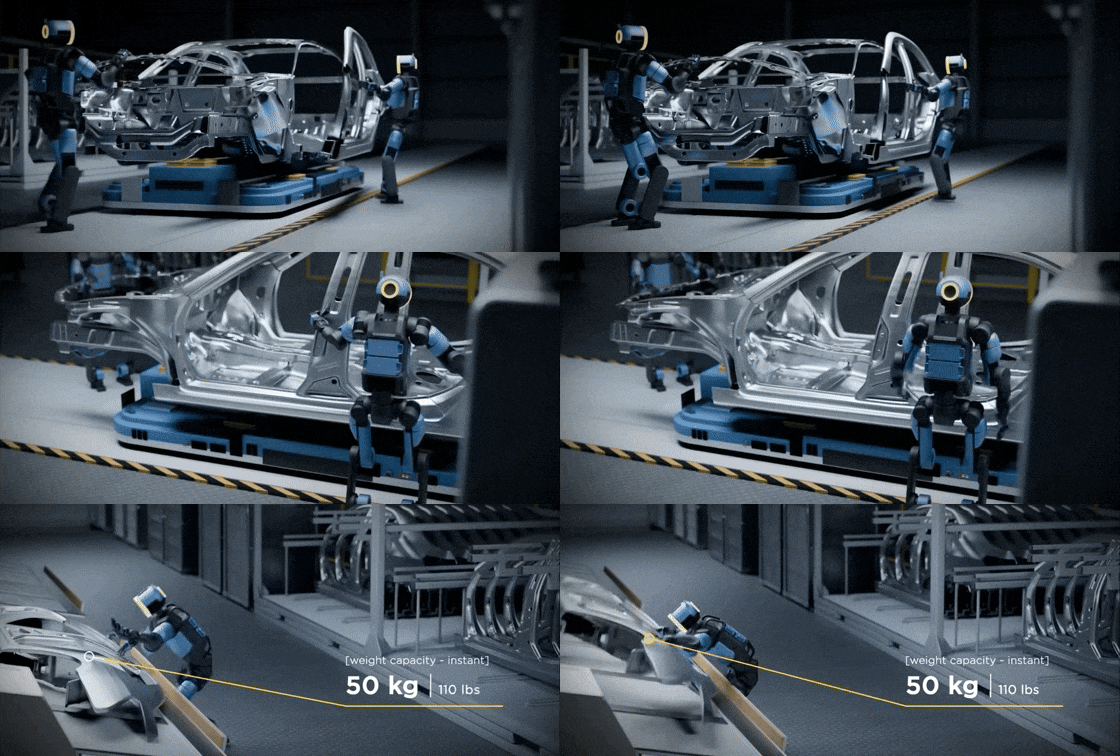
Image: Boston Dynamics
Atlas features 56 DOF joints, most capable of 360° rotation, enabling movements more efficient than a human's — especially in tight, time-critical manufacturing environments — thanks to 360° rotation at both the head and waist. Its head integrates a 360-degree panoramic camera, allowing omnidirectional perception without turning.
It also carries a fast-swappable dual-battery system. A single charge runs for about 4 hours; when the battery drains, Atlas can autonomously navigate to a charging station, perform the battery swap itself and immediately return to work — enabling 24/7 operations.
Boston Dynamics has already deployed Atlas at Hyundai's U.S. plant for tasks such as autonomous material handling, gathering data and experience to take back to Boston Dynamics. Next, the company plans more pilots within Hyundai Motor Group and aims to add new customers in 2027.
Starting in 2028, Atlas will be introduced into processes with safety and quality benefits, such as parts sorting. By 2030, applications will extend to component assembly. Over time, Atlas will take on repetitive motions, heavy loads and other complex operations.
To support mass production, Hyundai is mobilizing the group to build a scalable robotics manufacturing system — covering design, core component production, assembly and final deployment all within Hyundai's system. Boston Dynamics and Hyundai aim to establish capacity for 30,000 robots annually by 2028.
XiaoZhi's take: Atlas is finally shedding its "lab star" label and moving into production. With industrial-grade freedom of movement and autonomy, the race to define the factory of the future has truly begun.
Noetix Robotics sets timetable for first 1,000-unit overseas deliveries
At CES 2026, co-founder Zhang Shipu said Noetix Robotics has identified five core markets — North America, Europe, the Middle East, Southeast Asia, and Japan/South Korea — and plans to complete the first 1,000-unit tranche of overseas orders in the second quarter of 2026.
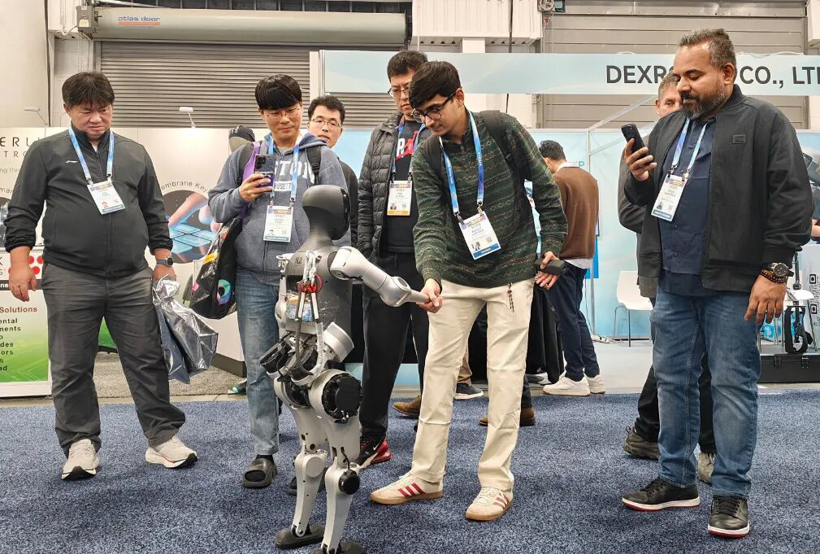
Image: Noetix Robotics
To hit that target, Songyan is building a flexible production and supply chain system that integrates ERP and MES, supporting customized overseas inquiries, scaled manufacturing and localized after-sales service.
For global expansion, the company will take a "scenario-first, case replication, brand deepening" approach. It will first deploy the Xiao Wantong N2 in proven scenarios tailored to each region — such as retail displays and interactive entertainment — create repeatable benchmark cases, then push toward regional scale-up, building a commercial loop from product delivery to customer success and, ultimately, stronger brand influence.
Songyan focuses on humanoid robot bodies and bionic faces — developing, manufacturing and selling products including the humanoid Xiao Bumi, N2, E1, and the bionic robot Xiao Nuo. Xiao Bumi was formally launched in late October; it stands 94 cm tall, weighs just 12 kg, supports graphical programming and voice interaction, and prioritizes ease of use, compactness, safety and strong interactivity. Songyan has said cumulative online and offline orders for Xiao Bumi have reached several thousand units.
XiaoZhi's take: A clear timetable for 1,000-unit overseas deliveries signals a substantive step in Chinese humanoid robot makers' global expansion.
BrainCo raises about 2 billion yuan
BrainCo has closed a new round of financing of about 2 billion yuan. The funds will accelerate core brain-computer interface R&D, extreme engineering breakthroughs, and product scaling toward mass production.
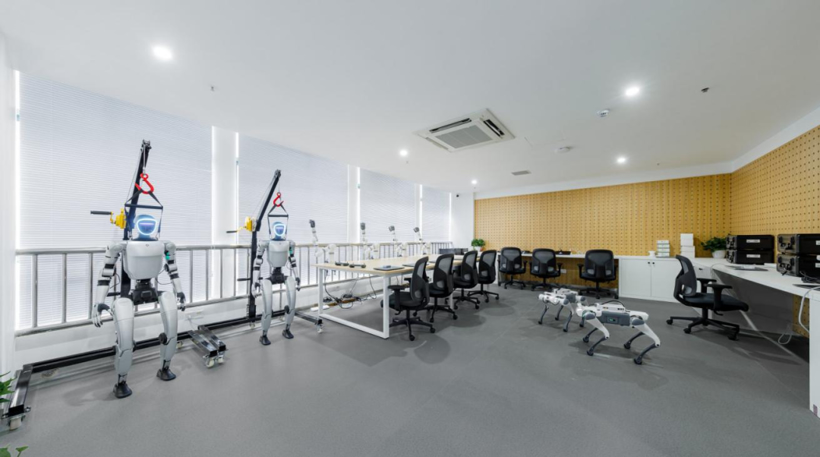
Image source: BrainCo
Backers include IDG, Walden International — founded by Intel CEO Chen Liwu — "Apple supply chain" giants Lens Technology and LY iTECH, as well as some strategic investors like H World Group.
Lens Technology will also undertake mass-production processes for BrainCo's core hardware modules, while Lingyi iTech has signed a strategic cooperation agreement with the company.
A brain-computer interface "unicorn," BrainCo was founded around 2015 by Han Bicheng's team, incubated at the Harvard Innovation Labs. The company has long focused on non-invasive BCI and has commercialized products such as intelligent bionic limbs and brain-computer smart sleep devices.
XiaoZhi's take: Nearly 2 billion yuan backing shows capital is betting on the shift from "proof of concept" to "scaled products" in brain-computer interfaces.
Qualcomm unveils a full-stack robotics offering
On Jan. 5 at the CES 2026, Qualcomm announced a next-generation robotics stack that integrates hardware, software and composite AI. The company also introduced its latest high-performance robotics processors — the Qualcomm YueLong™ IQ10 series.
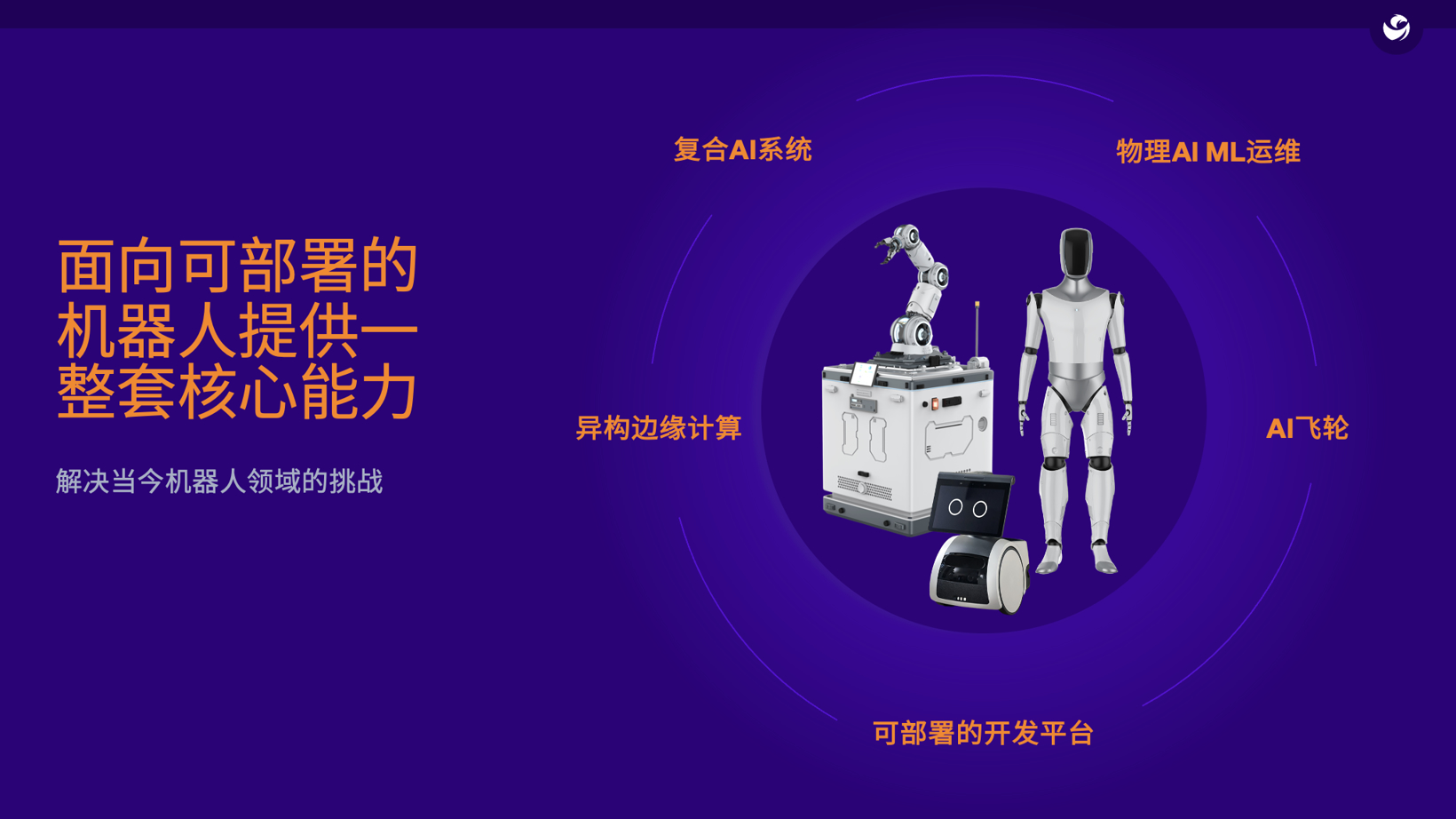
Image source: Qualcomm
The new stack combines end-to-end AI models such as vision-language-action (VLA) and vision-language (VLM), supporting advanced perception and motion planning — enabling generalized manipulation and human-robot interaction.
Powered by Qualcomm YueLong™ IQ10, and fusing strong heterogeneous edge computing, edge AI, mixed-criticality systems, software, MLOps and an AI data flywheel — plus a growing partner ecosystem and robust developer tools — the general-purpose robotics architecture enables easy reasoning and intelligent adaptation to spatiotemporal environments.
Designed for industrial-grade autonomous mobile robots (AMRs) and full-size humanoids, the Qualcomm YueLong™ IQ10 series aims to deliver a high-performance, energy-efficient "robot brain."
Qualcomm's industrial processor roadmap already supports multiple general-purpose robot form factors, including industry-leading humanoids from Accel Evolution, VinMotion and other global providers. Qualcomm is also in discussions with KUKA Robotics on next-generation robot solutions.
XiaoZhi's take: Qualcomm's full-stack approach hinges on a general-purpose chip and software ecosystem to "empower" the sector — a move that could accelerate robot adoption.
RoboSense's "Delivery Buddy" robot debuts at CES 2026
Since establishing its AI+robotics strategy in early 2025, RoboSense has built full-stack AI capabilities from hardware to algorithms. At this year's CES, RoboSense staged a global debut of its AI robot, showcasing breakthrough progress in embodied intelligence.
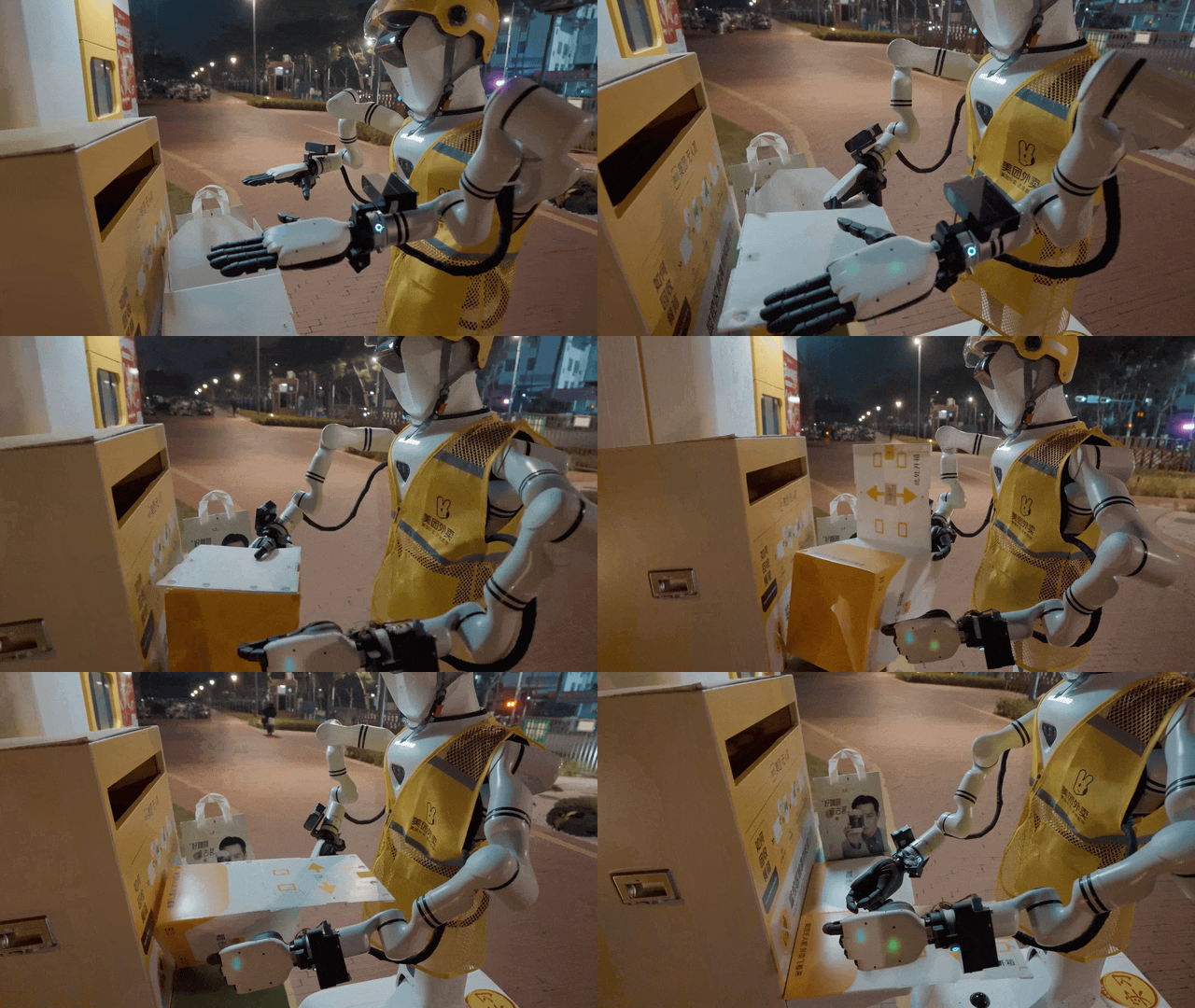
Image source: RoboSense
One highlight: the robot "Delivery Buddy" performed a long sequence of tasks with no human intervention — packing gifts, shelving, transporting, unboxing, delivering gifts and folding/recycling boxes — smoothly executing nearly 20 complex steps.
Behind the demo is RoboSense's self-developed "hand-eye coordination" solution, integrating its VTLA-3D manipulation model, Active Camera robotic eyes, and a multi-DOF dexterous hand.
RoboSense's VTLA-3D model is the first in the industry to introduce force-tactile modalities with 3D point-cloud data — fusing vision, force-tactile and language with high-precision color 3D point clouds generated by Active Camera. The approach enables more comprehensive environmental perception and notably lifts success rates for dexterous manipulation.
On hardware, the robot carries a complete sensing-to-actuation stack, all self-developed by RoboSense. AC-series sensors serve as the "robotic eyes": AC2 is mounted above the eyes and at the hand end-effector to provide close-range, high-precision stereo and color information for fine-manipulation perception; AC1 is installed on the torso and back for long-range navigation and obstacle avoidance. The end-effector uses an in-house 8-DOF dexterous hand that provides tactile signals, addressing visual blind spots and ensuring continuity and precision in operation.
XiaoZhi's take: A fully self-developed "hand-eye coordination" stack enabling autonomous closed-loop execution across complex workflows makes the commercial value of embodied intelligence tangible.
Mobileye to buy humanoid robot maker Mentee for $900 million
On Jan. 6, Mobileye said it has reached a definitive agreement to acquire Mentee Robotics Ltd. Mentee is an AI-driven humanoid robotics company with a third-generation humanoid developed through vertical integration.
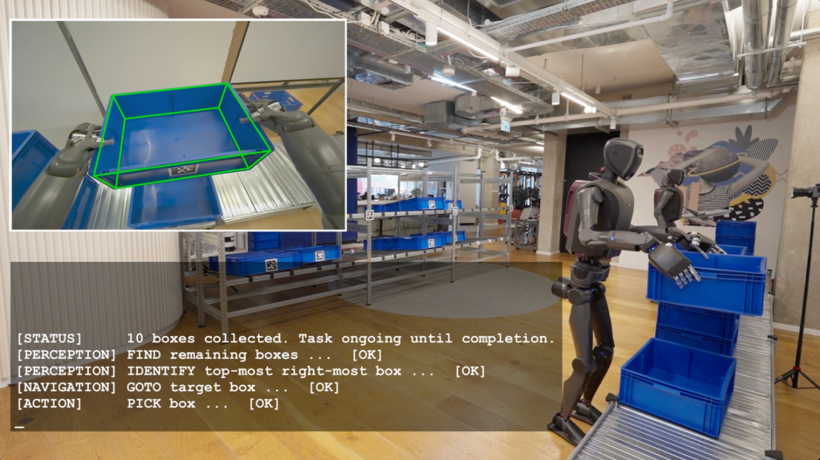
Image source: Mobileye
Mobileye said the deal is valued at about $900 million, including roughly $612 million in cash and up to around 26.2 million Mobileye Class A shares. Closing is expected in the first quarter of 2026.
The acquisition will combine Mobileye's advanced AI and global mass-production experience with Mentee's breakthrough humanoid platform and deep AI talent base — with an eye to building a Physical AI leader spanning driver automation and humanoid robotics.
Mobileye's higher-level driver automation and ADAS businesses are showing strong momentum. The deal expands Mobileye's footprint and marks a decisive step toward Physical AI. It will also speed Mentee's commercialization: first on-site customer PoC deployments are planned for 2026, targeting fully autonomous operation without remote control, with mass production and broader rollout slated for 2028.
XiaoZhi's take: Mobileye's leap from the "car's eyes" to a "general body" is an aggressive cross-over. Whether its autonomous-driving AI and mass-production playbook can carry over to humanoids will determine how this bet pays off.


