



Shanghai (Gasgoo)- Li Auto on December 3 launched the Livis, its most advanced AI-powered wearable to date and the company's first pair of smart glasses. Developed under a new global strategic partnership with Zeiss, Livis comes equipped with Zeiss optical lenses across the lineup and is offered in prescription, photochromic and sunglasses variants. Prices in China start at 1,999 yuan.
Positioned as an extension of the in-car experience, Livis integrates directly with Li Auto vehicles. When driving, users wearing the sunglasses variant can clearly view HUD data and unlock the vehicle with Face ID. With voice commands to "Li Xiang Tong Xue," drivers can adjust climate settings, activate steering-wheel heating or open the tailgate hands-free, creating a more seamless user experience.

Photo source: Li Auto
Livis pairs with the vehicle through a simple tap and reconnects automatically afterward. Li Auto says the glasses will eventually support individualized audio delivery—allowing the driver to hear navigation and ADAS prompts privately without disturbing rear passengers. A planned 2026 software update will also route front-row audio to the glasses during movie playback.
Every pair ships with a wireless charging case designed to fit into the car cabin, providing convenient top-ups without cables or modular accessories. The minimalist, drop-in design aims to eliminate battery anxiety while maintaining an aesthetic consistent with Li Auto's premium image.
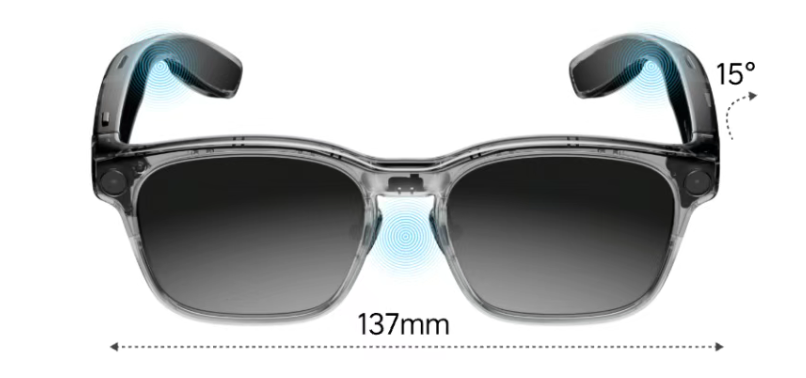
Photo source: Li Auto
Designed for all-day wear, Livis weighs just 36 grams and uses medical-grade TR90 material from Swiss supplier EMS. Li Auto claims the glasses offer one of the lightest wearing experiences in the industry, preserving comfort even with prolonged use.
The design builds on classic frame geometry but refines the brow and bridge curves for a more flattering fit. A semi-transparent frame reveals subtle internal elements, adding a tech-forward aesthetic, while the automotive-grade G3 curvature sharpens the visual profile.
Li Auto optimized Livis' ergonomics using head-shape data from more than 50,000 Chinese users. Adjustable silicone nose pads improve fit across face types, while titanium hinges are stress-tested for durability. The IP54 rating protects against dust and splashes. To manage heat, Li Auto placed heat-generating components outward and added a 2,177 mm² graphite layer, supported by temperature-control algorithms to keep the frame comfortable during long wear.
Livis comes in glossy semi-transparent or matte finishes, with color choices including black, tech gray and olive green, balancing lifestyle appeal with technological polish.
Battery life is another focus. In simulated daily use, Livis runs for up to 18.8 hours and lasts 78 hours on standby. The charging case provides four full recharges, keeping the glasses powered throughout multi-day use.
Photo source: Li Auto
All versions are equipped with Zeiss lenses—available in clear, blue-light-blocking, photochromic and prescription forms—aimed at everyday wearers and drivers alike. The partnership with Zeiss underscores Li Auto's ambition to elevate optical quality in consumer smart wearables.
The companies are also launching an online prescription-filling service that can produce and ship custom lenses within the same day. Their cooperation extends beyond China to global markets, with joint research planned for next-generation optical systems for smart eyewear.
Livis doubles as a first-person camera, freeing users' hands while capturing daily moments. The 12-megapixel lens supports a 105-degree ultra-wide field of view, electronic stabilization and automatic horizon leveling. Li Auto highlights its rapid-capture capability, snapping photos in just 0.7 seconds.
A Live Photo feature captures about three seconds of motion before and after each shot, while an AI portrait engine enhances image texture without erasing facial details, aiming for a more natural aesthetic.
Livis records hands-free first-person video with bright, vivid colors and supports multiple aspect ratios for social media. Users can shoot clips up to three minutes long, with a total limit of 41 minutes.
Open-ear spatial audio is tuned by Li Auto's acoustics lab, creating a 360-degree sound field. A dual-magnetic speaker structure—paired with the same Cirrus Logic amplifier used by Apple—delivers clear and private audio with reduced sound leakage. A bass-boost feature enhances low-frequency instruments even at low volumes.
A four-microphone array supports spatial audio pickup and noise reduction, capturing voices within a three-meter radius and preserving stereo positioning. Combined with AI transcription and task extraction, the system is designed to help users document meetings, lessons and creative sessions more efficiently.
Livis integrates closely with NetEase Cloud Music and supports native playback with voice control. Bluetooth 5.4 enables fast switching across devices, while multi-channel protocols ensure voice interactions always route through the glasses for privacy.
At the heart of Livis is an upgraded version of the "Li Xiang Tong Xue," powered by Li Auto's in-house multimodal MindGPT-4o model. Already used by 1.5 million drivers in millions of real-world interactions, the AI assistant acts as a proactive, personalized companion.
The system wakes in 300 milliseconds and completes end-to-end tasks in about 800 milliseconds, providing near-instant feedback.
In daily use, the assistant builds memory over time, learning habits and preferences to deliver anticipatory and personalized suggestions.
For work scenarios, the Li Xiang Tong Xue can record tasks by voice or photo, transcribe meetings and summarize key points, functioning as a virtual personal assistant.
With its multimodal perception, the AI assistant can answer questions, analyze visual inputs, and provide planning guidance across information, travel, lifestyle and entertainment scenarios. It can also generate analytical reports using captured data, supporting deeper decision-making.

Photo source: Li Auto
Powering the device is Li Auto's Livis OS, purpose-built for AI wearables. The system minimizes power consumption, remains on standby without shutting down and manages tasks dynamically for smooth performance across photo capture, recording, music playback and multimodal AI interaction. Validated across millions of vehicles, the OS promises stability and cross-platform compatibility with both iOS and Android devices.


