



Gasgoo Munich- After a brief lull in May, investment activity in the embodied AI sector rebounded strongly in June.
According to incomplete statistics from Gasgoo, June saw 36 disclosed financing rounds in China's embodied robotics and core components sector. Among them, 10 were major rounds exceeding 1 billion yuan—both figures representing monthly highs for the first half of the year.
Yet, this enthusiasm in the capital markets stands in stark contrast to the industry's assessment of the deployment timeline. Large-scale commercialization, most agree, is still two to three years away—or even longer.
On one side, capital inflows are surging and valuations are rising rapidly; on the other, products remain nascent, and the path to market is long. This divergence defines the context of the embodied AI sector in the first half of 2026.

Capital Chases Leaders, But Competition Is Far From Settled
Gasgoo data shows 171 financing events disclosed in the sector during the first half, with monthly counts of 21, 26, 35, 31, 22, and 36 respectively from January to June.
A clear "double-peak" pattern emerged in March and June, reflecting a rush of capital deployment after the Lunar New Year and a race for position mid-year. Notably, 38 rounds reached the 1-billion-yuan mark, accounting for over 22% of the total.
Broadening the scope, data from IT Juzi indicates 322 disclosed financing rounds in the sector during the first half of 2026, with a known total value of 93.5 billion yuan.
Specifically in June, the ten 1-billion-yuan-plus rounds went to Spirit AI, Astribot, Gigaai, SEAHI ROBOTICS, Lightwheel, Kunlunxing Robotics, AI² Robotics, ANYVERSE DYNAMICS, AGILINK, and DexForce.
The largest of these came from AI² Robotics, nearing 50 billion yuan. Notably, this marks the company's second major round this year, following a Series B in February that exceeded 10 billion yuan.
Others like Spirit AI, Gigaai, and Lightwheel also secured multiple large rounds this year. It is clear that capital concentration on top-tier players in the embodied AI sector is intensifying.
As top players attract intense funding, their valuations are rising rapidly.

Image Source: X Square Robot
On June 29, X Square Robot and AI² Robotics both announced that their valuations had surpassed 20 billion yuan after their latest rounds, with each claiming to be the "first embodied AI company in the Greater Bay Area to reach the 20-billion-yuan mark." The next day, DexForce announced the completion of a 1-billion-yuan Series B, pushing its valuation past the 10-billion-yuan threshold.
According to Gasgoo, including Unitree and DEEP Robotics which are preparing for IPOs, 18 domestic companies in the sector are now known to have valuations exceeding 10 billion yuan. Seven have surpassed 20 billion: Unitree, AI² Robotics, X Square Robot, Galbot, Xinghai Tu, Spirit AI, and Linkerbot.
For Unitree, the IPO filing shows a plan to raise 4.202 billion yuan. Assuming a public float of at least 10%, the listed valuation is projected at around 42 billion yuan. Meanwhile, while AgiBot hasn't disclosed an updated figure, its valuation reached 15 billion yuan in March 2025, leading industry insiders to believe it has long since surpassed 20 billion yuan, potentially even 30 billion.
Looking at investor structure, deep participation from industrial capital and the "national team"—state-backed funds—has been the hallmark of the first half.
For instance, AI² Robotics's latest round achieved full-chain capital coverage, spanning "national team-ministries-Greater Bay Area-insurance-securities-industry players-financial investors." X Square Robot's recent rounds saw participation from over 30 investors, including prominent financial institutions, tech giants, industrial capital, and national and local funds.
Overall, according to Wang Tianmiao, honorary director of the Robotics Institute at Beihang University and initiator of the Zhiyou·Yarui platform, 30% of China's newly established embodied AI unicorns were jointly fostered by tech giants and top-tier investment firms.
The "national team" is also a key driver. "Half of the unicorns we tracked have state capital involvement," Wang observes. This reflects the strategic intent to invest early and in small players: state funds not only invest directly but also participate as limited partners (LPs) in professional funds for targeted investments.
Notably, while the winner-takes-all dynamic is strengthening, the market is far from settled.
A significant trend emerged in the first half: a wave of startups founded less than a year ago also secured large funding rounds.
XYZ Embodied AI, for example, raised 1 billion yuan in just 10 months. SynapX, founded early this year, secured nearly 1 billion yuan in three months, with a 500-million-yuan next round reportedly closing soon. Manifold AI completed six rounds in a year, with its Pre-A rounds totaling nearly 1 billion yuan. Kunlunxing Robotics, founded 90 days ago, has raised billions, pushing its post-money valuation past the 1-billion-dollar mark.
Other newly established firms like Striding AI, Clear Intelligence, NeoWa Robotics, Delta Intelligence, and Archon Robotics have also attracted capital recently.
This means that in a sector without a clear leader, pedigree is an entry requirement, not necessarily a competitive advantage. As long as the founding team comes from top academic institutions or tech giants and brings unique technical insight and resources, capital is still willing to invest in new entrants.
In other words, a new player could enter the market at any moment and change the competitive landscape.
Funding Is Not the Finish Line, But the Ticket to the Positioning Battle
The activity in financing contrasts sharply with the reality of industrialization, where the sector is still in its infancy.
Across the market, even top players like Unitree and AgiBot have only just surpassed shipments of 10,000 units. For the full year, industry consensus suggests cumulative shipments in the core humanoid robot segment will reach only tens of thousands, failing to reach the 100,000-unit barrier.
So why is capital so abundant before commercialization matures? The answer lies on two levels.
Macroscopically, embodied AI is recognized as the next strategic high ground in tech. Whoever masters core tech first will gain leverage in the future AI landscape. This certainty underpins the influx of investment capital.
Microscopically, "accumulating resources" is a unanimous demand, especially as this year is seen as a critical window to secure a leading position.
Han Fengtao, founder of Spirit AI, stated: this is the critical year to accumulate resources and secure position. "Embodied AI is about to enter large-scale pre-training. Everyone knows large models consume capital, so companies are racing to secure funds. If you don't achieve top-tier funding and valuation this year, it will be very hard next year. At least in this first wave of embodied AI startups, there won't be another chance to build a foundation model."
Xu Huazhe, founder of Breakshell Robotics, offers a longer view: investors are essentially investing in the future.
"Why give us money? It's the belief that we can make robots truly general and intelligent, even outperforming humans in manual tasks. That process requires massive capital. For instance, the industry is upgrading from VLA to world models, which consume even more resources than VLA. That level of funding is essential."

Image Source: XYZ Embodied AI
For Liu Dong, founder and CEO of XYZ Embodied AI, the current funding activity is split 70-30: 70% is for reserving cash, while 30% goes toward initial commercialization.
This ratio clearly exposes the industry's current state: most capital is reserved for future large-scale training and iteration, not for immediate revenue returns.
Considering that funding needs will rise in parallel with production scale, Zhou Yong, founder and CEO of Linkerbot, believes overall industry demand will multiply.
"Current valuations are likely based on a shipment base of 10,000 units for top makers. If you look at chips, EVs, or even domestic large models, once a player hits 100,000 units, the annual capital requirement should be ten times what it is now."
In other words, today's multi-billion-yuan rounds may amount to no more than the price of an "entry fee" in the future industrial landscape.
However, as core technologies have yet to converge, Wang Tianmiao predicts the second half of the embodied AI race will remain intense and capital-intensive, accompanied by high trial-and-error costs and significant uncertainty.
Even Zhu Xing, CEO of Ant Lingbo Technology, argues that while hardware and "robot cerebellum" control have iterated rapidly, they aren't fully mature. "In my view, the upgrade of the 'AI brain' will redefine the hardware system, starting from perception and driving a comprehensive transformation."
After all, hardware must serve not just the cerebellum, but the brain. As brain intelligence rises, demands on hardware only grow. Zhu believes "AI redefining hardware" will be a major industry trend going forward.
The Hurdle of Deployment Is Harder Than It Looks
For embodied AI, capital enthusiasm solves the problem of having capital to invest, but achieving industrialization requires clearing another hurdle: deep integration into real-world scenarios.
"Real-world scenarios are complex and diverse, while labs simplify external conditions. This leads to many models performing well in internal tests but failing in real-world applications," Liu Dong notes. The transition from lab to application typically requires one to two years of integration.
That's why, he argues, scenario mining must happen in parallel with base model training. Early pilot tests can optimize training logic and prevent the technical roadmap from deviating.
This is a lesson Liu Dong learned in autonomous driving: the industry once rushed towards L4 and L5, but reality proved that companies focusing on L2 deployed faster and achieved higher market returns.
Han Fengtao agrees on the need for scenario exploration but warns against rushing. "There's no need to rush mass deployment yet, but we should start exploring scenarios, refining needs with customers, and deepening our understanding to feed back into hardware and data pipelines. This is essential, but avoid overextending."
His reasoning: current embodied models are immature, roughly equivalent to a one- or two-year-old's cognition. Even if we don't need graduate-level intelligence, they must at least reach high school level before low-cost mass deployment is viable. The focus now should be on pre-training—letting the "child" study and grow, not deploying it for work.
Yet, a widespread challenge plagues the industry: many companies are hesitant to engage with the application side.
"I've talked to many robotics companies, even highly valued ones, and they prefer to just sell products to integrators or delivery agents and transfer responsibility, letting the other side handle deployment," says Dong Kai, Director of the Technology Division at the CCID Group under the Ministry of Industry and Information Technology (MIIT).
That clearly isn't the solution. "Many high-valued companies have immature products and pragmatically admit mass deployment isn't ready. But we have to take that step eventually. In the process of exploring technical routes, we need scenario requirements to set boundaries for innovation, so we can achieve real breakthroughs in three to five years."
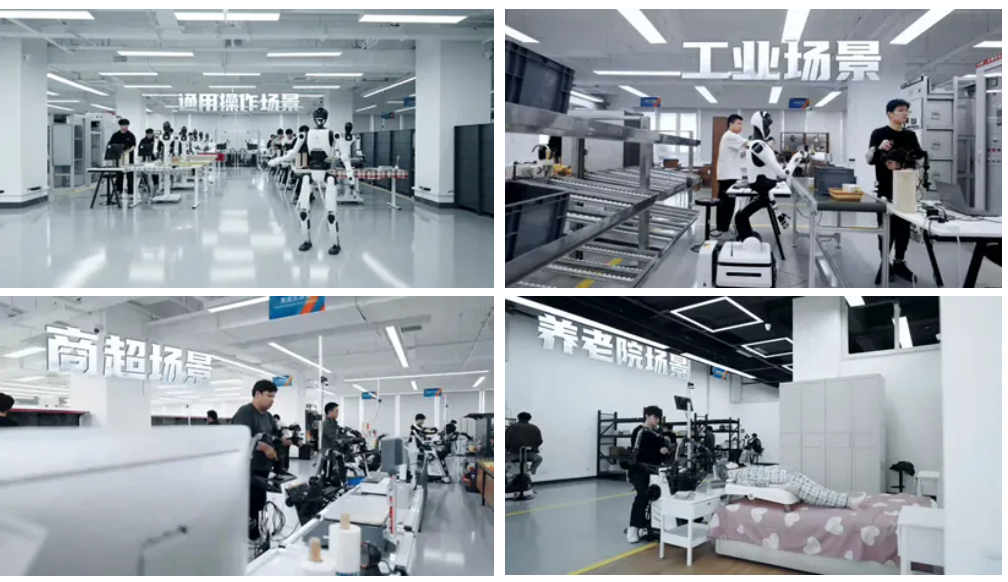
Image Source: Beijing Release
Encouragingly, this awareness is translating into national policy action.
In early June, the MIIT and the State-owned Assets Supervision and Administration Commission (SASAC) issued a notice launching the "2026 Special Action for Real-Scenario Training of Humanoid Robots and Embodied Intelligence." The plan aims to complete application verification and normalized deployment of key products like humanoid robots in representative scenarios by the end of 2026, identifying over 100 high-value application scenarios and driving a deployment capability of over 10,000 units.
Dong Kai interprets the policy's underlying logic: First, embodied AI deployment can't be done by a single company; it requires someone to provide access to application scenarios. Since many high-quality scenarios are held by state-owned units and central enterprises, the primary goal is to encourage these entities to provide access.
Second, moving from "individual effort" to "collaborative effort." Many companies only conduct POCs or demo videos because products aren't engineering-mature. This action aims to unite different players to actually deploy innovative robots in scenarios and tackle industrialization challenges together.
But having the right direction doesn't mean the road is easy.
In Dong Kai's view, China's embodied AI industry still faces multiple shortcomings: a lack of full-chain R&D support systems, insufficient consistency in mass production, and a severe shortage of innovative application service providers.
Based on this, Dong Kai offers a counter-intuitive take: "The capital market currently values model and robotics body makers the highest, but the first to realize industrialization profits will be the application delivery agents who bridge the last mile."
The implication is that as the industry shifts from "competing for funding" to "competing for deployment," those who can actually install robots on production lines, streamline processes, and generate efficiency will capture the first wave of benefits.
This gap is currently significant, which also makes it the biggest opportunity.
Conclusion
Embodied AI is experiencing a significant disconnect: capital is pricing the sector as if on the "verge of a boom," while the industry is progressing at a pace of "at least another two to three years."
The divergence between the two is both a breeding ground for bubbles and a catalyst for innovation.
When speculation and rationality act simultaneously on a sector that hasn't yet closed its business loop, no one can predict the outcome precisely. But one thing is certain: in this marathon, the fastest runner doesn't always win.


