Gasgoo Munich- Lithium carbonate prices have surged from their 2025 low of around 75,000 yuan per ton to top 180,000 yuan in the first quarter of 2026 — a gain of more than 100%.
A lithium price slump that lasted more than two years is finally over. Yet the thaw isn't triggering a universal rally across the industry; instead, it's creating an increasingly sharp divide between winners and losers.
Who's Winning: The Logic Behind the Q1 Results
The first quarter of 2026 painted a starkly contrasting picture for the top and bottom of the lithium battery supply chain.
Upstream resource companies have emerged as the biggest beneficiaries of this cyclical recovery.
Tianqi Lithium projects a net profit of 1.7 billion to 2 billion yuan for the quarter — a massive year-on-year surge of 1,530% to 1,818%. That single-quarter haul is already nearly four times its total profit for all of 2025.
Ganfeng Lithium anticipates swinging back to profitability with net income of 1.6 billion to 2.1 billion yuan, reversing a 356 million yuan loss from the same period last year. Salt Lake Industry, meanwhile, posted a 147.44% jump in first-quarter profit to 2.939 billion yuan.
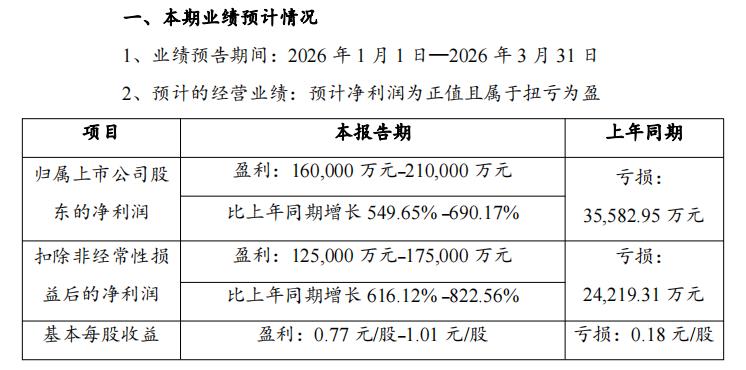
Image Source: Ganfeng Lithium
Even Canmax Technologies, which lacks its own lithium mines, is forecasting a staggering increase of more than 275 times in first-quarter profit, potentially hitting 1.05 billion yuan.
Downstream battery giants are also putting up impressive numbers.
CATL generated 129.1 billion yuan in revenue in the first quarter, up 52.45% from a year earlier, while net profit climbed 48.52% to 20.738 billion yuan — roughly 230 million yuan in daily earnings. Combined sales of power and energy storage batteries topped 200 GWh, giving it a 47.7% share of China's power battery installations, an increase of 3.4 percentage points.
On the surface, both ends of the supply chain are making money. But the underlying logic couldn't be more different.
For upstream players, much of that explosive growth is built on a foundation of deep losses during the same period last year.
In the first quarter of 2025, the average price of lithium carbonate was just 70,000 to 80,000 yuan per ton. At that time, Ganfeng lost 356 million yuan, and Tianqi's full-year profit was a mere 463 million yuan. Resource companies see their earnings move in lockstep with lithium prices, so a doubling in prices naturally drives the most aggressive profit recovery.
CATL's growth, by contrast, stems largely from market share gains and a boom in energy storage. First-quarter storage battery sales jumped 111.8%, now accounting for a third of total shipments. Notably, however, CATL's gross margin dipped slightly in the quarter — a sign that cost pressures from rising raw materials like lithium carbonate are starting to bite.
Midstream material suppliers find themselves in the toughest spot. Lopal Tech projects a first-quarter profit of 200 million to 250 million yuan — a staggering 870% to 1,063% increase. Yet this marks its first return to profitability since 2023. After three straight years of losses, Ronbay only managed to "climb out of the hole" in the first quarter of 2026. It highlights just how deeply midstream firms were squeezed during the downturn and how much longer it takes them to recover compared with the giants at either end of the chain.
As Ganfeng Lithium put it during an earnings call: "The most valuable indicator is growth in end-market demand. When we analyze the sector, we really look at the two ends — upstream mining and downstream demand. The midstream processing and battery production stages carry less weight because they're subject to significant volatility, and capacity is relatively easier to adjust."
Where to Next: How Companies See the Future of Lithium Prices
The impressive first-quarter numbers are in the books, but the market is asking a different question: How long can this rally last? Across the supply chain, the answer points to a single keyword — tight balance.
At its 2025 earnings briefing, Tianqi Lithium made a clear forecast: the global lithium industry will face a tight balance in 2026. Since the second quarter began, signs of supply strain at the resource end have already started to emerge.
The company noted that because mine construction, restarts, and expansions take far longer than lithium salt processing, supply is set to remain tight through the first half of 2026 — a situation compounded by shifts in the external environment. Mo Ke, founder of Genuine Lithium Research, is even more optimistic. He predicts lithium prices will peak above 200,000 yuan per ton in 2026, adding, "Prices will trend upward in the first half, and the third quarter will likely follow suit."
Ganfeng Lithium echoes that "tight balance" view. The company says that while overall demand growth has been solid this year, the supply side faces numerous challenges, leaving the overall balance of supply and demand on the tight side.
Notably, Ganfeng is looking beyond the immediate market to the broader contest between traditional and new energy. "Current high oil prices could accelerate the replacement of fossil fuels with new energy, further boosting medium- to long-term demand for lithium products," the company said.
Analysis from market research firms suggests lithium supply and demand will remain in a tight balance in 2026, with some forecasts pointing to a supply shortfall of 15,800 tons of lithium carbonate equivalent for the full year.
Image Source: CATL
On the demand side, energy storage is becoming the primary growth engine. CATL revealed during its earnings briefing that following the implementation of domestic policies No. 136 and No. 114, the market positioning and capacity pricing mechanisms for storage have clarified, turning it into an asset class with stable returns. Overseas, demand is getting an extra boost from the boom in AI and data center construction. To secure its supply chain for critical metals like lithium, nickel, copper, and aluminum, the company even established Era Resource Group with 30 billion yuan in registered capital.
From a longer-term perspective, the lithium battery supply chain is undergoing a deep structural reshaping. Upstream companies, having weathered a two-year winter of capacity cuts, are nearing the end of the clearing process, and the scarcity of resources is being repriced. The midstream sector faces the dual pressure of rising costs and intensifying competition — the saga of Ronbay taking three years just to turn a profit serves as a cautionary tale. Downstream battery giants, armed with scale and vertical integration, are the most resilient to cycles, but even they have limits on how much they can absorb rising raw material costs.
Tianqi Lithium's Greenbush spodumene mine CGP3 project commenced trial production in December 2025. With a built capacity of 2.14 million tons per year, it is the world's largest hard-rock lithium project. Domestically, the Yajiang Cuola spodumene mine is advancing steadily, with resources estimated at about 632,400 tons of lithium carbonate equivalent. Ganfeng Lithium continues to bring projects in Australia, Argentina, Mali, and Sierra Leone online, with capacity set to release gradually over the next three years, further boosting its self-sufficiency rate.
The giants are stockpiling ammunition for the next cycle. When prices rise again, those with thicker resource reserves and superior cost structures will be the ones standing firm.