



Gasgoo Munich- China's plug-in hybrid market is undergoing a profound shift in 2026, moving from a policy-driven era to one defined by consumer perception.
As end-users realize that "gas-or-electric" is no longer a gimmick but a daily reality, a more fundamental question surfaces: With battery costs still high and the race for range intensifying, what is the true value anchor for a mainstream family plug-in hybrid SUV? Is it further depressing entry prices, or making the most practical features standard? The Geely Galaxy M7 Yuanhangjia has chosen the latter. On April 28, this plug-in hybrid SUV—with 225 kilometers of pure electric range standard across the lineup—entered the market with a limited-time starting price of 109,800 yuan. It aims to redraw the competitive track using a logic of "value parity" in a market where the price war is showing signs of fatigue.
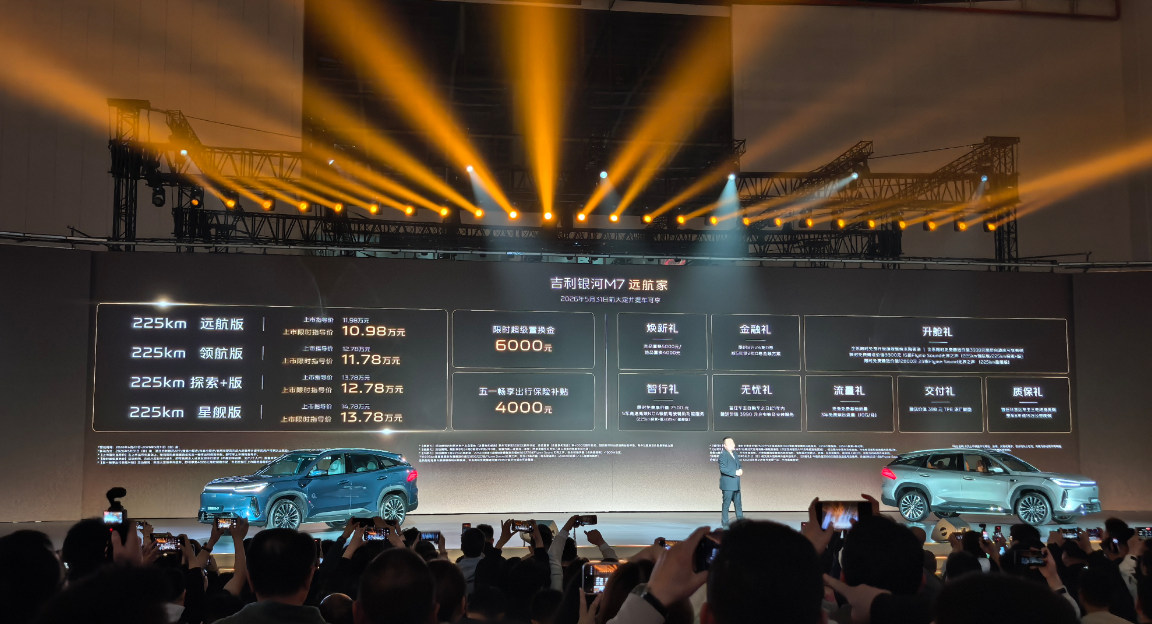
Image Credit: Gasgoo
Making Long Range and Smart Driving Standard Is Not a Compromise, But an Offensive Move
Over the past three years, the competitive script for the 100,000 to 150,000 yuan plug-in hybrid SUV market has been strikingly uniform: use a low-spec model to drag the starting price down around 100,000 yuan to attract traffic, then use high-spec trims to fill the profit margins. The result of this "funnel" strategy is that a vast number of consumers either endure short range and spartan configurations or are forced to pay up for upgrades. The Galaxy M7 Yuanhangjia does exactly the opposite. It has made features previously found only in models costing over 150,000 yuan standard across the lineup: 225 kilometers of pure electric range, highway navigation assist, a 15.4-inch 2.5K central control screen, and the Dragon Eagle-1 chip.
Behind this decision lies a precise insight into the shifting logic of consumer choice. For the vast majority of potential plug-in hybrid buyers, pure electric range is the primary purchasing factor. When a plug-in hybrid can cover a typical family's weekly commute without firing up the engine, the user experience essentially mirrors that of a pure electric vehicle, with the fuel system relegated to the role of long-range insurance.
The Galaxy M7 Yuanhangjia’s standard 225-kilometer pure electric range hits the psychological sweet spot for most plug-in hybrid users.
Even more intriguing is the trickle-down of intelligent driving features. The Qianli Haohan H3 package includes highway navigation assistance, all-scenario automatic parking, and AEB functionality that can bring the vehicle to a stop from speeds of up to 120 kilometers per hour. These were exclusive to the 200,000-yuan class just a year or two ago. Now, by making them standard on a 100,000-yuan vehicle, Geely Galaxy is redefining driver assistance from a premium feature to a basic safety configuration.
When industry leaders start using the standardization of safety features to define the product baseline, followers will face immense pressure on both costs and strategic decisions.
From a supply chain perspective, this "standardization of high-end specs" is not merely a tactic in the price war, but a concentrated demonstration of Geely’s systemic capabilities. The Aegis Gold Brick Battery, the Thor AI Electric Hybrid 2.0, and the GEA Evo architecture are all results of Geely’s in-house development or deep customization. The cost control enabled by vertical integration means the marginal cost of a 225-kilometer pure electric range is far lower for Geely than for competitors relying on outsourced batteries. Furthermore, the scale effect generated by the Galaxy brand achieving 2 million sales in 37 months has further diluted procurement costs for smart cockpits and autonomous driving hardware. The pricing strategy of the Galaxy M7 Yuanhangjia is, in essence, fighting a "value war" that competitors will find difficult to replicate, leveraging both scale advantages and deep R&D.
Clearly, future competition among mainstream plug-in hybrid SUVs will no longer be a single-dimensional race for range, but a comprehensive value contest combining "range + intelligence + safety." Whoever can deliver the most balanced, shortcoming-free experience at the 100,000-yuan price point will have the best chance of truly winning the trust of family users.
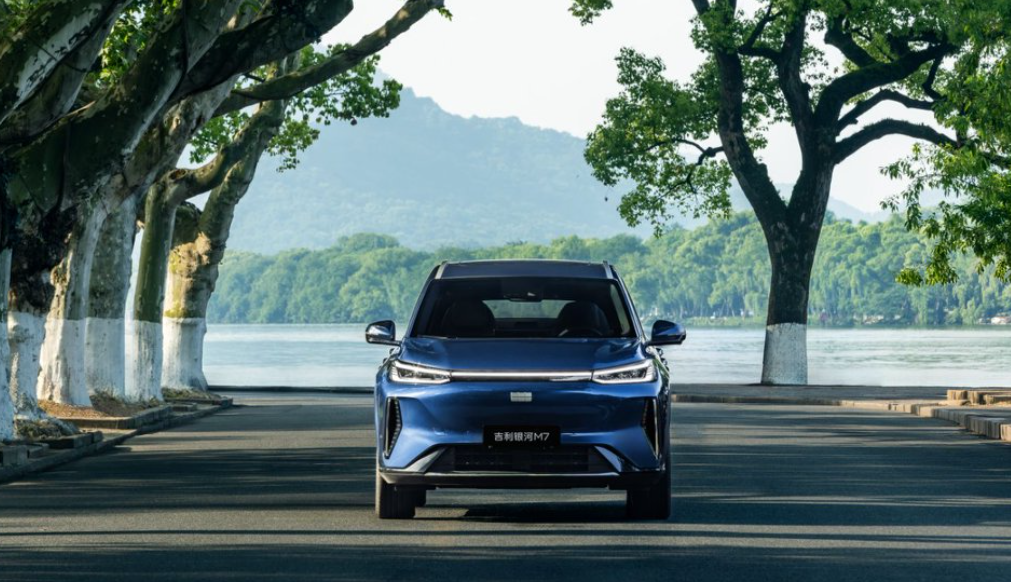
Image Credit: Geely Galaxy
Family Travel Scenarios Are Being Redefined
The true industry value of the Galaxy M7 Yuanhangjia lies not in how many specifications it stacks up, but in its attempt to answer a question that has plagued the plug-in hybrid market for years: Should a plug-in hybrid be primarily gas-based or electric-based?
Early plug-in hybrid models mostly followed a "conversion" mindset, with pure electric ranges of just 50 to 80 kilometers—essentially internal combustion engine vehicles with a battery attached. As battery costs have fallen and energy density has improved, the industry has gradually diverged into two paths: the large-battery, long-range route, and the "extreme electric drive" route represented by extended-range vehicles (EREVs).
The Galaxy M7 Yuanhangjia has chosen the former, pushing the status of "electricity" to unprecedented heights.
With 225 kilometers of pure electric range, 1,730 kilometers of comprehensive range, and a fuel consumption of 3.35 liters when the battery is depleted, this set of data fundamentally reconstructs the usage model for family users. Calculating based on a daily commute of 40 kilometers, 225 kilometers means absolutely no charging is needed during the five-day work week, and weekend trips around the city are also covered. Meanwhile, the 1,730-kilometer comprehensive range allows for a trip from Beijing to Shanghai without needing to refuel. More importantly, a 30% to 80% fast charge takes just 15 minutes. This means that even without home charging, a quick meal is enough to recover approximately 135 kilometers of range.
This combination does more than just eliminate range anxiety; it shatters the stereotype that plug-in hybrids are "troublesome to charge and inefficient without charging."
Data on handling and safety dimensions is equally worth exploring. A moose test speed of 81 kilometers per hour and a braking distance of 35.6 meters from 100 kilometers per hour are uncommon for a family SUV over 4.7 meters long. Behind this lies the low-center-of-gravity design of the GEA Evo architecture and the application of AI virtual tuning technology.
In traditional perception, handling is often ranked behind space and comfort for family SUVs. However, the Galaxy M7 Yuanhangjia’s engineering team clearly believes that emergency avoidance capability and braking safety are implicit necessities for family travel. Similarly, safety designs such as the Star Armor cage body, 1,500 MPa hot-formed boron steel door rings, and rear seat steel plates all point to a product philosophy that "passive safety should not be compromised due to price." These configurations—unobtrusive in specification tables but potentially life-saving in real accidents—are precisely the dimensions that family users should care about most but often overlook.
In terms of market landscape, the 100,000 to 150,000 yuan plug-in hybrid SUV segment where the Galaxy M7 Yuanhangjia resides is one of the most fiercely competitive arenas in China's auto market today. Models like the BYD Song Pro DM-i, Haval Xiaolong, and Changan Deepal S7 are all positioned here. However, the Galaxy M7 Yuanhangjia’s differentiation strategy lies in not attempting to outperform rivals on every dimension. Instead, it has pushed the limits on the three pain points family users care about most—daily running costs, long-range anxiety, and safety confidence—while standardizing intelligent features to lower the user's decision cost. This strategy of "picking battles" makes it easier to form a clear brand perception in a market overloaded with information.
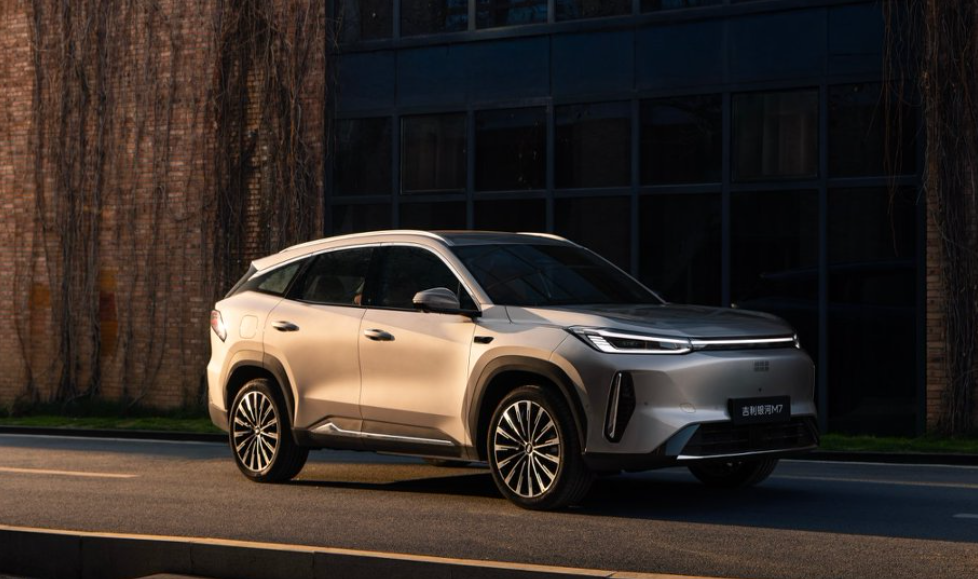
Image Credit: Geely Galaxy
Summary: Taken as a whole, the Geely Galaxy M7 Yuanhangjia is not a disruptive product, but it has precisely tapped into the rhythmic shift of the plug-in hybrid market from the early adoption phase into the mass adoption phase.
As more and more family users begin to evaluate plug-in hybrids based on the real-world usage scenario of "pure electric commuting plus fuel for long distances," whether a product can provide an anxiety-free daily experience is far more persuasive than the numbers on a specification sheet. The value of the Geely Galaxy M7 Yuanhangjia lies precisely in using standard long-range and intelligent features across the lineup to turn "anxiety-free" from marketing rhetoric into tangible product capability. That may well be the true source of its confidence to break through in such fierce competition.


