



Gasgoo Munich-On April 8, XPENG CEO He Xiaopeng took to social media to announce that the all-new flagship SUV, the GX, had "finally arrived." In He's telling, G stands for Greatness and X for Exploration. The car is defined as XPENG's "technological masterpiece for the Physical AI era," a "super intelligent agent" that will "define the benchmark for the next generation of tech flagships."
The GX didn't appear out of thin air. From its initial announcement in February 2026 to the exposure of undisguised prototypes and filing images in March, followed by He's latest Weibo update on April 8, the silhouette of this large six-seat flagship SUV has come into sharp focus. Its positioning, specifications, and technological origins are now largely public knowledge.
A First Look at the XPENG GX
Based on available information, the XPENG GX is a substantial vehicle. Measuring 5,265mm long, 1,999mm wide, and 1,800mm tall with a wheelbase of 3,115mm, it sits squarely in the full-size large SUV category.
Inside, it features a 2+2+2 six-seat layout, emphasizing a spatial experience where "every seat is center stage and every row can recline." The goal is to maintain ample trunk space even when carrying six passengers.
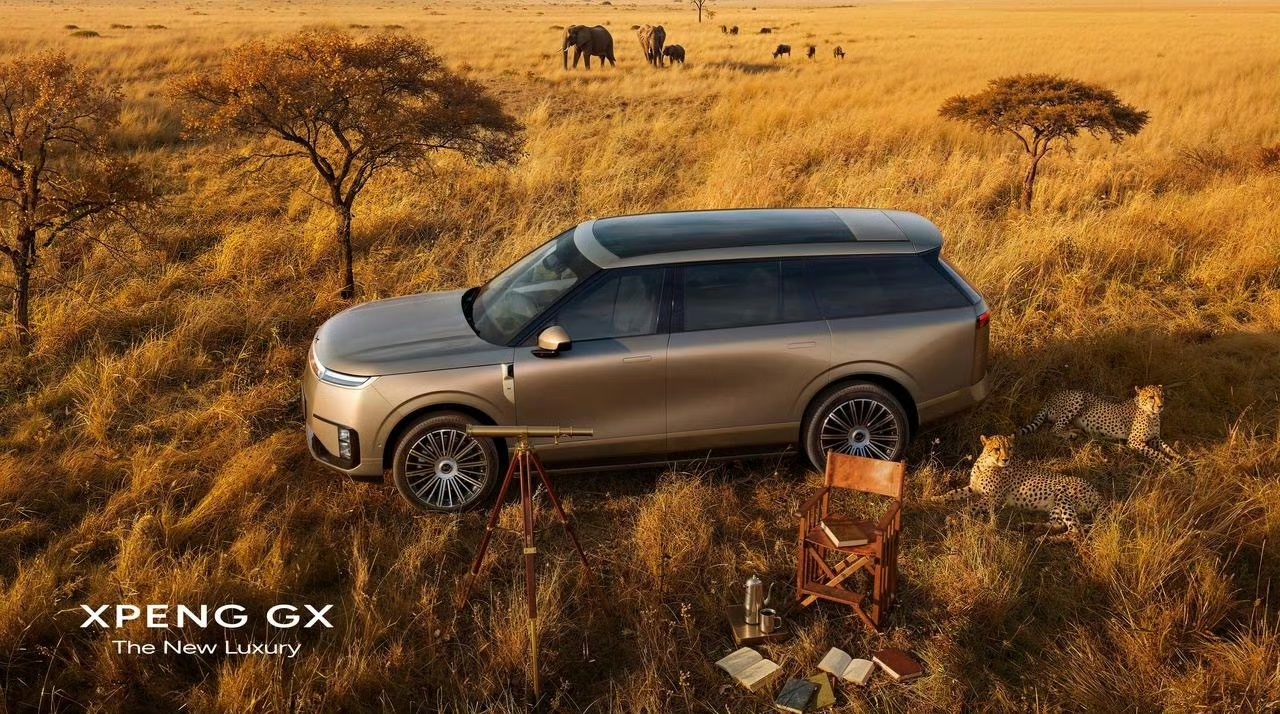
Image Source: XPENG
Powertrain options include both range-extended (EREV) and pure electric versions. The EREV variant uses a 1.5T range extender with dual motors, offering 320km of pure electric range (CLTC) and a total range exceeding 1,200km. The pure electric version features dual-motor all-wheel drive with a maximum output of 430kW. Built on an 800V high-voltage platform with 5C super-charging AI batteries, it boasts a CLTC range of up to 750km and can recover 500km of range in just 15 minutes.
The GX's core technological strengths center on intelligent driving and the chassis. It carries four in-house-developed Turing AI chips, delivering effective local computing power of up to 3,000 TOPS.
On the intelligent driving front, the GX adopts technology derived from XPENG's Robotaxis. These vehicles utilize the second-generation VLA model, marking a shift from a three-stage "Vision-Language-Action" architecture to an end-to-end "Vision-Action" direct link. This compresses system response latency to under 80 milliseconds and boosts inference efficiency by 12 times.
A Robotaxi version of the GX has secured a road testing license for intelligent connected vehicles in Guangzhou and is currently undergoing regular L4 autonomous driving tests on public roads.
For the chassis, the GX marks the global production debut of Bosch's next-generation steer-by-wire system. Eliminating the traditional mechanical steering shaft, it relies on pure electronic signals for millisecond-level command transmission, making it natively compatible with L4 autonomous driving requirements.
Combined with active rear-wheel steering, the agility of this large SUV—measuring over 5.2 meters—is significantly improved for city driving. Meanwhile, the steer-by-wire system frees up roughly 20% of space in the front cabin, opening up new possibilities for overall vehicle layout optimization.
On the safety front, the GX incorporates redundancy technology borrowed from flying cars. XPENG AeroHT's "Land Aircraft Carrier" employs a full-domain safety redundancy scheme covering critical systems like propulsion, energy, high- and low-voltage power, flight control, and bus communications. With a six-axis, six-propeller, dual-duct configuration, it can land safely even if a propeller fails.
Furthermore, the GX utilizes chips and architecture derived from embodied intelligence. These advancements stem partly from XPENG's robotics work—the new generation IRON humanoid robot integrates the second-generation VLA tech stack and runs on three Turing AI chips—and partly from the company's continued investment in the underlying architecture of Physical AI.
In 2026, XPENG plans to raise its R&D investment in Physical AI to 7 billion yuan, simultaneously pushing the commercialization of Robotaxis, humanoid robots, and flying cars. As a product integrating these cutting-edge technologies, the GX effectively concentrates XPENG's technical reserves from multiple forward-looking fields into a mass-production vehicle.
Overall, the XPENG GX aims to set a new benchmark above current mainstream flagship SUVs across four dimensions: intelligent driving capability, chassis handling, safety redundancy, and computing power.
Why Launch the GX?
XPENG's launch of the GX is not a simple expansion of its product line. Viewed alongside the XPENG Group's overall strategic direction for 2026 and its corporate rebranding, the GX serves a threefold purpose.
First, the GX acts as a "flagship carrier" for XPENG's transformation from an automaker to a Physical AI technology group. On April 1, 2026, XPENG Motors officially rebranded as XPENG Group, shifting from a vehicle manufacturer to a "Physical AI technology group."
He Xiaopeng has repeatedly emphasized that while XPENG's core business over the past decade was automobiles, the next decade will usher in a Physical AI era defined by "new energy vehicles combined with intelligent agents, robots, and flying cars."
The GX's positioning and configuration are almost a concrete enactment of this strategy: its intelligent driving tech comes from Robotaxis, its safety redundancy from flying cars, and its chip architecture from embodied intelligence.
In other words, the GX is no ordinary flagship SUV. It is the product of XPENG integrating technical capabilities from its four major Physical AI applications—second-generation VLA, Robotaxis, humanoid robots, and flying cars—into a single passenger vehicle.
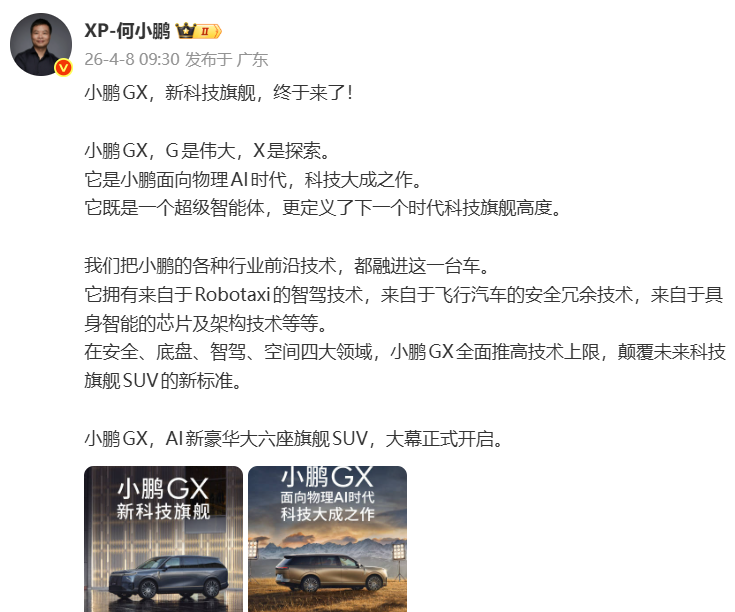
Image Source: He Xiaopeng's Weibo
The core significance of this car lies not in how many units it sells, but in proving to the market that XPENG's technological reserves are not isolated experiments scattered across different business lines. Instead, they are cross-domain reusable assets capable of forming a systematic competitive advantage.
Second, the GX is a strategic product designed to fill a gap in XPENG's lineup and face off in the premium SUV segment. For a long time, XPENG's core models have been concentrated in sedans and mid-size SUVs, lacking a large six-seater for multi-child or three-generation families. Yet the large six-seat SUV market is currently one of the fastest-growing segments in the new energy sector.
During previous research, He Xiaopeng discovered that three-row SUVs on the market today suffer from three common pain points: a cramped third row, insufficient luggage space when fully occupied, and poor handling due to a heavy body. These three form an industry "impossible triangle." The GX aims to break this triangle by finding a solution that balances space, comfort, and handling.
Judging by the current specifications, the AI chassis featuring steer-by-wire and active rear-wheel steering is the technological answer to the "hard-to-drive big car" problem. Meanwhile, the length of over 5.2 meters and rational space planning aim to address the riding and storage needs of families.
Third, the GX is a key variable in XPENG's quest for higher margins and improved financial performance. In the first quarter of 2026, XPENG delivered 62,700 vehicles, a year-on-year decline of 33.32%, putting it under pressure among major new EV makers.
He Xiaopeng has previously stated clearly that "making cheap, low-margin cars holds no value," and XPENG will not touch vehicles priced under 100,000 yuan. This implies XPENG needs to achieve better profitability in the mid-to-high-end market.
Currently, the MONA M03, priced between 120,000 and 150,000 yuan, is the main model supporting XPENG's volume. While it drives sales, its profit margin is limited. As a flagship SUV expected to be priced above 350,000 yuan, the GX holds far greater profit potential per unit than entry-level models.
Additionally, XPENG's service and other revenue grew 65.6% year-on-year in 2025 to 8.34 billion yuan, with a high profit margin of 68.2% in related businesses. A key component of this is technical R&D services in partnership with Volkswagen. The core technologies carried by the GX, such as the Turing AI chip and VLA intelligent driving model, also hold potential for future technology export and monetization. This means the GX is not just a car to be sold, but a "sample" showcasing XPENG's technical capabilities to the outside world for commercialization.
In summary, the XPENG GX is a critical step in the XPENG Group's strategic transformation from concept to product. It concentrates technical capabilities accumulated in Robotaxis, flying cars, and humanoid robots into a mass-production SUV, attempting to establish a differentiated competitive advantage in the premium large six-seat SUV market while improving the company's profit structure.
Whether this car succeeds will largely determine the market's confidence in XPENG's Physical AI strategy, and will directly influence XPENG's ability to gain a foothold in the premium SUV market.


