



Gasgoo Munich-Gasgoo has learned that Li Liyun, a leading figure in China's intelligent driving sector, has officially joined ENGINEAI Robotics as Chief Technology Officer.
A multidisciplinary scientist with expertise spanning autonomous driving, AI large model development, and industrial-scale mass production, Li previously served as a Vice President at XPeng. There, he spearheaded the autonomous driving team's AI-driven transformation and organizational upgrade, integrating product and technology.
Prior to that, he held core technical roles—including technical architect and senior expert—at LinkedIn's U.S. headquarters, Baidu's U.S. Apollo team, and JD.com's JDX Smart Logistics Laboratory. Throughout his career, he witnessed the industry's evolution from rule-based systems to the era of AI large models.
His appointment marks a strategic leap for Zhenqiang, shifting its focus from building humanoid robots known for physical prowess to achieving deep synergy across the "body, cerebellum, and embodied brain."
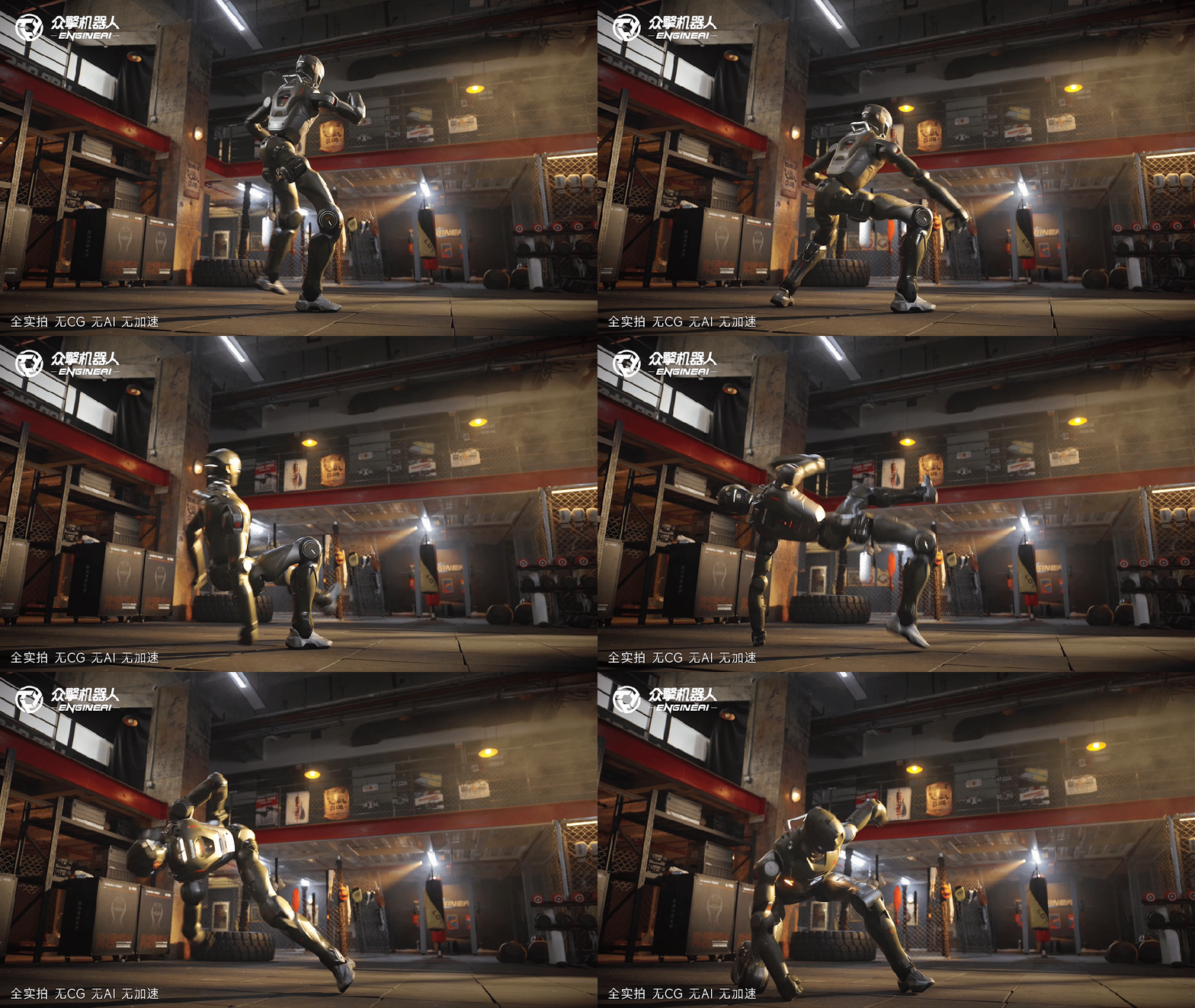
Image Credit: ENGINEAI Robotics
Looking ahead, Li will oversee the full lifecycle of Zhenqiang's embodied intelligence technology—ranging from frontier scientific exploration and product definition to engineering system construction and large-scale deployment. By introducing mature "industrial AI" strategies, efficient data flywheels, and robust engineering capabilities from the autonomous driving sector into the embodied intelligence track, he aims to accelerate the development of a fully integrated architecture. This architecture will feature native multimodal driving, coordination between the "large and small brains" and nerve endings, and a "model factory" capable of continuous evolution.
To date, Zhenqiang has rolled out a suite of products, including the lightweight companion SA02, the PM01 humanoid, and the full-size general-purpose T800. This creates a tiered product portfolio spanning various forms—from bipedal to full humanoid—and sizes, as the company gradually penetrates typical application scenarios like inspection and industrial manufacturing.
Meanwhile, Zhenqiang is accelerating the construction of a world-class embodied intelligence hardware platform. Two production lines with 10,000-unit capacity are steadily advancing, while a smart manufacturing base designed for an annual capacity of 100,000 units is now underway—laying the groundwork for mass production.


