



Gasgoo Munich-On September 8, the Passenger Car Market Information Joint Committee of the China Automobile Dealers Association (hereinafter referred to as "CPCA") officially released national passenger car market data for August 2026.
Data shows that retail sales nationwide reached 1.541 million units, a 23.6% year-on-year drop but a 5.5% monthly increase, signaling signs of a sequential recovery. Cumulative retail sales from January to August stood at 11.716 million units, down 20.8% year-on-year, with the broader market still hovering at low levels.

Image Source: CPCA
The real story lies in the internal structure. Retail sales of internal combustion engine (ICE) vehicles plunged over 40% year-on-year in August, with pure ICE models sliding 45%. Meanwhile, new energy vehicle (NEV) retail sales hit 1.005 million units, pushing the penetration rate to 65.2%—yet another historic high.
On one side, ICE vehicles continue to recede; on the other, NEV penetration has hit a new high even as supply expands. Far from slowing down, the "fuel-to-electric" shift in August accelerated noticeably.
The gap is widening across almost every dividing line: between domestic and joint ventures, between pure electric and plug-in hybrids, and between high-end and entry-level segments.
How exactly did the auto market navigate this off-season in August? And how much substance will the upcoming "Golden September" hold? Let's break down the data.
Domestic Brands Near 70%, Joint Ventures Plunge Over 30%
Let's start with the monthly rhythm.
Looking at the daily trend, the sales curve started low and ended high. High temperatures during the first half of the month clearly dampened consumers' willingness to visit dealerships. The Chengdu Motor Show later in the month rallied the crowds, and as manufacturers pushed for volume at month-end, daily retail sales were gradually pulled back into a recovery channel.
Camp differentiation was the most prominent theme in August. According to CPCA data, domestic brands retail sales reached 1.08 million units, down 19% year-on-year but up 4% month-on-month. Their share of the domestic retail market hit 69.9%, an increase of 4.1 percentage points year-on-year. Although slightly lower than July's 71%, the difference is negligible.

It is worth noting that domestic brand sales themselves are slipping, yet their share is rising against the trend. The reason is simple: the joint venture camp has fallen even deeper.
Domestic brands are being propped up by two legs: "NEVs plus exports." In August, domestic automakers' wholesale sales reached 1.822 million units, up 5% year-on-year, while production grew 4%. This makes them the only segment among domestic, joint venture, and luxury camps to achieve positive growth in both production and sales.
The joint venture camp is in a much tougher spot. Retail sales for mainstream joint venture brands stood at 310,000 units in August, a 35% year-on-year plunge but a 5% monthly increase. By origin, German brands held a 12.5% retail share, down 2.1 percentage points year-on-year; Japanese brands held 10.9%, down 1.4 percentage points; and American brands held 5.6%, down a marginal 0.04 percentage points—essentially flat.
The joint venture volume base has always been ICE vehicles, which are currently absorbing a severe shock from high fuel prices. Domestic gasoline prices have cumulatively risen by more than 1,720 yuan per ton this year alone, with an increase of 180 yuan since the end of July, keeping ownership costs stubbornly high.
This round of impact does not discriminate by camp: In August, ICE sales for domestic brands dropped 45%, mainstream joint ventures fell 40%, and luxury brands declined 33%. Almost everyone is under pressure.
However, joint ventures are not without bright spots. According to CPCA data, retail sales of NEVs from mainstream joint venture brands jumped 35% year-on-year in August. The retail penetration rate for NEVs rose to 13.4%, with wholesale penetration reaching 15.7%.
After years of growing pains, giants like Volkswagen, Toyota, and GM have finally shifted more resources toward electrification, and the results of catching up are starting to show. But in terms of absolute volume, joint venture NEVs still account for only 4.3% of the total NEV retail market—not enough to reverse the decline of their ICE foundation.
The CPCA also noted that some low-volume joint venture automakers are gradually regaining vitality—a marginal signal that is easily overlooked.
The luxury market is also undergoing adjustment. Luxury retail sales reached 150,000 units in August, down 26% year-on-year but up 22% month-on-month. The retail share stood at 10%, down only 0.3 percentage points year-on-year. As sticker prices for luxury cars return to a reasonable range, the year-on-year decline in share has narrowed significantly.
As domestic retail faces overall pressure, exports have taken on the role of stabilizing production capacity. In August, passenger vehicle exports (including complete vehicles and CKD) reached 888,000 units, a 77.8% year-on-year surge, accounting for 38% of total manufacturer sales—up from just 20% in the same period last year. Of this, domestic brands exported 780,000 units, up 82%, while joint venture and luxury brands exported 108,000 units, up 53%.
It is precisely this export floor that lifted manufacturer wholesale sales to 2.353 million units in August, a decline of only 5.3% year-on-year—18.3 percentage points higher than the retail growth rate. The production side remains more cautious: 2.348 million units were produced in August, down 4.5% year-on-year. The industry has drawn down 730,000 units of inventory over the first eight months of the year, as manufacturers generally produce to order, slowly digesting channel pressure.
The temperature gap on the manufacturer leaderboard is even more stark. On the retail side, BYD led with 234,000 units, followed by Geely in second place with 171,000. Chery and Leapmotor took third and fourth with 87,000 and 85,000 units respectively, with Leapmotor surging 63.9% year-on-year. Changan ranked fifth with 80,000 units, while FAW-Volkswagen and SAIC-Volkswagen slumped 36.8% and 42.7% respectively.

Image Source: BYD
On the wholesale side, the number of manufacturers selling over 100,000 units monthly rose to seven, collectively capturing 59.1% of the share. Head concentration continues to rise. Beneath the surface of domestic brands approaching a 70% share lies a deep shuffling occurring both between camps and within them.
NEVs Hit 65%, ICE Vehicles Contract by 40%
The sharpest contrast in August comes from the diverging paths of the fuel and electric curves.
According to CPCA data, retail sales of new energy passenger vehicles reached 1.005 million units in August, down 10.1% year-on-year but up 5.7% month-on-month. The retail penetration rate hit 65.2%, an increase of 9.9 percentage points year-on-year, marking yet another historic high.

Image Source: CPCA
The ICE side, by contrast, was much colder. Retail sales for conventional ICE vehicles stood at 540,000 units in August, down 40% year-on-year. Pure ICE models slid 45%, while ordinary hybrid vehicles actually grew 10%—one of the few segments still growing within the ICE camp. In August, wholesale sales of ordinary hybrids reached 107,000 units, up 54% year-on-year, with FAW Toyota and GAC Toyota remaining the main players.
Why did NEV retail sales also drop year-on-year? Aside from the high base number, weakness in the entry-level segment is the most direct drag.
According to CPCA data, wholesale sales of A00-class pure electric vehicles were only 61,000 units in August, down 51% year-on-year. While this volume accounts for just 6% of pure electric wholesale, its share plummeted by 9.3 percentage points year-on-year. With subsidy adjustments and insufficient purchasing power among low-income groups, the old strategy of relying on low-priced micro EVs to drive volume has clearly lost its edge.
The CPCA has repeatedly emphasized that only when entry-level electric vehicles are truly popularized can the auto market gain sustainable growth. That shortcoming remains glaringly obvious.
Unlike the sluggish retail side, the supply side is heating up. In August, wholesale sales of new energy passenger vehicles reached 1.51 million units, up 16.4% year-on-year; production reached 1.528 million units, up 19.2%; and exports hit 518,000 units, soaring 154.7%. The combined force of domestic retail, overseas exports, and manufacturer stockpiling has propped up production levels that feel quite different from the sentiment at the terminal.
Technology routes are also shifting positions. In August, pure electric wholesale sales reached 1.032 million units, up 25.9% year-on-year, accounting for 68.3% of NEV wholesale sales—an increase of 5.3 percentage points. Plug-in hybrids (PHEV) reached 386,000 units, a slight increase of 3.1%, taking a 25.6% share. Extended-range electric vehicles (EREV) totaled 93,000 units, down 10.9%, with their share falling back to 6.1%. August overall presented a pattern of "pure electric strong, extended-range weak."
Regarding the future battle between technology routes, Cui Dongshu, head of the CPCA, offered a clearer long-term judgment in an interview: "August data shows pure electric vehicles already account for 68.3% with leading growth. Long-term, pure electric remains the mainstream. With battery costs falling and charging infrastructure improving, the pure electric share is expected to steadily rise to 70% to 75%. Plug-in hybrids, as a transition and supplement, may stabilize around 20%, while range extenders stay within 10%."
In his view, plug-in hybrids and range extenders still have a market in areas with poor charging infrastructure and for long-distance travel, but their long-term share will gradually concentrate toward pure electric. Overseas markets follow a different logic; plug-in hybrids and range extenders still have room due to their environmental friendliness—"Li Auto's hot sales in Russia are an example of this overseas electrification preference strategy."
The internal ranking of NEVs is also fine-tuning. In August, domestic brand NEV retail sales fell 11% year-on-year, while mainstream joint ventures grew 35% and luxury brands fell 12%.
In terms of NEV retail share, domestic brands held 63.7%, down 6.1 percentage points year-on-year; new forces held 26%, up 5.5 percentage points, driven significantly by Leapmotor and NIO.

Image Source: Leapmotor
Among new force models, the pure electric share rose to 78.2%, with volume growing rapidly in the 100,000 to 150,000 yuan range. "Second-generation" brands incubated by traditional large groups—such as ZEEKR, Deepal, Arcfox, and Voyah—reached a combined share of 15.1%, up 2.3 percentage points, making them a vital force within the domestic camp.
At the corporate level, 19 manufacturers saw wholesale NEV sales exceed 10,000 units in August, accounting for a combined 93.6% share. BYD firmly held the top spot with 432,700 units, followed by a second tier consisting of Geely (173,700 units), Chery (115,200 units), and Leapmotor (103,100 units).
On the export front, BYD's monthly exports alone reached 184,400 units, while Geely and Cherry each neared 70,000 units. A00- and A0-class small cars accounted for 56.5% of pure electric exports, as high-value entry-level models are prying open the Global South markets.
The flip side of record penetration rates is that the elimination race within the NEV sector is accelerating: In August, only 19 manufacturers surpassed the 10,000-unit wholesale mark, two fewer than last year. Players without a foundation in technology and scale cannot even share in the dividends of industry growth.
September Market: How Golden Is "Golden September"?
After bottoming out in August, September has always been the turning point where the auto market shifts from slack to busy.
The CPCA points out that the traditional "Golden September, Silver October" is now underway, combined with end-of-quarter manufacturer pushes, terminal traffic is expected to continue warming up.
The low-start, high-end trend of August and the month-end push have already built up some momentum for September. The agency expects the dealer satisfaction rate for August, to be released in mid-September, to improve from July's low of 17%.
However, high base numbers are unavoidable pressure. In September 2025, a rush to buy swept parts of the country before subsidies were halted, pushing that month's retail sales to a historical peak. Achieving year-on-year growth this September on such a base is understandably difficult.
The macroeconomic picture is only weakly stabilizing: According to data from the National Bureau of Statistics, the manufacturing PMI rose 0.6 points to 49.8 in August, still below the boom-bust line. While domestic demand is recovering, the momentum is limited.
The CPCA's judgment is relatively restrained: September is expected to continue its sequential recovery, and as the effect of the ultra-high base gradually fades, the year-on-year decline will narrow significantly. In other words, the upward direction is not in doubt, but the process will be gradual.
The gap between fuel and electric will continue to widen. High oil prices continue to suppress ICE demand, while the appeal of new electrified products strengthens, so the "fuel-to-electric replacement" will keep advancing.
The agency expects the NEV penetration rate to operate above 65%, a high level, while ICE consumption willingness remains suppressed. The market will further contract into a few essential need scenarios, gradually becoming a niche supplement.
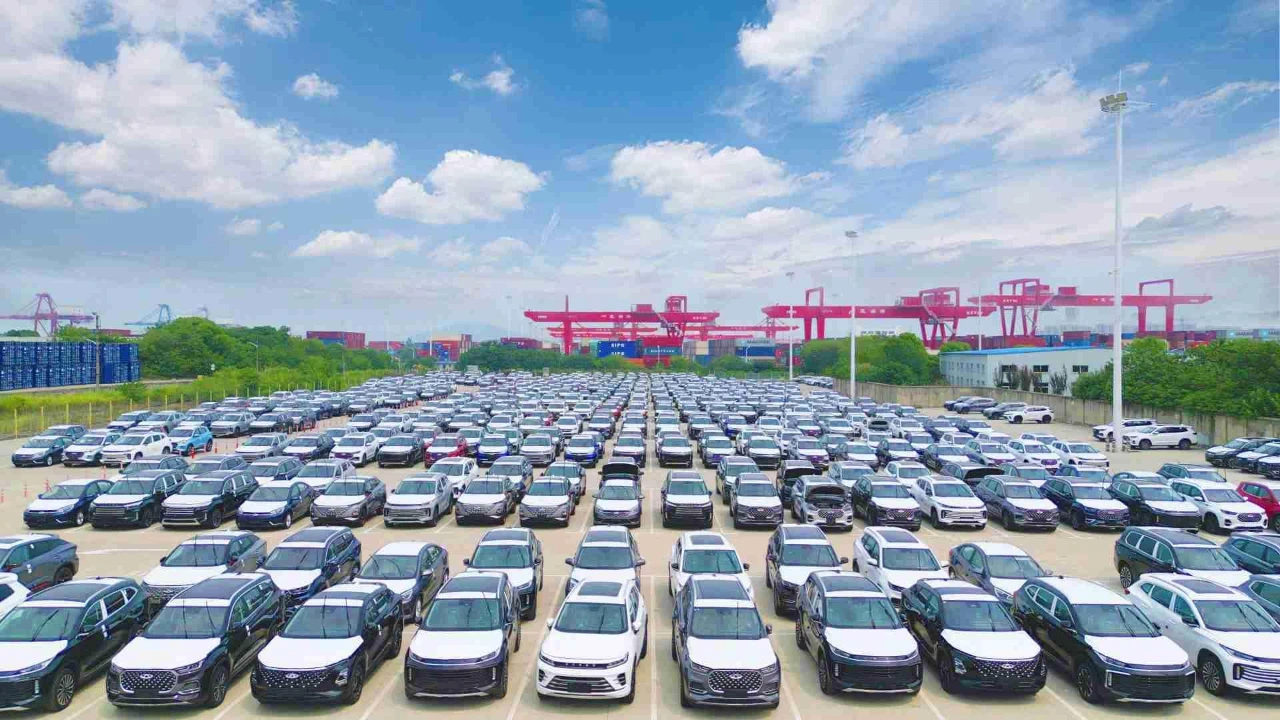
Image Source: Chery
It summarizes current consumption with three characteristics: first, high oil prices continue to catalyze fuel-to-electric replacement; second, replacement demand is squeezing out first-time buyer demand; and third, a new consumption driven by intelligent driving is forming. This means that even if total volume warms in September, structural differentiation will persist.
Policy is the most practical support in September. This year, trade-in subsidies continue to gain strength, with the payout rhythm expected to be low at first and high later. Many local governments will further increase support in September, directly driving terminal transactions.
Meanwhile, the industry's move against "involution" (excessive competition) is deepening. Upstream raw material prices have retreated somewhat, and the main line of competition is shifting from price wars to value wars.
According to Cui Dongshu, only 10 models announced price cuts in August, 13 fewer than last year—signs that the price war is indeed cooling. With new national safety standards for NEVs raising technical barriers, compliant products are iterating faster, and models relying on low prices and low quality to drive volume will continue to be squeezed out of the market.
Intelligent features are another clear key trend. With the release of assisted driving and L3-level autonomous driving standards, and the revision of Road Traffic Safety Laws regarding intelligent driving underway, smart driving is shifting from a "novelty feature" for the few to a "standard configuration" on more models.
The CPCA judges that smart driving is becoming the third major decision factor for consumers after range and charging. Attention to high-end smart driving models will continue to convert into actual orders. Additionally, the trend toward larger EVs combined with National Day travel suggests that large pure electric and plug-in hybrid models will benefit around October. Progress in fast-charging technology is also driving the acceleration of pure electrification in A-class cars.
Beyond the hustle, the industry's difficulty in making money hasn't eased. Data shows that from January to July 2026, the auto industry's revenue was 6.078 trillion yuan, up 2.7% year-on-year, while profit was 216.2 billion yuan, down 20%. The industry profit margin was only 3.6%, far below the 6.5% average of downstream industrial enterprises. In July alone, the profit margin was just 2.4%.
With upstream cost squeezing and terminal price battles, automakers are under pressure from both sides. This situation won't be completely reversed by just one "Golden September."
Overall, this year's "Golden September" is more likely to be a structural one: Sequential improvement is worth anticipating, but a broad rally is no longer in the cards. The wholesale side, buoyed by exports and quarter-end pushes, will remain significantly stronger than the retail side. NEVs, smart driving, high-end models, and going overseas are four relatively certain main themes, while ICE vehicles and the entry-level market must continue to endure.


