Gasgoo Munich-Themed "Leading the Era, Intelligence for the Future," the 2026 Beijing Auto Show runs from April 24 to May 3 at the China International Exhibition Center (Beijing). It has attracted over 2,000 companies from 21 countries and regions, featuring a display area of 380,000 square meters, 1,451 vehicles, including 181 global debuts and 71 concept cars. Based on on-site research and comprehensive analysis, Gasgoo Auto has compiled this summary report with the following core insights:
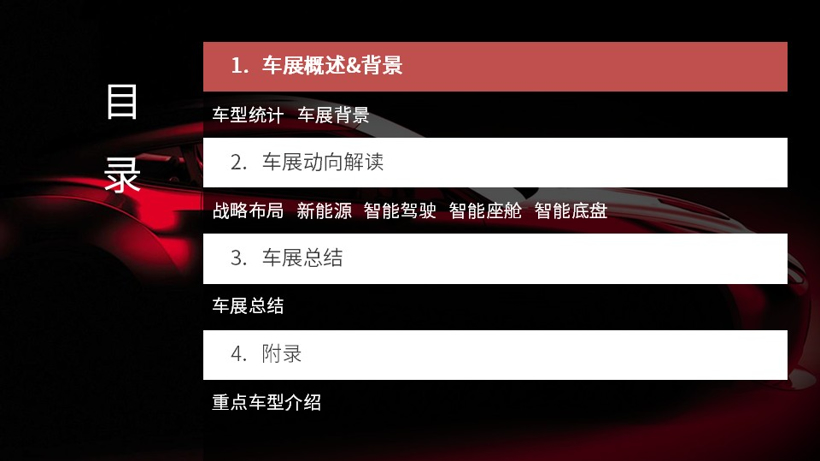
Automaker Strategic Layout Progress
1. Foreign brands fully reconstruct competitiveness through localization. The Volkswagen Group is launching its largest-ever NEV offensive, increasing investment in E/E architecture, AI intelligence, and China-specific technology foundations. It is shifting its "In China, for China" strategy from slogan to delivery. By leveraging joint ventures FAW-VW, SAIC-VW, and Volkswagen Anhui, the group aims to build a differentiated, all-encompassing product portfolio, upgrading China from a "regional market" to a global hub for innovation and decision-making.
The German luxury legion led by BMW, Mercedes-Benz, and Audi unveiled representative models like the BMW New Class, the all-new GLC EV, the CLA 300 L long-range edition, and the AUDI E7X. By devolving R&D, product definition, and procurement authority to their China teams, these luxury automakers are poised to turn their Chinese R&D centers into global technology export hubs.
Foreign players including Dongfeng Nissan, Dongfeng Peugeot-Citroën, and Hyundai Motor have collectively begun practicing an "In China, for China, to the World" development strategy, bringing localized smart electric solutions tailored for the Chinese market.
2.Domestic brands are achieving systematic breakthroughs across technology, design, experience, and market. Moving beyond the traditional European-American luxury paradigm, they are redefining "New Luxury" with Oriental aesthetics as the soul and smart technology as the bone. Zunjie S800 cumulative deliveries have surpassed 16,000 units, outpacing the combined sales of the Porsche Panamera, Mercedes-Maybach, and Mercedes S-Class for several consecutive months. Brands like NIO, Li Auto, and AITO have gone from followers to leaders in the 500,000-yuan flagship luxury market, completely breaking the monopoly. Meanwhile, BYD, Xiaomi, and others are beginning to lay out deep strategies in the supercar segment.
3.Large five-, six-, and seven-seat SUVs have become the most fiercely contested "red ocean battlefield". Nearly 50 new models made their debut in a crowded space with fully overlapping price bands (200,000–600,000 yuan). Domestic brands, new forces, and luxury brands are all engaging in close combat with models like the NIO ES9, Li Auto L9 Livis, XPENG GX, SAIC Volkswagen ID. ERA 9X, and Mercedes GLC. The domestic market is expected to gradually transition from incremental expansion to a stock market battle and structural reshuffling.
New Energy / Smart Cockpit / Assisted Driving / Smart Chassis
Core Highlights
1. New Energy Sector: Minute-level ultra-fast charging is accelerating in popularity. A slew of new battery products made a concentrated appearance, including BYD's second-generation Blade Battery, CATL's third-generation Shenxing ultra-fast charging battery, third-generation Kirin battery, Kirin condensed-state battery, second-generation Xiaoyao super-range extender battery, and Sunwoda's Xinxingchi 2.0. The industry has officially entered the era of minute-level rapid replenishment. Meanwhile, BYD, ZEEKR, Huawei, and Xingqu Technology have simultaneously rolled out supporting ultra-fast charging technologies, delivering a refueling-like experience. Ultra-fast charging has become a core competitiveness for new vehicles.
Domestic automakers intensify focus on the HEV hybrid track, Great Wall Motor, Chery, Changan, GAC, and Geely are concentrating on the HEV (hybrid electric vehicle) track. Relying on high thermal-efficiency hybrid-specific engines and smart energy management architectures, they are building a differentiated technical route that emphasizes equal weight for oil and electricity with intelligent coordination. Leveraging localized technical advantages and product innovation, they are breaking the long-term monopoly of Japanese automakers in the hybrid sector, establishing a differentiated competitive edge.
Alternative fuels rise, aiding low-carbon industrial transition, tracks for alternative fuels like methanol, ethanol, and hydrogen are rapidly emerging. Companies such as Haosi Power, Marelli, Phinia, and GAC have intensively released clean energy power solutions. Diversified alternative fuel technologies have become a key breakthrough for the automotive industry's low-carbon transition, helping the sector achieve comprehensive green and low-carbon development.
2.Smart Cockpit Sector: AI large models and agents are entering mass production, making interaction thoroughly natural. AI firms are releasing cockpit agent platforms to help automakers build AI brains. Volcengine showcased the Doubao cockpit assistant, Alibaba demonstrated the Qwen AI assistant, and Tencent displayed an open platform for all-scenario cockpit agents. Multiple vendors launched AI BOXes to facilitate on-device large model deployment; for instance, Lenovo Auto Computing released the Auto AI Box, the first cabin-driving computing platform based on the Thor chip, while SenseTime demonstrated SageBox, natively built for cockpit agents. Cockpit interaction is upgrading from single voice control to multimodal recognition—fusing voice, vision, gestures, eye movement, and occupant status sensing—to achieve more natural human-vehicle dialogue, proactive services, and cabin-driving coordination.
Mini LED and OLED solutions have become mainstream choices for flagship models. Beyond high-end domestic brands like NIO, Yangwang, and WEY, traditional foreign luxury brands represented by Audi and Cadillac are also accelerating their transition to new display technologies. Depth-of-field and dual-focal plane AR-HUD products are being launched in succession. P-HUD has become a new battleground for in-vehicle display players, with market participants ranging from international Tier 1 suppliers like Marelli and Harman to domestic HUD leaders such as Huayang Multimedia and Zejing Electronics, as well as new entrants from the optical sector like Tianma Microelectronics and Photon Crystal.
3. Assisted Driving Sector: Thousand-line and image-grade LiDARs have been released, becoming standard equipment for L3. Autonomous driving chip computing power has broken through the 1,000 TOPS barrier, and self-developed high-compute chips by new force brands have achieved mass production. Cabin-driving integrated chips are competing on the same stage: Horizon Robotics displayed its Xingkong series of cabin-driving chips and Huashan A2000 series, while production models featuring Qualcomm's 8775 cabin-driving fusion solution were all present. World models, large models, and end-to-end algorithms are accelerating into vehicles, moving cars from recognizing environments to understanding scenes, predicting changes, and planning decisions. World models are gradually becoming a primary focus for major automakers and suppliers. L3 autonomous driving has entered its first year of large-scale implementation, with models like the AITO M9, XPENG GX, Li Auto L9 Livis, Luxeed V9, and Audi E7X featuring L3 capabilities making concentrated appearances. Huawei Qiankun ADS 5.0 is pushing toward L3 mass production, reflecting the iterative upgrade and key breakthroughs in intelligent driving technology.
4. Smart Chassis Sector: Several leading domestic and foreign braking/chassis suppliers showcased EMB technology, creating a landscape of domestic and international competition and an explosion of EMB adoption. EMB has officially entered the mass production phase, with the Xingtu EX7 and Li Auto L9 Livis both achieving it. Rear-wheel steering models are being equipped in batches on mid-to-large SUVs and MPVs, and steer-by-wire technology has started mass production in new force flagship models; the NIO ES9, Li Auto L9 Livis, and IM LS8 all feature four-wheel steer-by-wire technology. Fully active suspension is entering mass production: the Li Auto L9 Livis uses an 800V fully active suspension, the NIO ES9 uses a fully active hydraulic suspension, and the Yangwang U7 uses a magnetic levitation motor suspension. These different technical routes aim to create the ultimate suspension ride experience.
Model Statistics
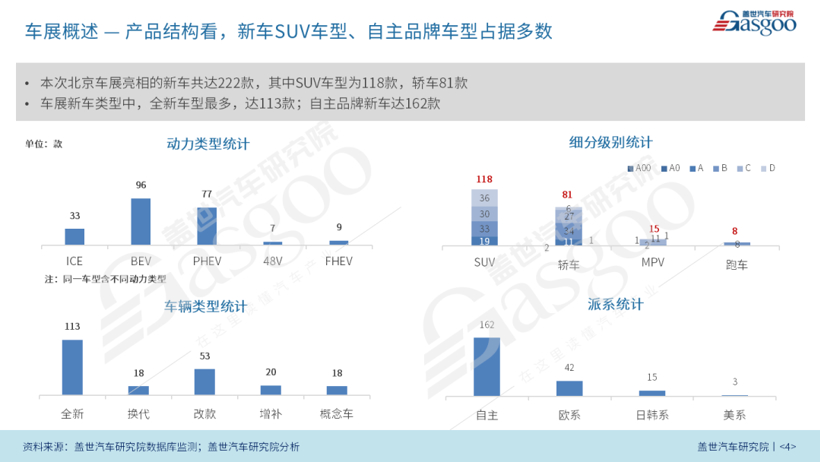
According to Gasgoo Auto data, 222 new models appeared at the 2026 Beijing Auto Show, of which 173 were new energy models, accounting for nearly 80%.
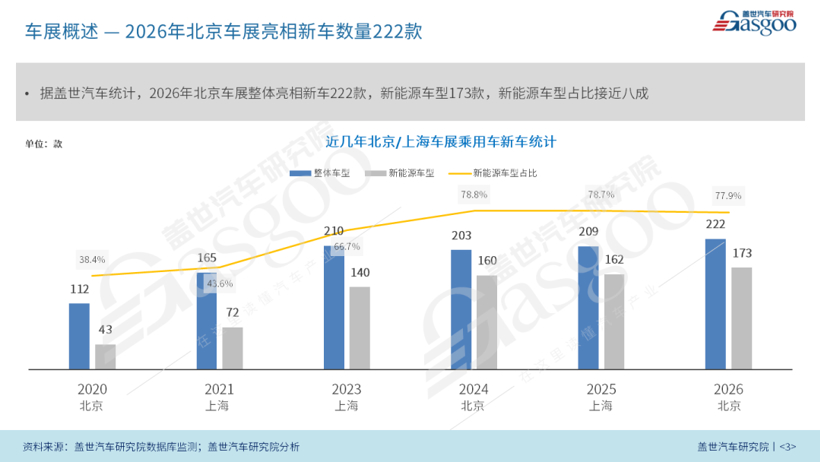
Overall Models: In terms of powertrain structure, BEV models numbered 96 and PHEV models 77, making them the two most common forms. By segment, SUVs numbered 118 and sedans 81, becoming the mainstream display models. By release type, all-new models were the most numerous at 113. By origin, domestic brands exhibited 162 models, European brands 42, and Japanese/Korean brands 15, with domestic brands occupying a clear dominant position at the show.
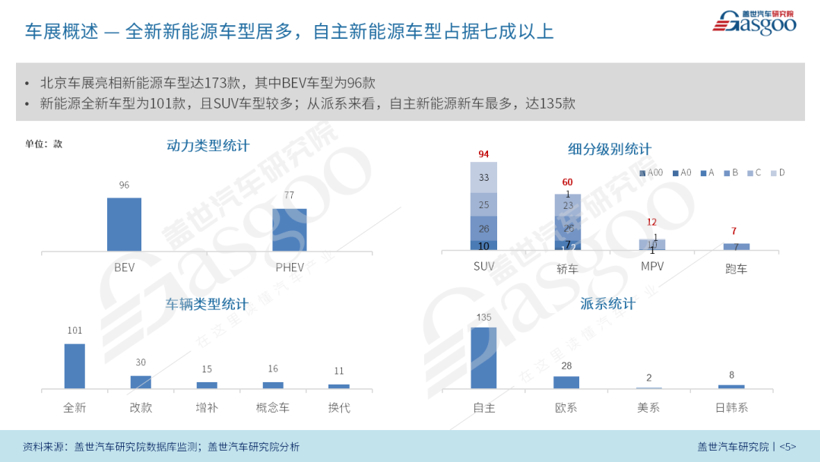
New Energy Models: By powertrain, BEV numbers were higher than PHEV, making it the most common form. By segment, there were 94 SUVs and 60 sedans. By release type, all-new models led the count at 101, accounting for over 58.4% of all-new models. By origin, domestic brands held a significant lead in new energy model debuts.
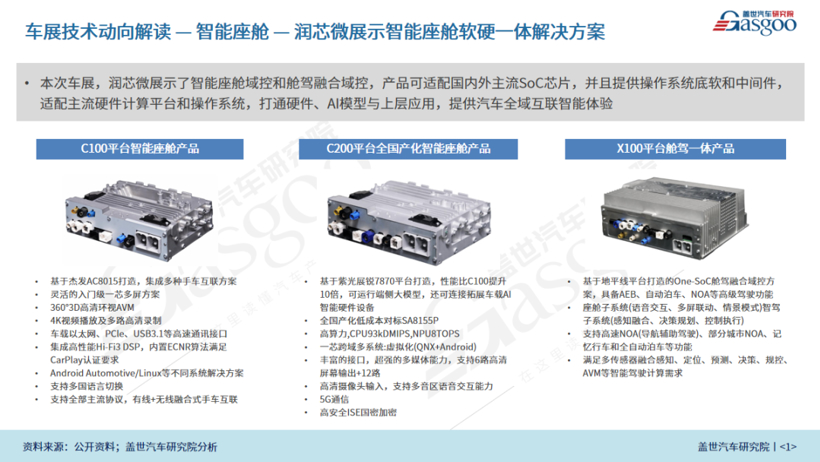
At this auto show, Runxiwei showcased its smart cockpit domain controllers C100 and C200, as well as the cabin-driving fusion domain controller X100. The C100 smart cockpit product is built on the AutoChip AC8015 chip, integrating various hand-car interconnection solutions that cover 93% of mobile phone models, enabling navigation, voice assistants, and audio-visual entertainment. The C200 fully localized smart cockpit product is built on the UNISOC 7870 chip, with performance 10 times that of the C100; it can run on-device large models and connect to expanded in-vehicle AI hardware. The X100 is a One-SoC cabin-driving fusion domain control solution based on the Horizon Robotics platform, featuring advanced driving functions like AEB, automatic parking, and NOA.
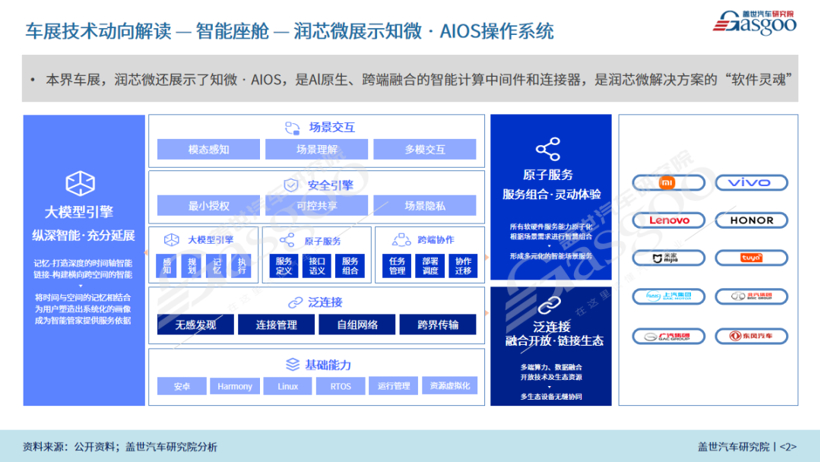
Runxiwei also offers the underlying operating system software and middleware—Zhiwei AIOS. It adapts to mainstream hardware computing platforms and operating systems, bridging hardware, AI models, and upper-layer applications to achieve cross-terminal and cross-scenario intelligent collaboration. This upgrades scattered on-board devices from "single-point intelligence" to "global connected intelligence."
/ Get Full Report /
74-page PDF
Click the image below for details