



Gasgoo Munich- 345.2 billion yuan in revenue, 14.4 billion yuan in core net profit attributable to shareholders, and 3.02 million vehicles sold. When Geely Auto released these figures on March 18, 2026, the markets immediate question was simple: The scale is there, but are the profits keeping pace?
The answer: Yes, and theyre holding their own.
A 36% surge in core profits outpacing 25% revenue growth is no small feat amid a two-year price war. Even more telling: as the penetration rate of new-energy vehicles (NEVs) topped 55% for the first time, Geelys overall profitability wasnt dragged down by sacrificing margin for volume. Full-year core net profit margin rose 0.8 percentage points to 4.2%, while per-vehicle core net profit climbed to 4,800 yuan in the second half.
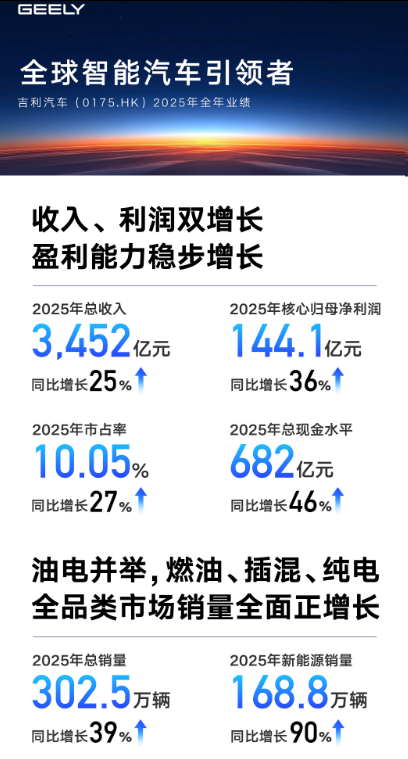
Image Source: Geely Auto
Institutional investors, however, wanted more. At the earnings briefing, one specific question kept coming up: Why hasnt the overall gross margin improved significantly?
Geely Auto Group CFO Dai Yong was candid. "R&D expenses hovered around 4 billion yuan each quarter, except for the fourth quarter, when they hit 5.9 billion yuan," he said. "The stable gross margin is due to a higher proportion of R&D spending being expensed immediately."
Its an easy detail to miss. Expensing R&D means counting more of that investment as an immediate cost rather than capitalizing it for amortization. Short term, that squeezes gross margins; long term, it strengthens the balance sheet. While the rest of the industry races to stack features, Geely is racing to invest — pouring 21.8 billion yuan into R&D in 2025, an 8.3% annual increase.
The two-hour briefing was packed with insights. Heres the breakdown.
Scale Pays Off, But Its About More Than Just Size
Geely sold 3.02 million vehicles in 2025. That number alone is a milestone — few Chinese automakers have ever cleared the 3-million-unit annual sales hurdle.
But scale isnt the whole story. The real story lies in the structure of that growth.
Start with new energy: annual sales hit 1.68 million units, a 90% year-on-year surge, bringing the penetration rate to 55.6%. Geely Galaxy alone contributed 1.24 million units — up 150%. Thats rapid growth by any industry standard.
Then theres internal combustion: the China Star series moved 1.21 million units, up 3%. Against a broader slump in ICE sales, that modest gain effectively held the line.
And finally, overseas markets: exports totaled 420,000 units for the year, with NEV exports surging 240% to 124,000 units.
Balancing fuel and electricity, home and abroad — this is the "diversified structure" management keeps emphasizing. At the briefing, Geely Auto Holdings Executive President and Executive Director Gui Shengyue summed it up: "Geelys new-energy vehicles have two defining traits: incredibly fast growth, and extremely broad category coverage."
What does "broad coverage" look like? From the 500,000-yuan-plus segment occupied by the ZEEKR 9X to the A-class market of the Galaxy Xingyuan, Geely has effectively blanketed every price band.
But the shift at ZEEKR deserves even more attention.
ZEEKR turned profitable in the fourth quarter of 2025. Thats a landmark moment — up to now, only a handful of "new force" brands have managed a quarterly profit. ZEEKR sold 224,000 units for the year, breaching the 30,000-unit mark in December alone. The ZEEKR 9X claimed the top spot in the large SUV segment above 500,000 yuan for two consecutive months in November and December.
Higher volumes of premium models translate directly to profit. The financial report shows that following consolidation, ZEEKR significantly bolstered the listed companys earnings, contributing to a 0.8 percentage-point increase in core net profit margin.
The Visible Payoff of Strategic Integration
In 2025, Geely pulled off a major move: taking ZEEKR private.
From the proposal in May to completion in December, the process took just over 200 days. When Gui Shengyue brought it up at the briefing, there was a hint of barely concealed pride in his voice: "We executed the first-ever global privatization via share swap between a U.S.-listed and a Hong Kong-listed company."
Why does that matter? Because integration isnt just about looking tidy — it delivers real returns.
The financials show administrative expense ratios, R&D investment ratios, and sales expense ratios dropped by 17.1%, 13.5%, and 0.7%, respectively, in 2025. Dai Yongs explanation: brand integration is driving efficient resource use, while technology sharing and joint procurement are starting to pay dividends.
This is the logic behind the "One Geely" strategy: four brands deeply sharing a "full-domain AI" technology foundation and a "full-domain safety" system, while pooling supply chains and coordinating channels. The flip side of economies of scale is cost sharing.
Lynk & Cos performance confirms this logic. Annual sales reached 350,000 units, up 23%, with the NEV mix climbing to 65%. The average transaction price for the Lynk & Co 900 exceeded 330,000 yuan, signaling that brand premium is still on the rise. Sustaining a lead in the 300,000-yuan segment is no small feat for a brand founded just a decade ago.
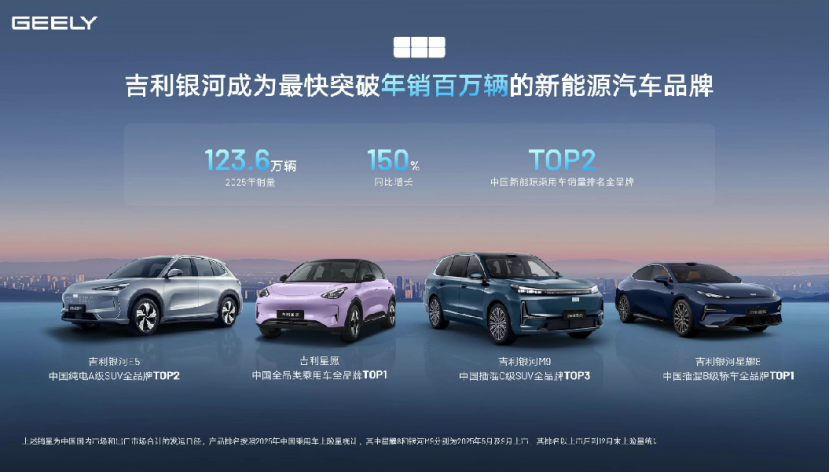
Image Source: Geely Auto
Galaxy tells a different story. With 1.24 million annual sales, it became the "fastest NEV brand to hit the million-unit annual mark." The Xingyuan consistently sold over 40,000 units for seven straight months, holding the top spot across all categories. The Galaxy M9 moved nearly 40,000 units in less than four months since launch.
Yet Galaxys rapid growth raises a question: In a mainstream market battered by a brutal price war, does the logic of trading volume for profit still hold? The data suggests yes. Despite a 150% explosion in sales, overall gross margins remained stable, indicating that product structure optimization is at work — a higher mix of well-equipped trims has offset the pressure of price cuts.
Smart Tech Enters the Harvest Phase
2025 marked the final year of the "Smart Geely 2025" strategy. In the companys words, the intelligentization rollout has "fully entered the harvest phase." So, whats the yield?
Start with autonomous driving. G-ASD (Geely Afari Smart Driving) obtained UN R171 certification, becoming the first Chinese high-level driver assistance system to go global. Thats an external validation of technical capability — securing EU certification means the solution has passed rigorous regulatory testing.
Then theres the computing foundation. On March 17 at NVIDIAs GTC conference, Geely announced a deepened strategic partnership with NVIDIA to develop L4 autonomous driving based on the DRIVE Hyperion platform. Li Chuanhai, president of the Geely Automobile Research Institute, offered a telling remark on stage: "This isnt a simple carmaker-plus-chip-maker arrangement. We are entering the era of physical AI to jointly define the next-generation technological foundation for smart mobility." The message is clear: Geely doesnt want to just be a "user" of NVIDIA chips; it wants a hand in defining the underlying technology itself.
On the cockpit front, installations of Flyme Auto surpassed 2.26 million units, cementing its lead in the domestic market. The next-generation Flyme Auto 2 has been released, and the hyper-realistic intelligent agent Eva has entered mass production.
But Gui Shengyue made a comment at the briefing that the industry should note. He admitted: "In previous years, there was constant chatter about flaws in our smart cockpit. Since Flyme Auto became widespread, that criticism has largely faded. But over the last couple of years, the talk has shifted to how our autonomous driving still lags behind some competitors."
The subtext? The pace of intelligentization competition is relentless. Just as the cockpit caught up, autonomous driving became the new battleground.
Gui offered a prediction: based on current progress, Geely Autos autonomous driving is expected to reach Teslas FSD level within 2026. Building on that, the company aims to construct a "smart mobility entity" combining L4 autonomous driving and an autonomous interactive cockpit over the next two years, with a goal of becoming a global leader in smart vehicles within five years.
That timeline isnt overly aggressive, but execution wont be easy. FSD itself is evolving, making this a moving target. However, Geelys advantage lies in its established "full-domain AI" system — from the intelligent computing center to Haohan, from Flyme Auto to NordThor EM-i plug-in hybrid electric vehicle (PHEV)-dedicated system. AI isnt just a module here; its the underlying capability threading through R&D, manufacturing, and operations.
Overseas Growth Hits the Fast Lane
Geelys overseas sales reached 420,000 units in 2025, with NEV exports surging 240% to 124,000 units.
That is rapid growth. The target for 2026 is 640,000 units, a 52% increase. Monthly exports have already breached 60,000 units in the first two months, soaring 129% year-on-year — a strong start.
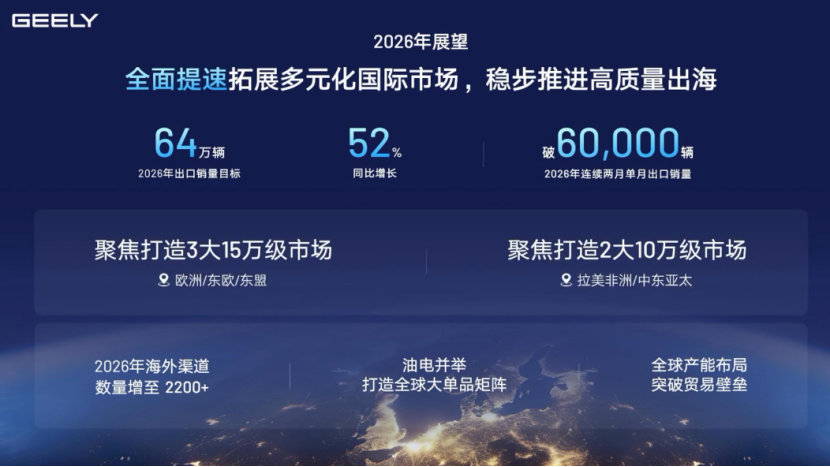
Image Source: Geely Auto
But the real challenge isnt volume; its the model. Gan Jiayue, CEO of Geely Auto Group and Executive Director of Geely Auto Holdings, told the briefing that Geely is shifting from an "international trade" model to a "product-oriented" one. The strategy leverages a "Geely + ZEEKR" dual-brand approach and the resource advantages of global partners to build a systematic global operation capability. In other words, instead of just exporting cars, Geely is now exporting its technology, supply chain, and service systems along with them.
ZEEKRs overseas progress deserves a closer look. It has already entered over 50 countries and regions, with the ZEEKR 009 becoming the best-selling luxury pure-electric MPV in markets like Hong Kong, Thailand, and Malaysia. Lynk & Co has opened more than 860 stores in over 50 countries and regions, with over 200 located overseas.
The 2026 targets are more specific: establish three regional markets selling 150,000 units each (Europe, Eastern Europe, and ASEAN), and two markets selling 100,000 units each (the Middle East and Asia, and Latin America and Africa). This strategy of blooming in multiple spots means overseas operations are no longer just the cherry on top — they are a genuine second growth curve.
Can the Profit Run Continue Under the 3.45 Million Target?
For 2026, Geely has set a sales target of 3.45 million units, representing roughly 14% growth. Thats not an aggressive pace, but the baseline is already massive.
The bigger question isnt sales volume, but whether the logic driving profit release can sustain itself.
Looking ahead, several supports are in place. First, the upcoming launch of the ZEEKR 8X, which will join the 9X to form a "luxury dual flagship" lineup. The 8X racked up over 10,000 pre-orders in just 38 minutes, signaling rising market acceptance of high-end products. A higher mix of premium vehicles translates directly to stronger per-vehicle profits.
Second is the scaling of autonomous driving. The H7 version will be rolled out across more Lynk & Co and Galaxy models, spreading costs through volume to achieve "democratized smart driving." This boosts competitiveness and opens up profit margins — when autonomous driving shifts from an option to standard equipment, the technological premium per vehicle is realized.
Third is overseas volume. The 640,000-unit target implies overseas sales will account for nearly 20% of the total. Since gross margins on NEV exports are typically higher than domestic sales, maintaining this pace will make the contribution to overall profits even more pronounced.
Of course, variables exist. If the proportion of expensed R&D remains high, short-term gross margins may face pressure. But Dai Yong sent a clear signal at the briefing: Geely wont slash R&D to protect margins. "Healthy growth" matters more than "pretty numbers."
At the close of the briefing, Gui Shengyue turned reflective. "I feel that our mindset today is more composed and more certain than ever before," he said.
Where does that confidence come from? The data tells part of the story: five consecutive years of growth, an explosion in NEV sales, profitability at ZEEKR, and accelerating overseas expansion. Strategically, its the release of integration dividends from "One Geely" and the maturation of the "full-domain AI" technological foundation.
The 2025 financial report proves that Geely is effectively racing on multiple tracks simultaneously: Galaxy chases volume, ZEEKR chases premium pricing, Lynk & Co holds the middle ground, internal combustion engines defend the installed base, and overseas markets drive new growth. This approach requires immense systemic support and exceptional management efficiency.
The results show that this approach works. But in 2026, with a higher baseline, fiercer competition, and faster tech iteration, can it maintain that same level of efficiency?
Gui Shengyue is optimistic. "I believe that for a considerable time to come, barring record sales, it is highly probable that at every future earnings briefing, our core net profit will also hit a new high," he said.
Thats a high bar to set. But judging by the 2025 scorecard, the direction is undoubtedly right.


