



Gasgoo Munich- If screens are no longer the star, where is the next battleground for the cabin?
Just recently, the Li Auto L9 Livis quietly dropped its steering wheel display screen, citing low usage. Almost simultaneously, Onvo’s L90 buried its air vents within real wood trim, while Volkswagen’s ID.ERA 9X integrated two wooden display panels into its rear doors.
This is no coincidence.
If the previous era was defined by "bigger screens and more screens," the logic of cabin interaction is now shifting from "brutal hardware stacking" to "invisible internalization of capability." From luxury marques to startups, from chip giants to material suppliers, the entire supply chain is re-answering a single question: When interaction no longer announces its presence through screens and buttons, where does the true moat of the cabin experience lie?
Screens Recede, Materials Awaken
If you look at the concept sketches of recent major model releases, you’ll notice designers are frantically "erasing" two things: protruding screens and jarring buttons. In their place is a seamless, fluid, sculptural "digital skin."
This is the disruption brought by "Smart Surface" technology. It embeds display and touch functions beneath wood grain, fabric, leather, and even electronic paper. When the screen is off, it is simply a pure trim panel; when illuminated, the interface emerges with composure, as if growing organically from within the material.
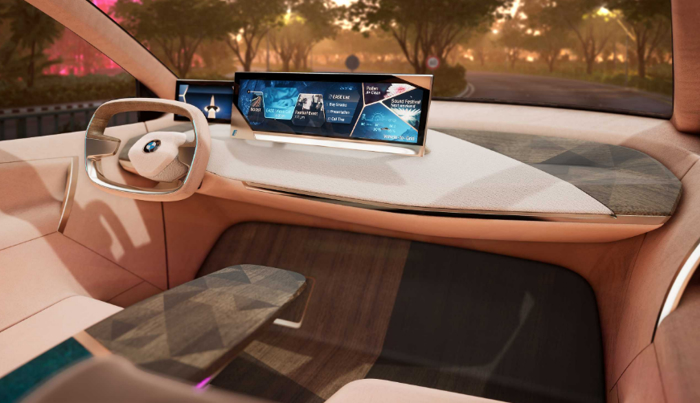
BMW Vision iNEXT concept; Source: BMW
In this aesthetic revolution, luxury brands are the undisputed originators—BMW above all. As early as 2018, the company showcased its vision for the future cabin—"Shy Tech"—on the BMW Vision iNEXT concept. Then, in 2023, the BMW i Vision Dee went further by eliminating all physical screens, relying solely on the BMW Advanced Head-up Display to present information.
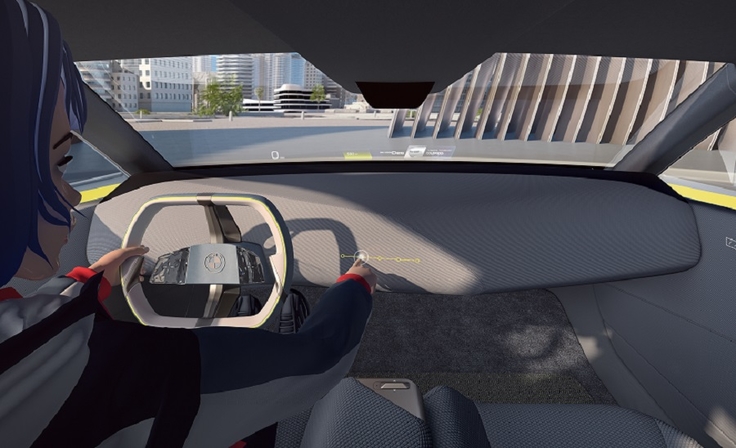
BMW i Vision Dee; Source: BMW
Then-CEO Oliver Zipse has long maintained that driver distraction, not speeding, is the primary cause of accidents. He identifies the center console screen as the chief culprit. "In 10 years, it will disappear," he has said. "Regulators may not allow it to continue existing."
The interior of the Jaguar Type 00 concept is equally distinctive. When the passenger seat is empty, the screen hidden beneath the wood grain sits as silently as a standard trim panel; only when someone sits down does it slowly rise. This is not a technical flex, but rather technology learning to "wait"—to appear at the precise right moment.
Yet, it is China's EV startups that are pulling these concepts into reality. The XPENG P7+ and G7 already feature hidden Touch Pad zones on their door panels in mass production; a light slide of the finger across the leather surface adjusts the seat without eyes leaving the road. Li Auto has patented hidden cameras, while BYD has secured solutions for hidden interior panels. Even the wood-grain screens once seen on numerous luxury concept cars have reached mass production on the newly launched Volkswagen ID.ERA 9X.

Source: Volkswagen
Even fabrics are awakening. In Toyota’s next-generation concept cabin, sliding a finger across the seat armrest controls the volume. Suppliers like NXP already offer mature solutions that weave flexible circuits and sensors into seat fabrics. Once the cost curve bends down, seats, door panels, and headliners will all become canvases for interaction.
"Our Ruiyin display hides the screen beneath a wood-grain surface, blending it seamlessly with the cabin’s interior style," Yu Daohe, S4 chief engineer for AMW’s User Experience Business Group, recently told Gasgoo. The key for the future, he noted, is no longer "adding a screen," but "making the screen the trim panel itself."
These signals converge to outline a clear industry trajectory: invisible interaction is flooding into the mass market. Data from Sigmaintell shows global automotive display panel shipments will reach roughly 250 million units in 2025, a 7.1% year-on-year increase. Yet by 2026, overall industry growth will slow significantly as the market shifts from scale expansion to technological stratification and value reconstruction.
By their calculations, 2026 may mark the "first year of mass production for wood-grain screens," with estimated global shipments of around 150,000 units, primarily for flagship applications. This means the "subtraction" movement has shed its "concept" label and entered the stage of actual delivery. Notably, AMW’s Ruiyin display has already secured designated projects and could hit the market as early as September of next year.
But subtraction has its limits. Hiding buttons is easy; hiding the user experience is a disaster. Xu Tao, R&D head for AMW’s User Experience Business Group in China, distills the standard for judging interaction solutions down to one line: "Whether you’re adding or removing physical buttons, the fundamental consideration is efficiency."
A quality smart surface must mimic the intuitive feel of a physical button. As a finger slides across wood grain, clear haptic feedback confirms the command has taken effect. Above efficiency lies a more robust line of defense. "Safety—functional safety and cybersecurity—is the primary consideration in any display unit interaction," Xu said. This explains why warning lights retain physical switches and why smart surfaces universally employ anti-mistouch and pressure-sensing technologies.
Form may be invisible, but reliability cannot be compromised. When a wood-trim panel glows with a warm light beneath your fingertips, you don’t feel the coldness of technology—you feel the surprise of a material endowed with soul.
Cameras Hide, Protection Draws Closer
If smart surfaces solve "visual clutter," then under-screen cameras are here to resolve a more sensitive and pervasive anxiety: the sense of being watched.
The wheels of regulation are turning faster. Both the EU and China mandate that all new vehicles come standard with a Driver Monitoring System (DMS) starting in 2027. Data confirms the surge in demand: according to Gasgoo Automotive Research Institute, the standard installation rate of DMS cameras in China’s domestic passenger vehicles hit 27.24% in the first quarter of 2026—up 6.44 percentage points year-over-year.
But a jarring camera staring you in the face triggers instinctive resistance. Under-screen camera technology was born to resolve this paradox. The camera sits completely hidden beneath the display; you cannot see it, yet it accurately captures your gaze and facial state through the panel.
Interestingly, the under-screen camera that the mobile phone industry has chased for years without success has found its breakthrough in the automotive sector. Yu Daohe highlights this technological window: "The advantage inside the car is that we don’t need to consider RGB, only infrared. In this scenario, the technology becomes viable—a significant breakthrough."

Smartphones demand strict color imaging quality, making light loss through the screen difficult to resolve. Automotive DMS, relying only on infrared, neatly bypasses this hurdle. Yet technical viability doesn’t guarantee user acceptance. What users truly care about is often not specs, but an indescribable psychological feeling. "Consumer surveys show that drivers and passengers generally don’t want a camera pointing at them," Yu says. "It’s a feeling of personal privacy."
From a purely functional standpoint, cameras placed under the screen, on the A-pillar, or on the steering column can all perform monitoring. But in terms of perceived value, the under-screen solution dissolves the oppression of "surveillance," replacing it with the peace of mind of "silent guardianship." This represents a higher realm of interaction design: technology intervenes promptly when needed and fades completely when it is not.
The ambition of under-screen cameras extends far beyond privacy and aesthetics. When integrated with the vehicle’s domain controller, it transforms from an isolated sensing unit into a critical node in the safety loop. Xu Tao envisions a scenario where "detecting driver attention via the in-car camera effectively reduces the risk of loss of control caused by sudden driver incapacitation. Simultaneously, it can trigger a downgrade of autonomous driving functions, coordinating chassis braking and steering to work together."
Zooming out, in-cabin sensing needs are expanding from DMS to Occupant Monitoring System (OMS), and even integrating millimeter-wave radar to detect children left behind. The number of sensors will inevitably rise; if left exposed, the cabin risks becoming an unsettling "surveillance room." "Imperceptible" sensing solutions—hidden under screens or within structural components—are the only way to reconcile function with aesthetics. When technology no longer aggressively announces its presence, a deeper trust is established between human and machine.
Only by Building Muscle in China’s "Gym" Can You Qualify for the Global Table
No matter how beautiful the technical blueprint, without engineering and supply chain support, it will remain stranded on the concept car stand. And right now, the arena determining who can turn those blueprints into reality is undergoing a decisive shift.
The intensity of competition in China’s saturated market is unmatched anywhere else in the world. Consumer expectations for cabin experiences iterate rapidly, transmitting unpredictability down the supply chain—OEMs want wood-grain screens one day and fabric touch controls the next, all rushed to market at breakneck speed. This extreme competition is turning the Chinese market into a massive "intelligent gym."
In the eyes of numerous foreign Tier 1 giants, China has already led the transition from "electrification" to "intelligentization," becoming the source and bellwether of the global industry’s smart transformation. As Tang En, CEO of AMW China, puts it: Only by building muscle in China—the world’s most competitive gym—can you qualify to compete on the global stage.
It is under this logic that AMW has launched a transformation to reshape its competitiveness from the ground up.
The first move was the decentralization of decision-making. AMW carved out the China market from the Asia-Pacific region to report directly to global leadership and established a "China for Global" department. Cong Yina, head of AMW’s User Experience Business Group in China, has felt the shift deeply. "Now, they are bringing global platforms to China and letting us handle R&D with ‘China Design,’ using the local supply chain and executing at local costs," she says. Chinese R&D teams for under-screen cameras and e-paper surfaces can now interface directly with international OEMs, bypassing German headquarters and drastically shortening project cycles.

Schematic of innovative products from AMW’s User Experience Business Group in China
The second move is the front-loading of platform development. OEMs now demand development cycles as short as 18 months—or, in extreme cases, just six—yet safety verification steps cannot be skipped. AMW’s solution? Anticipate future needs, then invest resources to build and validate underlying platforms. When customer demand arrives, they simply adapt and optimize on a mature foundation. "In a sense, we are pre-stocking these technical capabilities," Cong Yina says bluntly. "Based on this approach, even in extreme scenarios like a six-month development cycle, we have the capacity to respond to customer needs."
The third move is the thorough localization of the supply chain. Material costs for cabin products often account for 60% to 80% of the total, with screens being the largest chunk. AMW is aggressively introducing experienced local suppliers in China to foster competition, while devolving price negotiation power from global headquarters to local teams. Cong Yina offers a stark comparison: "Previously, prices had to be negotiated by the global team; now, the local team can finalize negotiations independently. We not secure optimal costs by expanding competition, but we also achieve a massive boost in speed."
Simply put, only when the cost of screens hidden beneath wood grain falls within the reach of mainstream models can invisible interaction truly transform from a luxury toy into an everyday reality for ordinary drivers.
The essence of this transformation is a complete subversion of the definition of "who empowers whom."
For decades, the flow of technology was almost exclusively one-way—from Europe and the U.S. to China. Now, it is becoming a two-way loop. Chinese teams not only serve local customers but also participate directly in the development of global platform projects, providing solutions for global vehicles using Chinese supply chain costs and Chinese-style efficiency. Cong Yina’s words capture the shifting zeitgeist: "In the past, foreign experts often came to China to guide us on technology and industrial production. But now, it’s different."
At the same time, will the integration of large models and AI shrink the demand for display hardware? Yu Daohe’s verdict: it won’t shrink; it will upgrade. "AI applications in the cabin are increasing. For sensing and execution, our perception provides more information to the host, which directly impacts hardware upgrades." The data flood from multimodal fusion requires higher-quality display interfaces and more natural tactile feedback to support it. It is a positive cycle: invisible interaction drives stronger sensing needs, and those needs require more advanced invisible hardware to support them.
Ultimately, the competition in interaction will expand from "efficiency" and "safety" to "emotion." Beyond the yardsticks of efficiency and safety, Xu Tao adds a third dimension: "In terms of emotional interaction, or personalized interaction, we will use localized innovation and R&D to create different demos that interpret our philosophy of personalized interaction."
The next generation of cabin interaction will not only solve "how to do it," but also answer "what to make people feel."
Perhaps the highest realm of technology is to be unaware of its presence, yet to feel the warmth it provides. When sensors and chips retreat behind trim panels and vanish into pixels, what remains for the driver and passengers is a clean, comfortable, undisturbed space—and a sense of composure that says "everything is under control, yet effortless."


