



Gasgoo Munich- Black Sesame Technologies released its 2025 annual report on March 31.
The company posted total revenue of 822 million yuan last year, a 73.4% surge from the previous year. Gross margin held steady at 41.0%. While attributable net loss widened to 1.425 billion yuan, the adjusted net loss—excluding share-based payments and fair value changes on preferred shares—narrowed by 17.5% to 1.076 billion yuan.
Behind these figures lies a dual-engine strategy: the mass-market ramp-up of core autonomous driving operations and a strategic foothold in emerging fields like embodied intelligence.
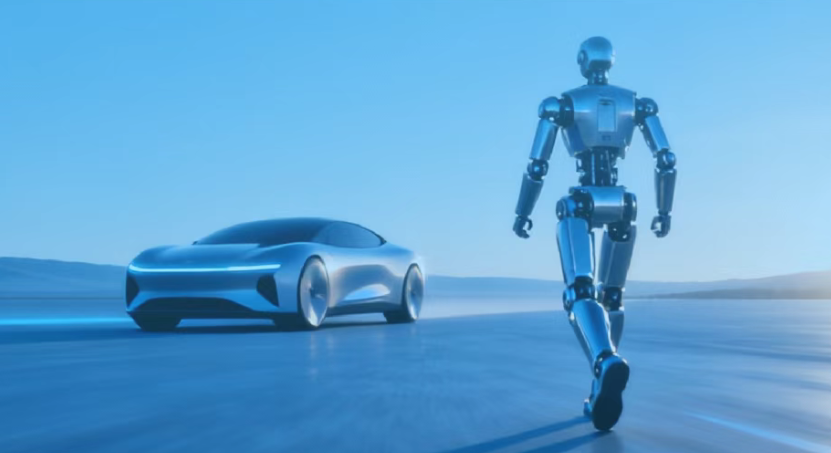
Image Source: Black Sesame
Anchored by Autonomous Driving Chips, Building a Stable "Cash Cow"
For Black Sesame, autonomous driving chips are its foundation—and the ballast stabilizing its revenue growth.
In 2025, revenue from assisted driving products and solutions climbed to 687 million yuan—a 56.8% jump that accounted for over 80% of total revenue. The gross margin for this segment stood at 37.4%.
Black Sesame attributes this growth to three drivers. In passenger vehicles, new models featuring its Huashan series chips hit the market with strong sales, lifting shipments of high-end assisted driving chips. In the L2-L3 commercial vehicle sector, competitiveness improved, marked by significant gains in both client numbers and average pricing. Meanwhile, the company achieved batch shipments in L4 scenarios such as autonomous logistics.
Specifically, the Huashan A1000 series remains the company's backbone.
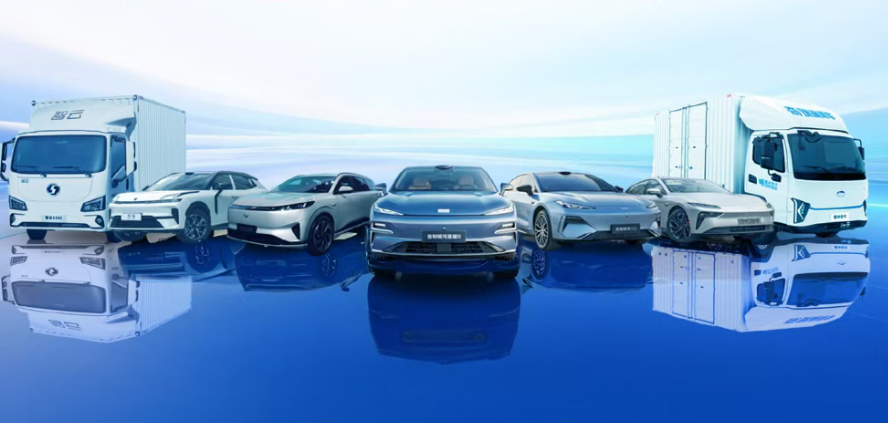
Image Source: Black Sesame
Now five years into its lifecycle, the chip has been integrated into multiple models from top-tier automakers like Geely, BYD, and FAW, and is expanding into overseas markets.
Leveraging experience from mass production, the A1000 has successfully crossed over into commercial and L4 scenarios, including postal logistics vehicles and autonomous sweepers. The "Chuanxing Zhiyuan" S6 series, developed with Desai SV, exemplifies a typical L4 application using the company's "dual-brain redundancy" architecture backed by high-safety computing power.
The "newcomer" Wudang C1200 series is ushering in the era of central computing.
As a leading central computing chip platform, the series has entered mass production in new models from top automakers and is undergoing validation and delivery at several others, covering diverse needs from integrated cabin-driving-parking systems to entry-level autonomous driving. Additionally, its secure intelligent architecture based on the C1200 has won OEM approval and is currently being validated for multiple new projects.
Looking ahead, the "ace" up its sleeve—the Huashan A2000 series—serves as the core force for Black Sesame's push into high-end autonomous driving.
As the world's first high-computing chip with panoramic general capabilities, the A2000 is built on a 7nm process and supports full FP16/FP8 precision computing. It is currently being deeply adapted for end-to-end and Vision-Language-Action (VLA) algorithms by core algorithm providers like DeepRoute and Nullmax, and has already secured design wins from leading automakers.
Building on this, Black Sesame has made the A2000 the centerpiece of its 2026 strategy, aiming to finalize solution adaptation and mass production. The goal is to help partners achieve large-scale deployment of L3 advanced assisted driving while actively positioning itself in L4 scenarios like Robotaxis. The company plans to drive mass production with Apollo Go this year and accelerate collaborations with other L4 leaders.
Simultaneously, it plans to push for batch shipments in commercial vehicle sectors such as construction machinery, sweepers, unmanned logistics, and light trucks, achieving scaled penetration across L2-L3 commercial vehicles and L4 unmanned logistics scenarios.
Notably, leveraging the A2000's global market access—bolstered by passing relevant U.S. reviews—Black Sesame plans to accelerate the mass production of overseas vehicle projects, aiming to build the industry's most open and user-friendly high-end computing platform.
If the A1000 and C1200 represent Black Sesame's current "granary," the A2000 is its ticket to the L3/L4 era—carrying the ambition to transition from a leader in China to a global competitor.
Pushing into Edge AI to Forge a "Second Growth Curve"
If autonomous driving is Black Sesame's foundation, then edge AI—represented by embodied intelligence—is the "second growth curve" it is aggressively building.
In 2025, revenue from embodied intelligence solutions reached 96.3 million yuan. While this lags far behind the autonomous driving business in scale, it boasts a gross margin of 48.7%—nearly 10 percentage points higher—helping lift the company's overall gross margin above 40%.
This performance underscores Black Sesame's transformation from an "autonomous driving leader" into a "full-stack edge AI chip provider."
Targeting the embodied intelligence sector, Black Sesame unveiled its SesameX platform in 2025. Featuring a "whole-brain intelligence" system, the platform uses three core modules—Kalos, Aura, and Liora—to provide robots with full-stack computing power ranging from basic control to advanced cognition.
Thanks to deep insights into embodied intelligence scenarios and forward-looking technical deployment, the SesameX platform quickly garnered positive market feedback following its launch.
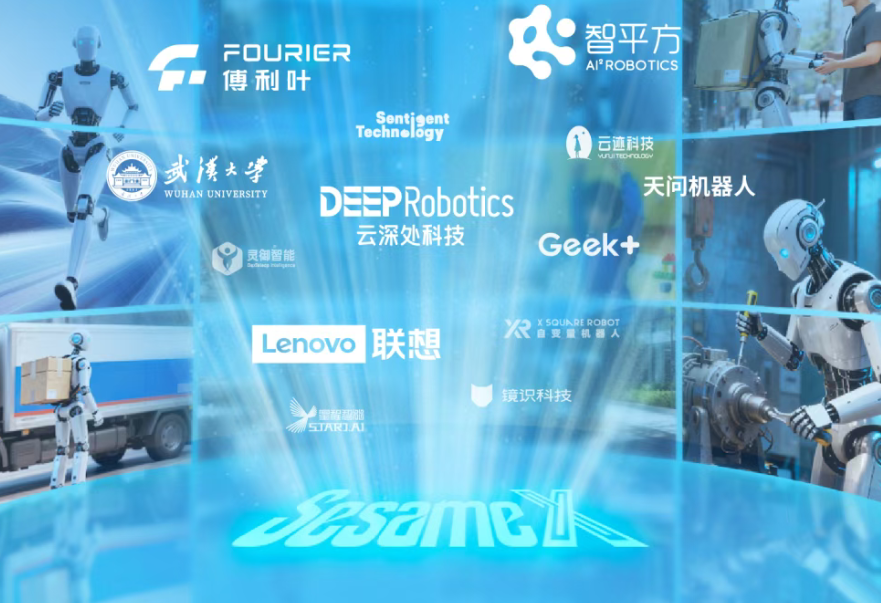
Image Source: Black Sesame
During the reporting period, Black Sesame partnered with leading robotics companies including DeepRobotics, Fourier Intelligence, Lenovo, AI² Robotics and Joyson Electronics to drive commercialization. Related solutions are now being delivered at scale in scenarios such as quadruped robots and intelligent shipping inspections, creating a dual-engine growth structure alongside autonomous driving.
Meanwhile, Black Sesame's intelligent imaging solutions have demonstrated strong monetization capabilities.
By expanding its intelligent imaging solutions into areas like AI glasses, the company generated 39.2 million yuan in revenue for this sector in 2025—a 7.9% increase. With a gross margin of 84.7%, it maintained the high profitability seen in 2024.
Black Sesame has cultivated the AI imaging sector for years, with its solutions now deployed in over 500 million devices. Notably, in its partnership with Li Auto, the company provided customized imaging algorithms for Li Auto's first AI glasses, Livis. Covering core functions such as HDR fusion, multi-frame noise reduction, video stabilization, and portrait optimization, the product has entered mass production.
Building on this, Black Sesame is currently co-developing AI glasses with several leading clients.
The company aims to leverage its technical edge in on-device AI imaging to accelerate the deployment of edge large models and AI agents. By extending imaging capabilities from simple processing to multimodal understanding and intelligent decision-making, it plans to build a next-generation intelligent imaging technology system.
Notably, Black Sesame's pan-AI software-hardware solutions have also been deployed at scale. Technologies supporting smart traffic management, parking, and rail transit systems are already in operation across Shanghai, Zhejiang, Chengdu, Qingdao, and other regions.
Conclusion
A clear strategic outline emerges from Black Sesame's 2025 financial report: the company is shifting from a growth model reliant on the "single-point breakthrough" of autonomous driving chips to a platform-based ecosystem driven by "autonomous driving + embodied intelligence" and covering "automotive-grade + consumer" scenarios.
Looking ahead to 2026, Black Sesame has defined embodied intelligence and high-end autonomous driving as its "core dual engines." Focusing on product deployment, technological evolution, and platform upgrades, the company aims to accelerate the transition of key technologies from research to industrialization.
On one hand, Black Sesame will continue to drive the scaled deployment of the SesameX platform in logistics, manufacturing, and services to build a "robot whole-brain system." This includes advancing partnerships with top robotics firms to implement solutions for industrial robots, inspection robots, dexterous hands, and waste-sorting robotic arms.
On the other hand, through the acquisition of Zhuhai Eeasytech, the company is executing a "chip + algorithm + scenario" strategy to fill gaps in the entry-level computing market. This move aims to achieve "full-series coverage" across high, mid, and low tiers, spanning from automotive-grade to consumer-grade and from high to low computing power.
On the technical front, Black Sesame plans to complete the experimentation and verification of next-generation intelligent vision processing IPs and deliver next-generation Neural Processing Unit (NPU) IPs to the SoC team. The objective is to complete the tape-out of new chips within 2026, launch market promotions, and design the latest generation of more flexible and efficient NPU architectures.
For existing platforms, the company will continue refining kernel development to match A2000 and GPU precision, while strengthening the A2000 full-process toolchain. Additionally, Black Sesame will actively conduct pre-research on domestic process computing chips and toolchains.
Ultimately, Black Sesame aims to evolve from an automotive chip company into a platform enterprise capable of providing complete AI inference chip solutions for intelligent vehicles, robots, and various AIoT terminals.


