



Gasgoo Munich- BYD and Geely cracked the top ten in global auto sales for 2025, while six Chinese automakers—including Chery and Changan—landed in the top 20, outnumbering Japanese firms. When it comes to selling cars, Chinese brands have officially taken a seat at the global table.
But volume doesn't equal value. Volkswagen and Toyota each generated more than 2.3 trillion yuan in annual revenue, firmly holding the top two spots. Among Chinese players, only BYD broke into the global top ten. The profit gap is just as stark: Toyota netted over 230 billion yuan, while China's leader, BYD, managed just over 30 billion—roughly one-seventh of Toyota's haul.
The root of the disparity lies not in profit margins, but in sheer revenue scale. Major global automakers currently post net profit margins between 2% and 6%, a range China's top players have also entered. What really separates them is global market scale, the contribution of luxury brands, and the brand premiums built up over decades.
Chinese automakers have taken a massive leap in globalizing sales, but there's still a long road ahead before they become true "global automakers" in every sense.
Revenue Top 10: BYD Makes the Cut
Financial data for 2025 compiled by Cui Dongshu, secretary-general of the China Passenger Car Association (CPCA), shows global auto industry revenue swelling from 14 trillion yuan in 2020 to 20 trillion yuan. The hierarchy remains stable: traditional giants Volkswagen and Toyota continue to lead the revenue rankings, while General Motors, Ford, and Stellantis hold their ground in the trillion-yuan camp.
BYD, with 804 billion yuan in revenue, is the only Chinese automaker to crack the global top ten. By comparison, that's roughly one-third of Volkswagen's revenue and about 35% of Toyota's. SAIC Motor follows at 650.6 billion yuan, ranking twelfth. Geely and Chery also landed in the top 20 with revenues around the 300 billion yuan mark, though they still trail the leading multinationals.

When it comes to profitability, Toyota is in a league of its own. With net profit exceeding 230 billion yuan, the Japanese giant alone accounts for half the combined net income of the 43 automakers tracked. BMW, Volkswagen, and Hyundai lag behind, yet each still posts net profits in the 50 billion yuan range.
Among Chinese firms, BYD leads the pack with 33.8 billion yuan, ranking eighth and surpassing Tesla and General Motors. SAIC, Geely, and Chery follow with profits between 16 billion and 20 billion yuan, also securing high spots. The rest show modest performance, with some "new force" EV makers still in the red.
The reality facing Chinese automakers today is this: sales are growing slightly faster than profits.
Product mix is a key factor. Chinese brands are currently concentrated in the 100,000 to 300,000 yuan price band—a fiercely competitive segment with slim margins. In contrast, Toyota and Volkswagen derive profit from luxury marques like Lexus, Audi, and Porsche, where per-vehicle earnings far exceed those of mass-market family cars.
Chinese automakers are pushing into premium markets—BYD with Yangwang and Denza, Geely with ZEEKR, Great Wall with Tank, and Changan with Avatr. Yet these brands remain largely focused on the domestic market. In mature regions like Europe and North America, brand recognition and luxury influence are still limited.
The domestic price war continues to squeeze margins. Over the past two or three years, automakers have slashed prices repeatedly to grab market share. As Cui Dongshu noted, automaker profits are being pinched by both price wars and battery costs, pushing industry-wide profit margins to historic lows.

Economies of scale cannot be ignored. Toyota sells over 10 million vehicles annually, Volkswagen close to 9 million, while BYD moves about 4.6 million—that volume gap directly impacts unit costs. Furthermore, heavy investments by Chinese firms in autonomous driving, chips, overseas channels, and localized factories are difficult to convert into profit in the short term, keeping R&D spending at historically high levels.
Leapmotor is a microcosm of this trend. In 2025, the company's revenue jumped 101% to 64.7 billion yuan, with net profit hitting roughly 500 million yuan—its first annual profit—while gross margins rose to 14.5%. That performance stands out among new EV startups, yet the scale of profit remains limited.
Rapid growth, with profits still playing catch-up—that is the true state of Chinese automakers today.
In Reality, the Gap Is Narrowing
The comparisons above rely on static 2025 data. Looking at a single year, the gap appears wide. But extend the timeline to observe the dynamic changes over the past five years, and a different picture emerges: that gap is closing at breakneck speed.
In 2020, BYD's revenue was just 153.5 billion yuan; by 2025, it had surged to 804 billion yuan—more than a fivefold increase in five years. Geely, Chery, and Great Wall Motor all doubled from around 100 billion yuan to roughly 300 billion yuan, while startups like NIO and Li Auto have reached the 50 billion to 100 billion yuan range.
During the same period, most multinational automakers saw growth slow significantly, with some even declining. Revenue growth at Toyota and Volkswagen slowed to single digits, while General Motors and BMW barely budged in the last two years. Mercedes-Benz revenue fell from 1.24 trillion yuan to 1.09 trillion yuan, and Nissan also posted notable declines.

By comparison, China's top automakers are trending upward. Estimates suggest Chinese companies now account for roughly 18% of global auto revenue.
The catch-up is even more pronounced on the profit front. Around 2020, Chinese NEV makers were largely unprofitable. Startups like NIO, XPENG, and Li Auto posted double-digit losses, while BYD saw its net profit briefly dip to 4 billion yuan.
By 2025, however, BYD's net profit hit 33.8 billion yuan. Li Auto and Leapmotor turned profitable, while Geely and Chery reached the 10 billion yuan profit mark, benefiting from economies of scale in new energy vehicle sales.
In 2021, Toyota's net profit was 34 times that of BYD; by 2025, that ratio had shrunk to roughly seven times. The pace of acceleration is clear. The combined net profit of Chinese listed automakers has risen to nearly 20% of the global total.
What truly reshaped the global landscape was the shift to new energy vehicles. For decades, core technologies like engines and transmissions were dominated by European, American, and Japanese automakers. The electrification era changed the rules of the game. Batteries, electronic control, and intelligence became the new core competencies, and the Chinese industry seized the first-mover advantage in this technological switch.
Han Zhiyu, a professor at Tongji University, notes that Chinese automakers have developed original capabilities, establishing several world-leading hybrid architectures. These include BYD's DM technology, Great Wall's Hi4, and Geely's Raytheon powertrain systems.
The global window created by the pandemic also played a crucial role. From 2020 to 2022, chip shortages and logistics disruptions forced production cuts worldwide, while Chinese manufacturing recovered first. The stability of the country's auto supply chain began to shine.

During those years, Chinese automakers not only expanded domestic market share but also accelerated exports. In 2020, China exported roughly 1 million vehicles; by 2023, it surpassed Japan to become the world's largest auto exporter. By 2025, export volumes had surged again, exceeding 8 million units.
The significance of exports goes beyond just adding units; it improves profit structure. Overseas markets typically command higher prices and offer better margins than the domestic market.
BYD's overseas sales grew to 1 million units in 2025, with average export prices in Southeast Asia running 15% to 20% higher than at home. In the first four months of 2026, overseas sales accounted for over 40% of BYD's total, becoming a second growth curve for both volume and earnings.
Chery's exports now account for nearly 70% of its total volume, transforming it into a company balanced between domestic and international sales. Leapmotor, leveraging its joint venture Leapmotor International with Stellantis, exported over 60,000 vehicles in 2025, driving a 400% year-on-year surge in overseas revenue. In the first four months of this year, Leapmotor's average monthly exports hit the 10,000-unit mark.

Image Source: ANFAC
Improvements in supply chain capabilities and operational efficiency are also at play, manifesting in three key areas.
First, the industrial chain. China has built a complete NEV supply chain, with battery makers like CATL and BYD wielding global influence. In 2025, Chinese companies occupied six of the top ten spots for global power battery installations, commanding a combined market share of over 70%.
Second, operational efficiency. Inventory turnover days for domestic brands dropped to 50 in 2025, while European and American automakers saw theirs rise above 65 days.
Third, supply chain clout. Days payable outstanding for domestic automakers rose to 149 days by 2025, whereas Toyota's dropped to 55 days over the same period.
Cui Dongshu points out that this reflects the dominant position of domestic automakers within the supply chain, even as some traditional Western automakers face increasing financial pressure due to shrinking payment cycles.
How Far From a Truly "Global" Automaker?
The global competitive landscape began to shift noticeably around 2024.
Before 2024, data showed some multinationals on a fluctuating upward trend, while others remained relatively stable. For instance, Volkswagen's net profit grew from 70.8 billion yuan in 2020 to 140.9 billion yuan in 2023, while Hyundai jumped from 11.5 billion to 71.6 billion yuan in the same period. Toyota, despite some decline, consistently stayed above 120 billion yuan.
But by 2025, Volkswagen's net profit had plummeted to 56.9 billion yuan. Toyota, BMW, Tesla, and Honda also saw varying degrees of decline, while Ford and Stellantis slipped into net losses.

Image Source: ANFAC
Profit margins for most multinationals slid from above 7% to between 2% and 5%, with some firms turning negative. The pressure persisted into the first quarter of 2026. BMW's revenue fell 8%, pre-tax profit dropped 25%, and automotive margins slipped from 6.9% to 5%. Toyota's operating profit fell 49% year-on-year to 569.4 billion yen, while Daimler Truck's operating profit was halved.
Toyota issued a profit warning for fiscal year 2026, forecasting operating profit of 3 trillion yen—down 21% year-on-year and well below market expectations. The company cited losses of 670 billion yen stemming from the conflict in the Middle East.
For years, multinational automakers tried to balance "protecting profits" with "pursuing electrification." But as Chinese brands expand globally, that balance has become harder to sustain. High transition costs, fierce competition from Chinese firms, and soft global demand have converged, putting short-term performance under severe pressure.
In contrast, Chinese automakers have offset the saturation of domestic demand with strong export momentum.
In the first four months of 2026, China's auto exports exceeded 3.12 million units, up more than 60% year-on-year, putting the full year on track for another record. Leaders like Chery, BYD, and SAIC frequently set monthly export records, becoming key drivers of sales growth and earnings stability. Chery's exports now account for over 70% of its volume, while BYD set a new monthly high of 135,000 exported units.
Europe is becoming one of the fastest-growing overseas markets for Chinese brands. In the first quarter of 2026, Chinese brands captured nearly 10% of Europe's NEV market. BYD's share there jumped to 2%, while Leapmotor's monthly sales surged from the thousands to the 10,000-unit mark. In Southeast Asia, Chinese brands hold over 80% of Thailand's EV market. This will further accelerate the globalization of Chinese automakers.
Multinationals have begun to fight back against the Chinese onslaught. On price, Korean and Japanese brands moved first. Kia decided to narrow the price gap between its European models and Chinese competitors from 20%-25% to 15%-20%. Hyundai, Toyota, and Honda have also offered substantial discounts in Southeast Asian markets like Vietnam.
On the product front, European automakers like Volkswagen plan to sell China-made vehicles in Europe, leveraging the country's supply chain cost advantages to counter Chinese brands and defend market share.
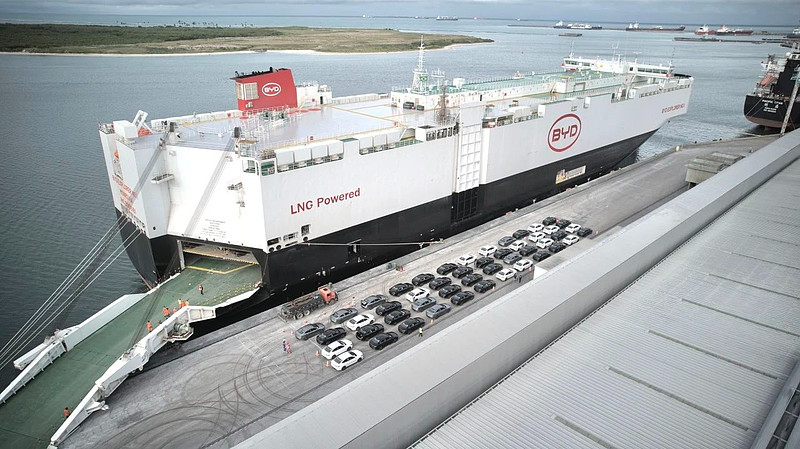
Image Source: BYD
This means the price wars and strategic shifts seen in China over the past few years are being replicated globally, fundamentally altering the competitive landscape.
In terms of sales volume, Chinese automakers are already globally competitive. But in terms of brand strength and profitability, they still need to break their dependence on the "high value-for-money" model.
Toyota's true strength lies not just in being the world's top seller, but in the mature global system behind it: stable quality control, long-standing brand recognition, localized supply chains, mature financial services, and global operational capability. BMW and Mercedes-Benz maintain high profits not merely because of their products, but because they have built complete global brand ecosystems.
By comparison, Chinese automakers still rely heavily on expanding overseas through "high specs, high value-for-money." This approach opens the door to quick sales volume, but it falls short of building a truly global brand.
The side effects of price wars also warrant caution. Han Zhiyu has noted that some companies, in an effort to cut costs, pass pressure down the supply chain. Payment terms become chaotic, with some settlements starting only after a vehicle is sold. He argues that competition must ultimately return to technology, quality, and systemic capability, rather than relying solely on low prices.
Cui Dongshu also points out that while Chinese automakers have achieved product premiumization, they still lag in brand premium, global awareness, and systemic capabilities.
This introspection is turning into action. More and more Chinese automakers realize that relying solely on price and specs won't build long-term competitiveness; they must put down local roots in overseas markets.
For example, BYD is building a factory and R&D center in Brazil, aiming to raise the localization rate to 50% by 2027. Chery launched its first overseas regional operations center in Barcelona, Spain, steadily increasing the ratio of local employees in its international workforce. Geely is advancing a global R&D system with centers in Sweden and Germany. Great Wall Motor, Changan, and GAC have all established production bases in key markets like Thailand.
Summary:
By sales volume, Chinese automakers have already taken the global stage. In terms of NEV technology, supply chain strength, and export volume, the Chinese auto industry is even reshaping the global landscape. Yet when looking at revenue structure, profitability, brand premium, and global systemic capabilities, a gap remains between Chinese firms and true global giants like Toyota, Volkswagen, and BMW.
Chinese automakers have effectively completed the phase of "just getting cars out the door." The competition ahead isn't just about exporting more vehicles; it's about who can build a truly global brand, global channels, and a global profit system. This step is harder than merely boosting sales, but it will determine whether Chinese automakers can ultimately secure a core position in the global industry.


