



Gasgoo Munich-On March 31, onsemi officially unveiled its China strategy, designating Shanghai as its Greater China headquarters and planning to appoint a China general manager with dual technical and management functions. Anchored by four pillars—"Design in China, Make in China, Deeply Cultivate China, Go Global"—the move marks a deep upgrade to its presence in the country.
This move is more than just a strategic increase by onsemi; it reflects how global semiconductor giants are repositioning and deepening their ties with China—a core market—amid industry shifts.
From "Selling Products" to "Co-creating Innovation": onsemi's China Pivot
The core of onsemi’s new strategy is a shift from traditional product exports to deep local synergy, upgrading China from a single market into a key hub for global innovation and manufacturing.
The first step in executing this strategy is establishing the Shanghai headquarters and appointing a China general manager who will also serve as head of systems engineering for the region. This dual role breaks the common dilemma in foreign firms where management and technology are siloed. In the past, decision-making power often sat with overseas headquarters while local teams passively executed orders. Now, technical insight is integrated directly into the decision chain, significantly boosting local response times.
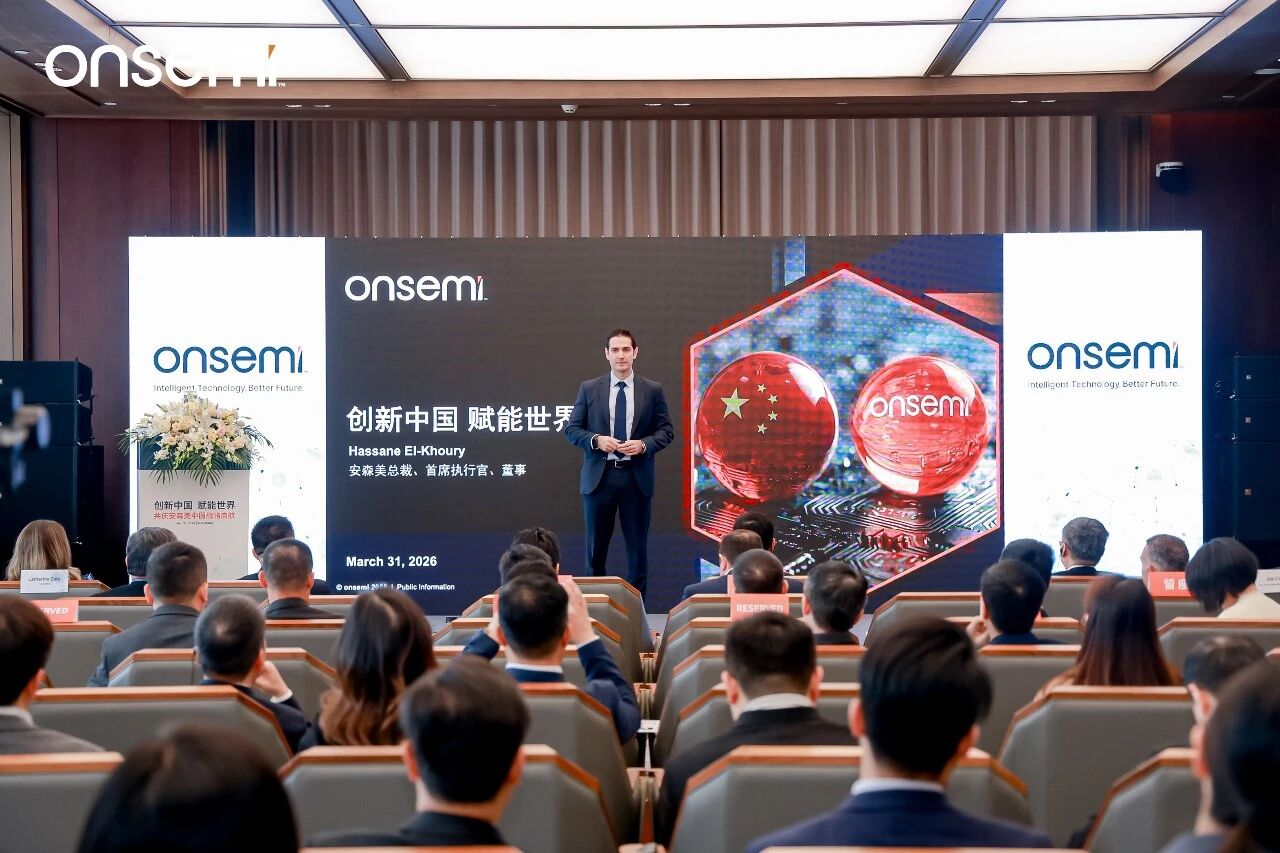
Image Source: onsemi
onsemi CEO Hassane El-Khoury was candid about the strategic adjustment: "Our customers need more than just components; they are looking for partners who can innovate alongside them with consistent execution. Our China strategy is about co-creating solutions with customers in China and scaling them for the global market." That statement captures the essence of the new strategy: co-develop in China, then launch worldwide.
The four pillars form a complete closed loop for the strategy's execution, with tangible actions backing each link.
On the design front, onsemi is continuously expanding its Shanghai R&D and systems engineering teams, focusing on three high-growth tracks: automotive, industrial, and AI data centers. It has already established eight joint application laboratories in China and plans to add three more, targeting localized solutions for AI power applications. This layout precisely matches the explosive demand in China’s new energy vehicle and computing infrastructure sectors, shifting the R&D focus from "global adaptation" to "China customization" before feeding back to the world.
In manufacturing, onsemi has chosen a dual-drive approach of "integrating proprietary capabilities with local partnerships" to build a front-to-back-end manufacturing system. The collaboration with Innoscience is particularly critical; the two sides will accelerate the global commercialization of gallium nitride (GaN) products. This layout leverages China's mature manufacturing ecosystem while achieving supply chain resilience and cost optimization through local cooperation.
"Deeply Cultivate China" and "Go Global" represent the value extension of the strategy. onsemi will integrate deeply into China's innovation ecosystem and honor its local procurement commitments. At the same time, relying on its global manufacturing network, it will push technology platforms proven in China out to the world, helping clients bridge the gap from "success in China" to "global scale." This logic upgrades onsemi's China business from "serving China" to "China driving the world," fundamentally reconstructing its strategic positioning.
Not Just onsemi: Why Are Foreign Semiconductor Firms Collectively "Taking Root" in China?
onsemi's strategic upgrade is not an isolated case, but a microcosm of a collective turn by global semiconductor giants. Since the start of 2026, foreign semiconductor firms have been making intensive and deep moves in China, shifting their core logic from "market penetration" to "ecological rooting."
In March, STMicroelectronics announced that STM32 wafers produced by Hua Hong Semiconductor had begun delivery to Chinese customers, with plans to achieve mass production of more series in China by 2026. Moving from "selling global chips in China" to "making China chips in China," the European semiconductor giant is upgrading China from a mere market to a manufacturing base, building a localized supply chain loop.
Japan's Nagase signed an agreement in Wuxi in March, investing $30 million to build a high-purity semiconductor materials base. The project focuses on core materials like developer and electroplating solutions, directly filling gaps in the Yangtze River Delta's semiconductor materials chain. This upstream layout shows that foreign firms are deeply penetrating from "selling chips" to "taking root in the industrial chain."
Behind these moves lie three core trends.
First, China's strategic status is becoming increasingly prominent. China is the world's largest market for automotive semiconductors and holds a significant share in industrial and data center semiconductors, with overall growth rates ranking among the highest globally. Especially in emerging fields like new energy vehicles and AI computing, demand continues to climb, making it a key driver of growth for foreign enterprises. For most global semiconductor companies, performance in the Chinese market is often closely tied to their growth prospects for the next few years.
Second, it is an inevitable choice for supply chain resilience. Against the backdrop of global semiconductor supply chain restructuring, a "China + Global" dual-cycle layout has become the optimal solution for foreign firms to mitigate risks and improve efficiency. Manufacturing in China allows them to be close to the market while leveraging China's complete industrial chain to reduce costs.
Third, the value of local innovation is gaining prominence. Technological breakthroughs and the accelerating ecosystem in power semiconductors and third-generation semiconductors in China have made foreign firms realize that deep participation in Chinese innovation is a crucial path to grasping next-generation technology trends. The GaN cooperation between onsemi and Innoscience is a typical case of "co-creating in China and promoting globally." Foreign firms are no longer just technology exporters; they are becoming deep collaborators and joint beneficiaries of local innovation.
onsemi establishing Shanghai as its Greater China headquarters marks the entry of foreign semiconductor layout in China into the "headquarters economy" era.
From setting up offices to establishing R&D centers, and now landing regional headquarters in China, foreign firms are granting the Chinese market higher strategic weight. With the entire chain of decision-making, R&D, and manufacturing moving deeper into the region, China is no longer a "peripheral market" for the global semiconductor industry, but is evolving into a core innovation hub and manufacturing center.
Amidst this shift, the relationship between foreign and local enterprises is undergoing subtle changes: competition remains, but collaboration is deepening. The partnership between onsemi and Innoscience, and the foundry agreement between STMicroelectronics and Hua Hong, both confirm a trend—the future semiconductor landscape will not be a simple binary opposition of "local substitution" versus "foreign dominance," but a more complex global collaboration network.
In this network, China is evolving from a "participant" to an "axis." onsemi's move is merely the beginning of this era.


