



Gasgoo Munich- Rumors of a crackdown on humanoid robot IPOs swept through the market on September 9.
Chinese regulators are raising the bar for humanoid robot startups looking to go public, according to The Information. Insiders say applicants stand a better chance only if they can demonstrate recurring revenue, narrowing losses, or genuine innovation. As of now, regulators have not publicly released new rules specifically targeting humanoid robot IPOs.
Shao Tianlan, founder and CEO of Mech-Mind, wasted no time weighing in.
"The secondary market is not a venture capital market; it shouldn't function like one," he argued. With few exceptions, companies must "at least prove product-market fit" and demonstrate a real, sustainable business of significant scale before tapping the capital markets.
The following day, he turned his attention to data collection centers, leasing firms, related-party transactions, and the revenue structures of certain embodied intelligence companies.
Some of his remarks were pointed. These views reflect personal opinions from industry participants, and no public regulatory conclusions have endorsed the allegations against other companies. Controversy aside, Shao's back-to-back statements have forced a pressing question onto the table.
For the past two years, the robotics industry has been busy proving it can sell products. Now, the capital market is demanding to know: Who bought them? And will they keep buying next year?
Robots Are Still Hot, But the Market Is Getting Picky
On the morning of September 10, Unitree Robotics' stock dipped below 500 yuan for the first time during trading, touching a low of 498.7 yuan per share. By midday, it stood at 500.49 yuan, down 2.62%, with a total market capitalization of approximately 202.4 billion yuan.

Image source: Screenshot from Eastmoney.com
Less than a month ago, on August 19, Unitree debuted on the STAR Market. Its opening price on the first day hit 1,100 yuan, briefly pushing its market value to 444.9 billion yuan.
More than 240 billion yuan in market value has evaporated.
Unitree's wild swings since listing provide part of the backdrop for The Information's report. As Reuters noted, the stock retreated by about 45% following its debut surge, sparking discussions about valuation bubbles and investor risk.
The A-share robotics sector also struggled that day. Siasun Robot dropped roughly 2% during trading, TASUN fell by more than 5% at one point, and robotics ETFs along with several heavily weighted stocks moved lower in tandem.
Hong Kong stocks painted a different picture.
Even as the Hang Seng Index weakened in early trading, SEER Robotics surged as much as 23%, Yunji Technology jumped more than 14%, and Mech-Mind climbed nearly 10%. Excelland Robotics, which had listed just the day before with a 150% pop, began to give back those gains on the morning of September 10.
A single day's trading doesn't define the health of an industry, but at least there was no collective retreat of the robotics concept.
Capital is still chasing robotics—it just isn't assigning the same price to every player.
If anything, this differentiation arrived somewhat late.
Over the past year, the pace of robotics companies heading to the capital markets has clearly accelerated. According to incomplete statistics from Gasgoo Embodied Intelligence based on exchange and company disclosures, at least 12 Chinese robotics firms have completed their initial public offerings between the start of 2025 and September 10, 2026. The count is limited to core businesses like robot units, platforms, and systems, and excludes secondary listings.
In 2025, Geek+, Yunji Technology, and OneRobotics went public one after another. Entering 2026, GALAXIS TECHNOLOGY, Huayan Robotics, LDRobot, Robot Phoenix, SEER Robotics , and ROKAE listed in succession. Since August, Unitree, Mech-Mind, and Excelland Robotics have all rung the bell.
And there are plenty more waiting in line.
Wind data shows a clear warming trend for robotics companies listing in Hong Kong in 2026. By early August, the queue included 51 firms with core businesses spanning industrial robots, service robots, and embodied intelligence solutions.
At the same time, financing in the robotics sector reached 121.7 billion yuan in the first eight months of this year.
Money is pouring in, and companies are popping up everywhere.
Data from the Ministry of Industry and Information Technology shows there were already over 140 humanoid robot manufacturers in China by 2025, with more than 330 products released that year. By the first half of 2026, the number of humanoid robot products had surpassed 400—accounting for more than half of the global total.
A few years ago, simply getting a bipedal robot to walk steadily was enough to earn a seat at the table.
Now, that table is full.
Walking, running, and grabbing still matter, but they are increasingly insufficient to justify a company's scarcity value. Products are iterating, financing continues, and share reforms and IPOs are proceeding. For some young embodied intelligence companies, three stages that were once distinct—technical validation, commercial validation, and capitalization—have now been compressed into a single time window.
Once they reach the secondary market, the math naturally changes.
After 1.7 Billion in Revenue, the Market Starts Picking It Apart
Unitree is the most direct example.
In 2025, Unitree generated 1.708 billion yuan in revenue, with humanoid robots contributing about 868 million yuan, or 51.8% of the total. Net profit attributable to shareholders was roughly 278 million yuan, while net profit after exclExcelland Roboticsng non-recurring gains and losses was about 590 million yuan.
At a time when humanoid robots are still largely in the high-investment phase, such revenue and profitability are rare.
But after going public, that 1.7 billion yuan figure was quickly dissected.
According to IPO prospectus data for the first three quarters of 2025, research and education accounted for 73.6% of Unitree's humanoid robot revenue, while commercial and consumer uses made up 17.4%, and industrial applications accounted for about 9%.
A distinction on timing is necessary here: the 73.6% figure covers January to September 2025 and cannot be directly applied to the full-year humanoid robot revenue of 868 million yuan. Public materials have not yet fully disclosed whether the application structure shifted significantly during the rest of the year.
Even so, the data from the first three quarters reveals a clear characteristic: a significant portion of those willing to pay for humanoid robots today are still universities, research institutes, laboratories, and developers.
It is a real business.
When new technology enters the market, the earliest customers often come from the research sector. Universities need algorithm platforms, laboratories need hardware carriers, and developers need a robot capable of continuous secondary development. Unitree has at least proven that this segment can not only achieve scale but also turn a profit.
But the capital market's imagination for humanoid robots clearly extends beyond the laboratory.
The next frontier is the factory.
A university buying a handful of robots for algorithm research carries a completely different commercial implication than an automaker calculating the return on investment and scaling an order from 20 units to 200.
Industrial clients do the math more directly.
Can it replace a specific workstation? Does it keep up with the cycle time? How long can it work stably in a day? How many people are needed to fix it when it breaks? Can the investment be recouped within two years?
Research clients are more willing to pay for "what it can do," but factories ultimately pay for "how much value it creates."
Unitree has already conquered the first market. In the coming years, whether its industrial applications can take the baton is far more significant than simply selling a few thousand more robots.
Mech-Mind is at a different stage.
Its prospectus shows that the contribution of active customers to annual revenue rose from 61% in 2023 to 78% in 2025, and reached 86% in the first quarter of 2026. The average deployment per customer also increased from 7.2 units in 2023 to 13.2 units in 2025.
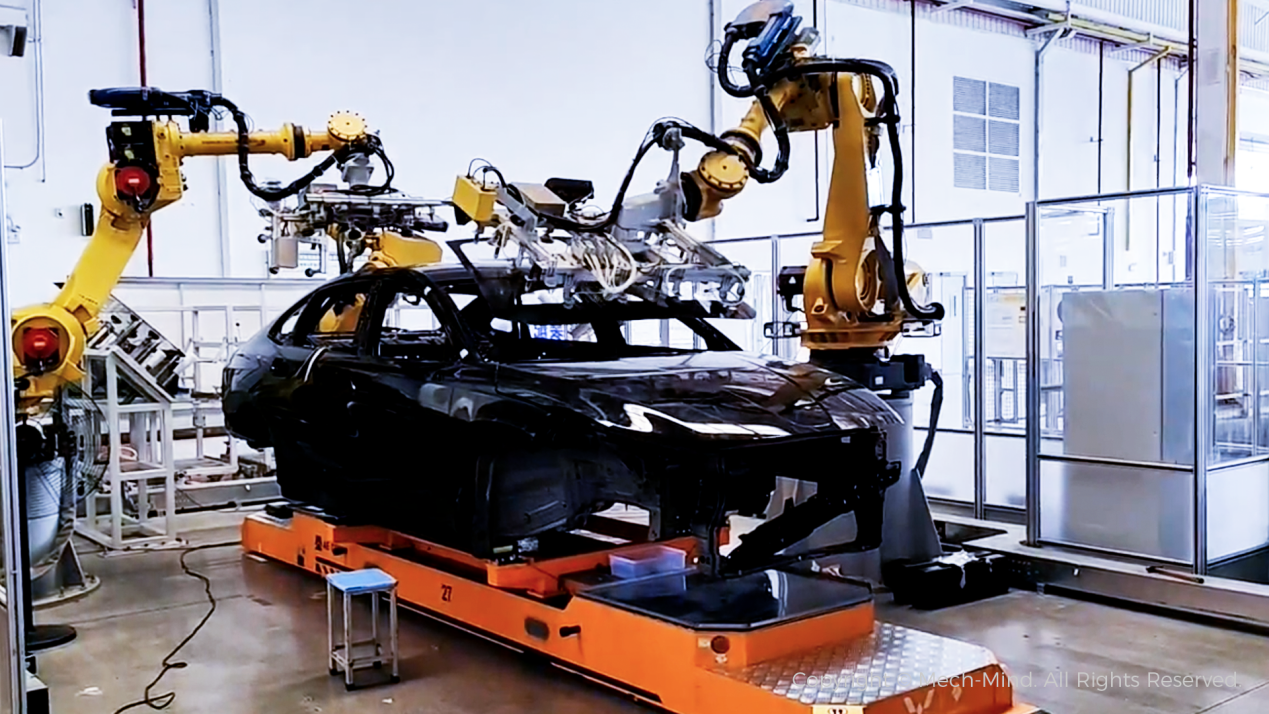
Image caption: Mech-Mind AI + robot performing windshield installation
Mech-Mind primarily provides AI + 3D vision and robotic "eye-brain-hand" components; it is not a humanoid robot manufacturer, so the two types of companies cannot be directly compared. Once an industrial vision system is integrated with robotic arms, PLCs, and production line processes, it inherently creates certain switching costs.
But there is a simple, rustic standard for doing industrial business: The first order may rely on sales capability, but the second order often depends on the product itself.
If a customer is willing to expand one set of equipment to five, replicate it from one production line to a second, and then roll it out to another factory, the quality of that growth is fundamentally different from the growth that comes from constantly hunting for new customers.
Excelland Robotics represents yet another revenue structure.
In 2025, the company generated approximately 318 million yuan in revenue. Of that, RaaS—or "Robot as a Service"—revenue was about 49.88 million yuan, accounting for 15.7%. Between 2023 and 2025, this revenue stream grew from 9.38 million yuan to 49.88 million yuan.
RaaS does not focus on "how much to sell a robot for," but rather links fees to actual usage: charges can be based on deployment time, or on the number of orders and volume of work.
If a robot sits idle on site, it becomes very difficult to keep collecting that money.
While this segment currently accounts for a modest share and its profitability is far from mature, it makes the status of the robots after delivery much easier to observe.
Unitree, Mech-Mind, and Excelland Robotics are certainly not the three standard answers.
They simply represent different facets you see when "robot revenue" is broken down: research procurement, industrial repurchasing, hardware sales, and ongoing operations.
On the balance sheet, it's all called operating revenue, but the underlying businesses are completely different.
"Done This Year, Do Even More Next Year"
This is why one sentence from Shao's second post is worth highlighting on its own.
He said: "If you generate this kind of revenue this year, next year you not only have to keep doing it—you have to do more."
That line was originally buried in his criticism of some peers, but if you strip away the specific allegations, it actually hits on a major headache for listed companies: this year's growth becomes next year's baseline.
If a startup suddenly lands a few big projects and doubles its revenue, the primary market is quick to frame it as commercial acceleration.
After going public, the question becomes: What about next year?
You sold 500 units this year—where will the next 1,000 come from? You built several data collection centers this year—how many more need to be built next year? A batch of clients bought for pilot projects this year—when will the budget for the second batch arrive?
So, the "1,000-unit orders" that generated the most buzz in the robotics industry over the past two years are becoming metrics that require looking forward.
Orders for 100 units, 1,000 units, or 100 million yuan certainly have value. At the very least, they show robots have moved out of the lab and clients are willing to pay to try them.
But after an order is signed, there is still production, delivery, commissioning, acceptance, revenue recognition, and payment collection.
Only when all of that is complete does the first piece of business truly land.
Further down the line comes the truly difficult part of PMF: Is there a second order?
An automaker buys 20 robots for a pilot, expands to 200 six months later, and then replicates the same solution to other bases—that is a completely different story from one where the project stalls after the initial 20 are delivered.
The first contract might be genuine in both cases.
The difference lies in the second.
The same logic applies to data collection centers.
Robots need to learn grasping, handling, and assembly; they cannot be trained solely on internet videos. Massive amounts of real-world operational data are an infrastructure requirement that embodied intelligence cannot bypass. In June, the Ministry of Industry and Information Technology and the State-owned Assets Supervision and Administration Commission launched a special initiative for real-world scenario training for humanoid robots and embodied intelligence, explicitly calling for the accumulation of high-quality real-machine data through training in actual scenarios.
Therefore, data collection centers themselves do not deserve to be viewed with skepticism.
The same goes for local demonstration projects.
New energy vehicles had demonstration operations, and autonomous driving has test zones and demonstration areas. When a new technology enters the early stages of an industry, someone inevitably has to bear the cost of the first round of trial and error.
However, if a company preparing to go public uses such procurement as key proof of commercialization, it is only natural for the secondary market to dig deeper into the books.
What is the actual utilization rate of the equipment? Can the data tasks continue? Once the initial round of infrastructure is laid out, will equipment still need to be purchased at the same pace?
These questions are not about whether the revenue is "real or fake."
They ask whether this money can be earned repeatedly.
From "Can It Work?" to "Is It Worth Using?"
Interestingly, industrial policy is also pushing robotics toward this stage.
In June this year, the general offices of the Ministry of Industry and Information Technology and the State-owned Assets Supervision and Administration Commission jointly launched the 2026 special action for real-world scenario training of humanoid robots and embodied intelligence.
The document did not focus on achieving yet another new movement, but rather required robots to enter real-world environments such as manufacturing, inspection and maintenance, warehousing and logistics, catering and retail, medical care, and emergency rescue.
Even more noteworthy are the evaluation criteria.
Real-world operational success rates, efficiency improvement rates, safety and reliability, and economic feasibility have all been written into the application validation metrics.
By the end of 2026, the policy aims to form more than 100 high-value application scenarios, drive a deployment capacity of 10,000 units, and push robots to initiate "work mode" in a batch of representative scenarios.
The phrase "work mode" is blunt.
At launch events in the past, a robot lifting a box or tightening a screw would earn applause. In a factory, no one places a large order just because a robot succeeds occasionally.

Image caption: Galbot Galbot S1 goes to work at CATL; Image source: CATL
How long can it work in a day? Can the success rate stay within an acceptable range? How long does it take to recover after a stoppage? Do you need to assign extra staff just to maintain the robot? Ultimately, is it cheaper or more expensive than manual labor?
These questions aren't as catchy, but at the scaling stage, they are the hardest hurdles.
The industry used to be busy proving that robots "can do the job."
Now it has to start proving they are "worth using."
This, in turn, will reshape revenue.
Only when the benefits a robot brings to a client can cover the costs of procurement, deployment, and maintenance does a reason for repurchasing emerge. Without this economic calculation, even the most impressive demos or largest initial orders will struggle to sustain growth permanently.
When Robots Go From a "Sector" Back to Being a Company
Therefore, even if the news about tighter IPOs is confirmed, it would be difficult to interpret it simply as the capital market cooling on robotics.
Just three months ago, the China Securities Regulatory Commission sent a very clear signal.
On June 17, at the Lujiazui Forum, CSRC Chairman Wu Qing proposed implementing strategic deployment for future industries and supporting "hard tech" companies in fields such as quantum technology, bio-manufacturing, and embodied intelligence to list on the STAR Market.
The capital market still needs embodied intelligence and will not require all frontier technology companies to be profitable before listing.
It is not surprising for a robotics company to be temporarily in the red.
Having a small revenue scale does not necessarily pose a problem either.
If the technology is scarce enough, the market can bet on the future; if stable customers have been secured, the company can prove itself through its business; and if investment continues, the market can see losses narrowing and economies of scale taking shape.
However, with more than 140 hardware manufacturers and over 400 humanoid robots already in China, "I make humanoid robots" can clearly no longer be the valuation itself.
Companies have to return to the corporate level.
Exactly where is your technology stronger than your peers'? Why do clients choose you? Is this year's revenue from one-off projects, or will it continue to recur? Are accounts receivable ballooning along with orders? After the first batch of equipment is delivered, when will the second batch arrive?
For the past two years, humanoid robotics has been a massive "sector."
Investors invested in the sector, local governments competed for the sector, and companies were used to leading with how many trillions the market would be worth in the future.
After an IPO, the sector slowly recedes into the background.
What remains on the financial statements is revenue, gross profit, cash flow, customers, and orders.
The market on September 10 actually offered a preview of this shift.
While Unitree fell below 500 yuan, several Hong Kong-listed robotics stocks still surged. The market hasn't suddenly decided robots aren't valuable; it has just started recalculating the price for different robotics companies.
Shao said the vast majority of companies must "at least prove product-market fit" before going public.
For humanoid robots, PMF may not have a single uniform passing grade.
It could be a batch of research clients purchasing over the long term, or a factory expanding from 20 units to 200, or existing clients increasing deployments for several consecutive years, or a robot working daily on-site and continuously generating service revenue.
But ultimately, one thing must happen repeatedly: after using it, the client is still willing to keep paying.
For the past two years, robotics companies have mostly showcased their first orders. Now, the market will likely wait for the second.


