



Gasgoo Munich- At the Smart EV Development High-Level Forum 2026, Kang Bo, vice president of Seres Group, outlined a vision for global cooperation and the future of low-carbon transportation. His insights—drawn from corporate practice—reflect the broader momentum and core trends shaping China's new-energy vehicle (NEV) sector.
Kang Bo noted that China's NEV sector has achieved a dual leap in both quality and volume over the past five years. Domestic penetration rates have surged from 5% to 50%, and China is projected to account for more than 60% of global NEV sales in 2025—cementing its status as the core driver of the global auto industry's green transition. As the sector undergoes profound change, the deep integration of electrification and intelligence is transforming vehicles from traditional tools into "mobile intelligent agents." This shift meets rising user demands for safety, comfort, and smart mobility, making open cooperation and cross-border integration the industry's emerging consensus.
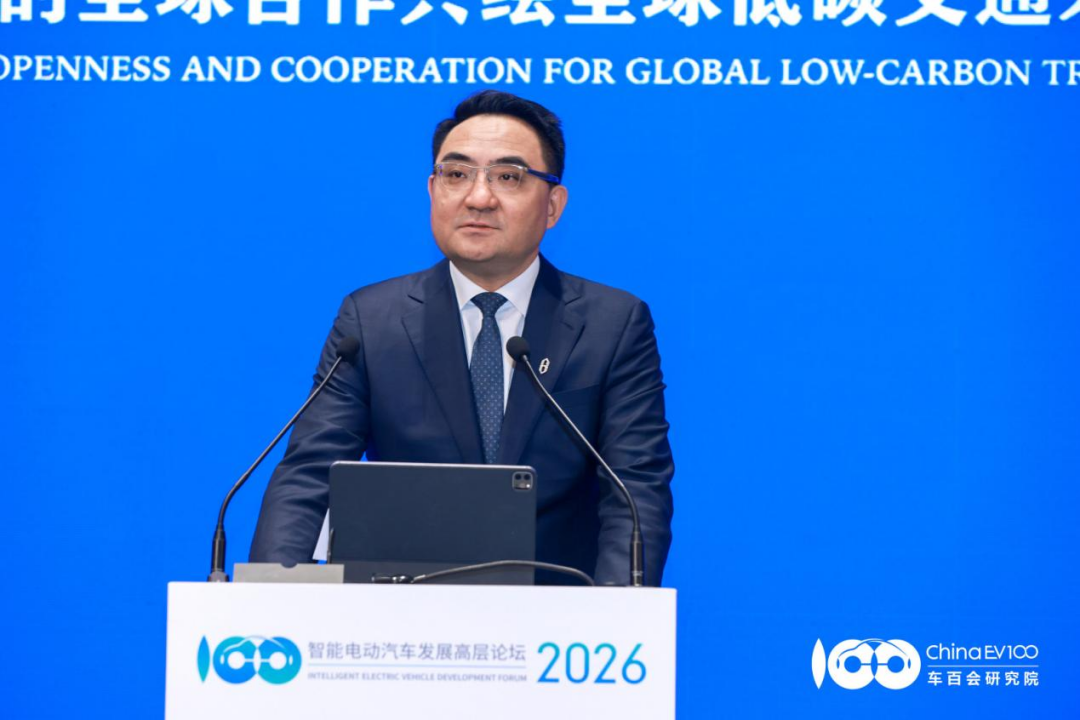
Kang Bo, vice president of Seres Group; Image source: China EV 100 Research Institute
Intelligence and premiumization remain the industry's core growth vectors. There is still significant room for NEV penetration in the luxury segment, where products blending technology with luxury are gaining market favor. In practice, cross-sector collaboration has become a critical path for upgrading intelligence. By leveraging technical synergy, companies are achieving the large-scale deployment of advanced driver-assistance systems (ADAS) and smart cockpits. User acceptance of these intelligent features continues to rise; industry data shows that ADAS usage mileage on top-selling models has surpassed 50%, underscoring the practical value of these technologies.
R&D innovation and supply chain synergy form the backbone of high-quality industry development. Companies across the board are ramping up R&D investment to drive breakthroughs in core technologies and their commercialization. Key areas like range-extender technology are now empowering the sector, with relevant technologies commanding leading market shares. On the supply chain front, innovative cooperation models—such as the "1+2+N" ecosystem and "factory-in-factory" approaches—are optimizing resource allocation. These practices enable efficient supply chain integration and collaborative innovation, significantly boosting production efficiency and offering a blueprint for the broader reconstruction of the industry's supply chain.
Global expansion has become a necessary path for the sustainable development of Chinese NEV makers. The industry's "going global" strategy is shifting from simple product exports to a comprehensive output of technology, products, services, and brand value. Kang Bo outlined a three-stage process for Chinese automakers: entering the market, moving up the value chain, and establishing a global presence. However, companies face multiple challenges, including geopolitical tensions, compliance requirements, and brand building. Consequently, the principle of "international core capabilities with localized adaptation" has become central to succeeding overseas.
Low-carbon development has also become an industry consensus, with companies setting carbon neutrality targets and fulfilling commitments through green manufacturing, green products, and eco-friendly mobility. ESG ratings are now a key indicator of a company's sustainability capabilities. Looking ahead, as electrification and intelligence deepen, cross-sector collaboration, global expansion, and low-carbon transformation will be the keys to breaking through for China's NEV industry—ultimately driving the global auto sector toward a greener future.


