



Gasgoo Munich- Gasgoo reported on April 12 that at the Auto Design Forum 2026, Tsinghua University's distinguished liberal arts professor Liu Guanzhong took the stage. Centering on the theme "Transcending — Leading," Liu explored the core direction of future mobility design against the backdrop of China's auto industry. He argued that Chinese automakers must break free from the narrow mindset of "building cars" and instead embrace a broader design philosophy to lead a mobility revolution. The goal is an upgrade from simply exporting products to exporting design itself.
Liu argued that China's auto industry now possesses the capacity to lead but should not confine itself to the vehicle itself. The focus must shift to the essence of "mobility." He noted that change drives global development. After a century of automotive history, China should not settle for merely leading the car sector; it must shatter traditional thinking and leap from "manufacturing" to "creation." This means moving beyond an over-reliance on cultural symbols and tapping into the traditional wisdom of "harmony between humanity and nature" — achieving a symbiotic relationship among people, technology, and society.
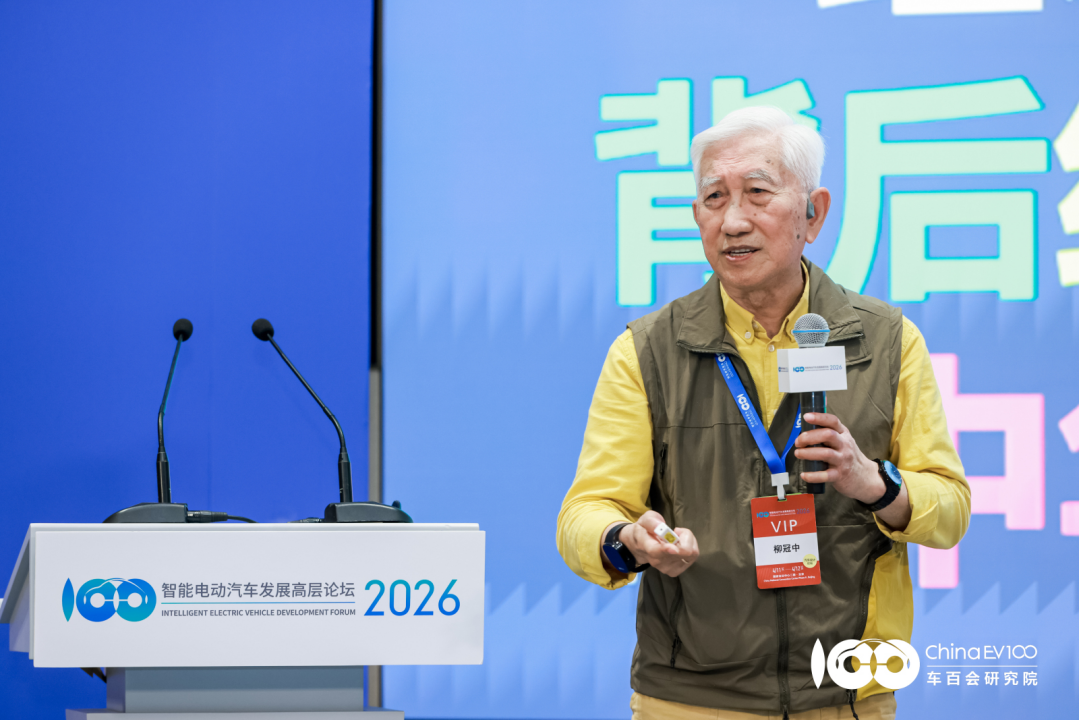
Liu Guanzhong, one of Tsinghua University's first distinguished liberal arts professors. Image source: China EV100 Research Institute
Addressing the current landscape, Liu was blunt: the industry is obsessed with "styling" while neglecting the core issues of "structure and system." Some firms expanding overseas remain trapped in traditional dependencies. He emphasized that the industry needs strategic, macro-level design to drive development — not just a stream of new products. The focus must shift to creating new categories and industries, shouldering the design responsibility of building a new society.
On the topics of global expansion and "new quality productive forces," Liu argued that Chinese automakers cannot settle for merely exporting products. They must achieve "design export" — shipping out entirely new mobility concepts. He interpreted the core of new quality productive forces not merely as technological upgrades, but as a catalyst for transforming production relations, corporate management, and market mechanisms. By innovating standards and models to unleash productivity, the industry must return to its "people-first" roots — addressing diverse human needs rather than purely driving consumption.
Liu stressed that the core of design is problem-solving, not chasing luxury or a singular look. Future mobility design must target actual needs — solving pain points in scenarios like commuting or community gatherings. He advocated for a shared mobility model that prioritizes "usage over ownership." While AI can provide technical support, he insisted that final decisions must remain human-centric. Chinese automotive design needs to break free from the constraints of digital technology, distilling knowledge into wisdom. The aim is to craft mobility solutions that fit life itself, forging a development path with distinct Chinese characteristics.

