



Gasgoo Munich- Hyundai Motor Group has deployed gardening, delivery, and security robots at its renovated Seoul headquarters, aiming to boost convenience for employees, according to Gasgoo.
The lineup features the DAL-e Gardener, a service robot designed for landscape management; the DAL-e Delivery, which handles beverage drop-offs; and Spot, a security robot developed by Boston Dynamics, Hyundai's robotics subsidiary.
While Hyundai frames the move as an effort to foster an office where humans and machines coexist naturally, it carries broader weight. It signals the automaker's accelerated push into embodied intelligence and marks a pivotal moment for South Korea's robotics sector as it shifts from concept to reality.
A "Triple Rehearsal" Inside Hyundai's HQ
By using its own turf as a proving ground, Hyundai's headquarters deployment amounts to a carefully orchestrated strategic drill.
First, the trio addresses three distinct scenarios—landscaping, in-building delivery, and security patrols—covering the typical service requirements of modern commercial real estate. The DAL-e Gardener handles automatic trimming and watering, the DAL-e Delivery shuttles beverages between offices, and Spot takes on autonomous patrol duties.
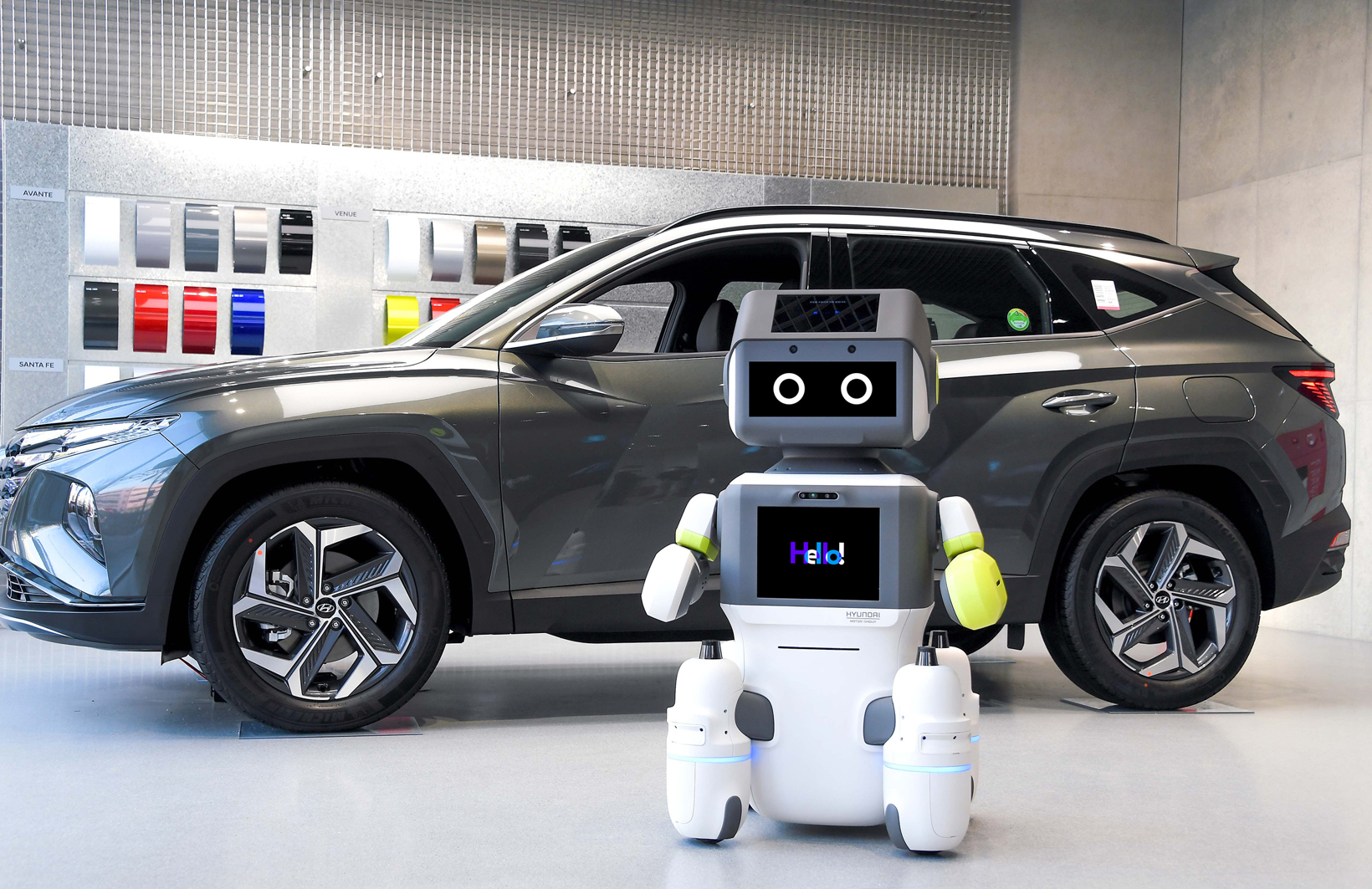
Hyundai Motor Group introduces the AI service robot "DAL-e"
Crucially, an in-house deployment allows internal technical teams to gather real-world operational data and observe how the machines perform in a complex office environment. This setup validates the stability of navigation algorithms, the fluency of human-machine interaction, and the efficiency of multi-robot coordination.
Secondly, the deployment demonstrates that Hyundai's dual-track strategy of "acquisition plus in-house R&D" is entering a phase of integration and tangible results.
An easily overlooked detail is that these robots originate from two distinct R&D ecosystems. Spot comes from Boston Dynamics, a fully acquired U.S. subsidiary representing world-class motion control and quadruped technology. The DAL-e series, meanwhile, hails from Hyundai's domestic robotics labs in Korea, focusing more on productizing services for specific scenarios.
Deploying products from both ecosystems in the same space proves Hyundai has successfully bridged the full chain: integrating cutting-edge technology, commercializing it, and validating it in real-world scenarios.
Notably, the DAL-e delivery robot had already been tested in cities like Seoul, handling "last-mile" deliveries for food, groceries, and parcels.
More importantly, this deployment signals that South Korea's embodied intelligence industry is shifting from "feasibility" to "utility."
As a benchmark for South Korean manufacturing, Hyundai's routine use of robots at its headquarters carries significant weight. The commercialization of service robots has long faced a core dilemma: technology demos are dazzling, but once deployed in real environments, issues like stability, cost, and user acceptance quickly surface.
Hyundai's move sends a clear signal to other domestic players: deploying service robots in office settings is now practically feasible.
When an industry leader takes the first bite, confidence across the supply chain tends to rise—and follow-up action accelerates.
The path forward is hardly guaranteed to be smooth. Will Spot and the DAL-e series maintain stable performance? How receptive will employees be to robot-delivered coffee? Are long-term maintenance costs manageable? Only time will tell. Yet, Hyundai has undeniably pressed "start" on the verification phase.
South Korea's Robotic Ambitions
As Hyundai pushes ahead with R&D and deployment, the South Korean government is doubling down on the sector. Over the past two years, it has rolled out a series of major policy initiatives.
Back in 2023, Seoul unveiled a robotics development strategy aiming to invest more than 3 trillion won by 2030. The goal: expand the market size from 5.6 trillion won in 2021 to over 20 trillion won by 2030, and deploy 1 million robots across various sectors.
In April 2025, the country launched the "K-Humanoid Robot Alliance" to foster an ecosystem dedicated to the R&D and production of humanoid robots. The initiative aims to develop an AI foundation model tailored specifically for locally made machines, positioning Korea to capture the emerging "one robot per household" market.
Then, in August 2025, the government announced a comprehensive "AI Great Transformation" across corporations and public agencies. The objective: transform South Korea into the world's leading powerhouse in physical AI—the convergence of artificial intelligence and robotics.
Specifically in robotics, the plan is to develop general-purpose humanoid robots within five years and deploy them in logistics and manufacturing, with the aim of breaking into the global top three in humanoid technology.
Overall, according to a representative from the South Korean Embassy in China, the country's focus in embodied intelligence centers on three areas: developing general-purpose technologies for sectors like logistics and emergency response; enhancing autonomy levels, with shipbuilding, automotive, and precision manufacturing serving as the primary application scenarios; and cultivating a more open ecosystem.
These aggressive moves stand in contrast to South Korea's gradually waning momentum in the embodied intelligence sector.
Earlier this year, the Korea Institute for Industrial Economics and Trade (KIET) released a report titled "Analysis of Competitiveness and Policy Directions for Korea-China High-Tech Industries." It concluded that China has secured a competitive edge over South Korea across the entire value chain of major high-tech sectors—including robotics, electric vehicles, batteries, and autonomous driving—semiconductors excluded.
Specifically regarding robotics, KIET noted that China outperforms South Korea in pricing and infrastructure, holding a lead in overall industrial competitiveness.
Currently, South Korea's strategy in embodied robotics is spearheaded by two giants: Hyundai Motor and Samsung.
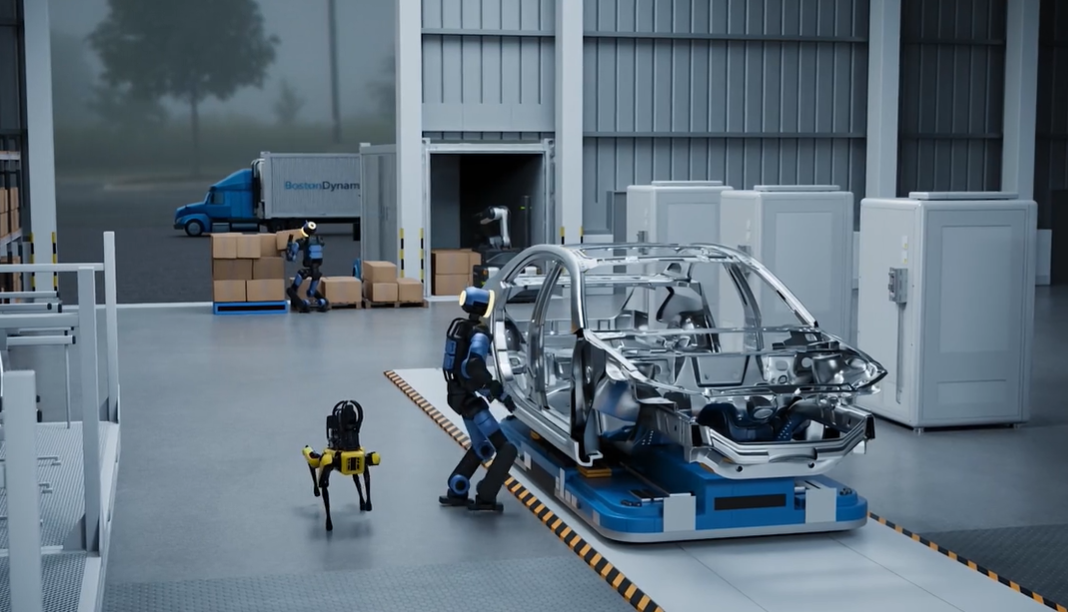
Image Source: Boston Dynamics
Hyundai is anchoring its strategy on Boston Dynamics, pursuing a path of "acquisition and integration." At CES 2026, the group officially unveiled its AI robotics strategy: to introduce the Atlas humanoid robot into production lines by 2028, achieve an annual output of 30,000 units by 2030, and build a robot manufacturing plant in the United States.
Samsung, conversely, has chosen a path of "vertical integration and in-house deployment." Since 2023, the electronics giant has steadily increased its stake to gain control of Rainbow Robotics. It also established the "Future Robot Promotion Team" and "InnoX Lab" to focus on developing core humanoid technologies.
Samsung's unique advantage lies in its "dual role": it is both a robot manufacturer and one of the world's largest potential users. Its semiconductor wafer fabs and consumer electronics assembly lines serve as prime application scenarios for humanoids. This "self-developed, self-deployed" model creates an efficient closed loop between R&D and application, while ensuring a massive domestic market to support scaled deployment.
Meanwhile, at the ecosystem level, a wave of specialized SMEs is rising rapidly. Companies like Tesolo, which focuses on robotic end-effectors, and Neubility, an autonomous delivery robot specialist, form an innovation tier beyond the major conglomerates.
Additionally, battery technology from Samsung SDI and LG Energy Solution, combined with the component capabilities of Hyundai Mobis, provide solid underpinning for complete system integration.
However, overall statistics indicate that the localization rate for robotic components and materials in South Korea currently hovers around just 40%. By comparison, the supply chain localization rate for Chinese robot makers has already topped 60% in 2025.
Yet, it is undeniable that South Korea's strategy—led by major conglomerates, supplemented by innovative SMEs, and supported by existing industrial foundations—is clear. Its ambition to secure a foothold in the global embodied intelligence race is fully on display.
Latest reports suggest the South Korean military is even exploring a strategic partnership with Hyundai Motor to study deploying robots on the front lines. The goal is to effectively address the country's worsening troop shortage by fielding a larger robotic force on the battlefield.
This means that from commercial production to national defense, South Korea's robotics deployment now spans diverse scenarios. Its strategic goal of becoming a "robotics powerhouse" is steadily transitioning from paper plans to concrete action.


