



Gasgoo Munich- In the first part of our deep dive, "Chinese Solutions to the World — The Rise of China's Auto Supply Chain," titled "Top 100 | Global Auto Tier 1s Are Undergoing a Power Shuffle," we looked at shifts in the Global Automotive Supplier Top 100 list to observe how Chinese suppliers are climbing the global value chain.
But rankings are just the result. The real question is: What capabilities are driving this shift?
The smart chassis offers a perfect vantage point.
On one side, Chinese suppliers are breaking into core domains like braking, steering, and suspension—fields once guarded by high barriers. On the other, international giants like Bosch and ZF are shifting more R&D, engineering, and debut validation to China before taking those results global.
The outcome is far from settled. Yet the old landscape is starting to crack.
A Supplier with 20 Million Yuan in Revenue Puts EMB into Mass Production
Roll back the clock five years, and it would have been hard to imagine a major breakthrough in next-generation braking coming from a Chinese company with just 20 million yuan in annual revenue—Orient-motion Technology Co..
In April 2026, the Chery Exeed EX7 will enter mass production equipped with Orient-motion Technology Co.'s intelligent EMB.

EMB (Electromechanical Braking) is a technical term that doesn't easily register with consumers. Simply put, traditional cars rely on hydraulic fluid to transmit braking force to the wheels when you hit the pedal. EMB removes the brake fluid and hydraulic lines entirely, generating braking force directly through motors at the wheel.
After more than a century of automotive evolution, braking is finally going fully "by-wire."
This is the next-generation technology that global giants like Bosch, Continental, and ZF are all fighting for. But this time, a Chinese company dwarfed by traditional global Tier 1s was the first to get it into a mass-produced passenger car.
And this won't be the only surprise in 2026.
The NIO ET9 has already integrated steer-by-wire, rear-wheel steering, and fully active suspension into its SkyRide chassis. ZF’s steer-by-wire system eliminates the mechanical connection between the steering wheel and the front wheels. ZF officially hails the ET9 as China’s first mass-produced car with a true steer-by-wire system.
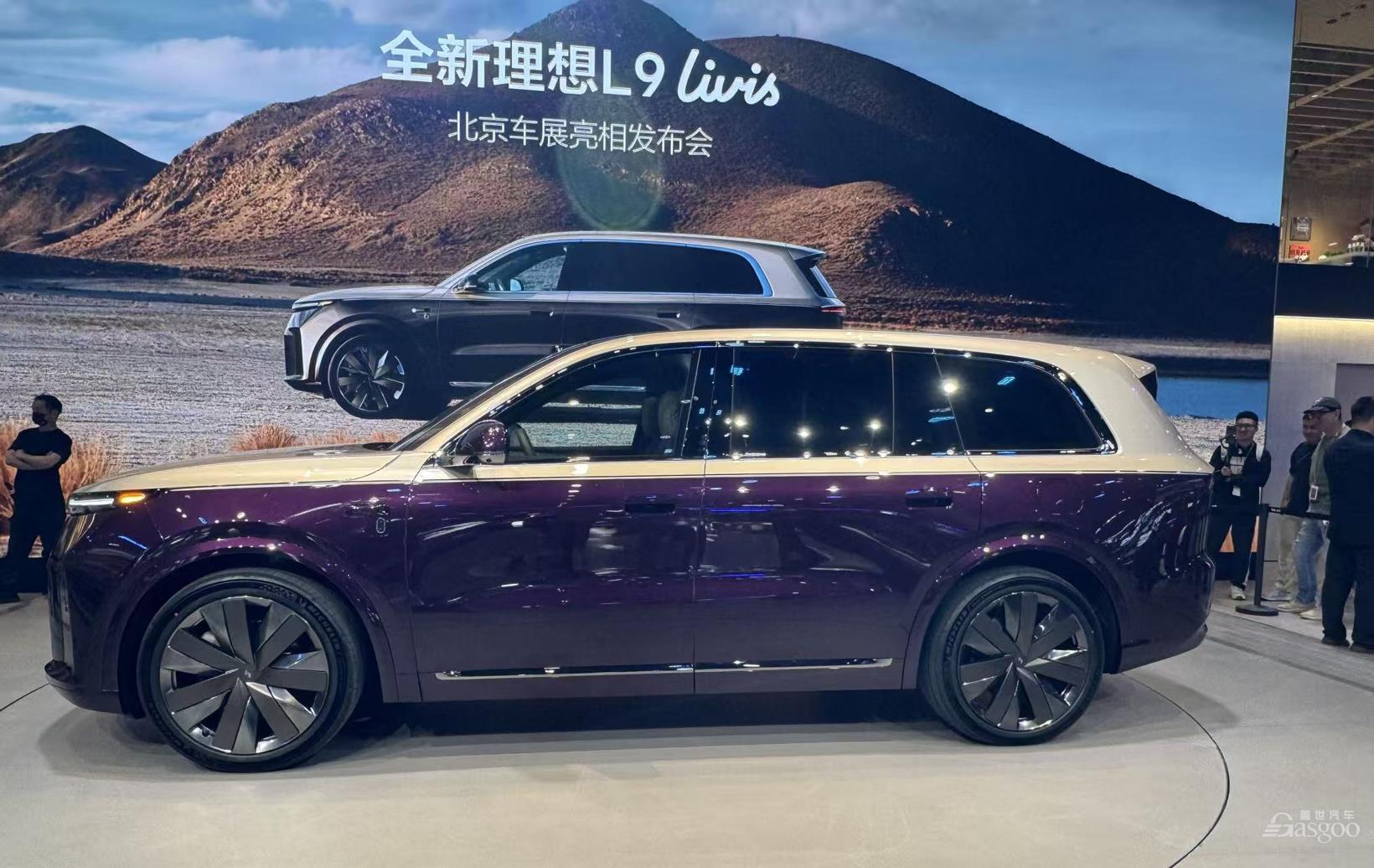
Around the Beijing Auto Show 2026, another wave of technology landed: the Denza Z convertible featured BYD’s full-stack self-developed steer-by-wire; the new Li Auto L9 Livis combined steer-by-wire, rear-wheel steering, EMB, and active suspension in a single chassis system; and XPENG’s GX is advancing the fusion of steer-by-wire, rear-wheel steering, brake-by-wire, and air suspension.
Companies may choose slightly different technical paths, but the direction is strikingly similar: braking, steering, and suspension are moving from mechanical to electronic control, and from independent actuators to the fusion of longitudinal, lateral, and vertical motion.
Nor are Chinese automakers the only protagonists.
ZF’s steer-by-wire launched first with the ET9. Bosch, meanwhile, explicitly forecasts that cumulative sales of its brake-by-wire and steer-by-wire systems will exceed 7 billion euros by 2032.
For the chassis industry, this shift is particularly significant.
You can swap cockpit chips or iterate driving algorithms, but braking and steering leave little room for error. A car can freeze and reboot, but brakes cannot. That is why, for decades, the core chassis market was one of the deepest strongholds of traditional global Tier 1s.
But by-wire technology is prying that door back open.
As mechanical links are replaced by electronic signals, chassis competition is no longer just about mechanics, materials, and tuning. It now involves actuators, software, functional safety, and motion control algorithms.
A 20 million yuan company beating Bosch to mass production with EMB doesn’t mean it has the strength to challenge the German giant outright.
But at the very least, the door to the table has been reopened.
Why Are Brake Makers Suddenly Building Steering and Suspension?
If you look at the product catalogs of China’s smart chassis companies today, a curious pattern emerges: everyone is branching out.
WBTL's core business was braking. Now, beyond basic braking, WCBS, and EMB, it has moved into electric steering, steer-by-wire, air suspension, and even ADAS.
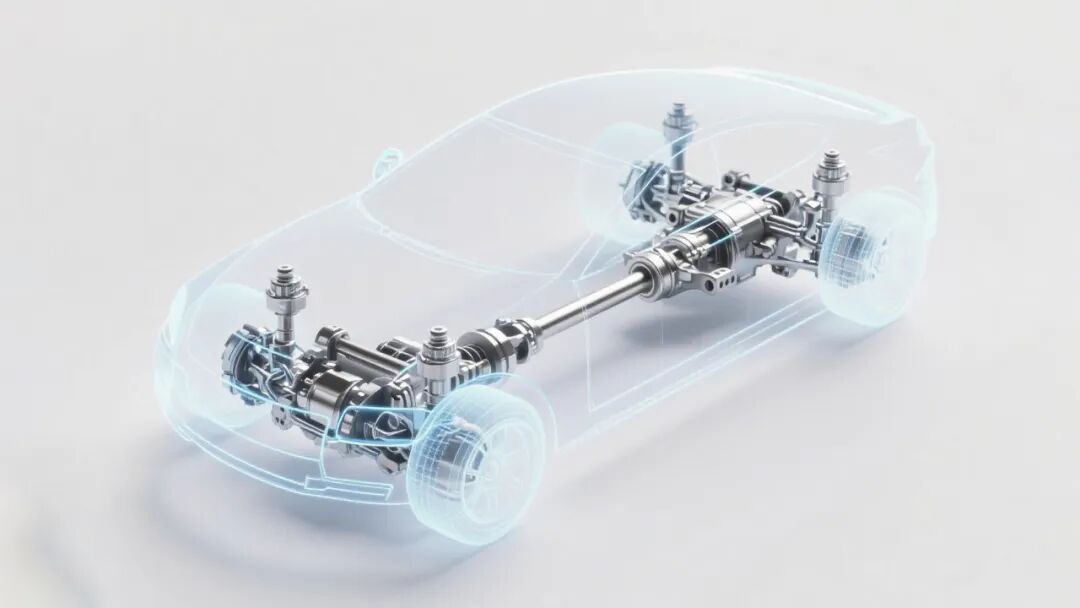
Image Source: WBTL
Baolong first built its edge with TPMS, then moved into sensors, and has now become a key supplier for air suspension.
GLB Technology expanded from One-box to EMB, air suspension, and chassis domain controllers; Chenzhi Tech has already covered brake-by-wire, steer-by-wire, and active suspension.
Why is everyone crossing boundaries?
The answer lies in the car’s three basic directions of motion: braking controls longitudinal, steering controls lateral, and suspension controls vertical.
In the era of traditional cars, these three systems were relatively independent. Automakers could source them separately and then handle vehicle integration. But with by-wire technology, those walls are coming down.
Take a high-speed emergency avoidance maneuver, for example.
A future intelligent vehicle can simultaneously alter front and rear steering angles, individually control braking force on all four wheels, and suppress body roll via active suspension. The car performs one action—avoiding the obstacle—but behind the scenes, it is calling on steering, braking, and suspension all at once.
In that moment, if a supplier only understands braking, it’s hard for them to determine exactly how the car should ultimately move.
That is why WBTL’s move from braking into steering and suspension, and GLB Technology’s bundling of actuators with chassis domain controllers, aren’t just about adding a few products.
They are fighting to control the system entry point for the next generation of chassis.
New companies like Orient-motion Technology Co. offer another path: since it’s hard to fight century-old Tier 1s head-on in the mature hydraulic braking market, they bet directly on EMB to secure a spot as the technology restarts.
Thus, three types of companies are converging on the same direction: niche leaders extending from star products to systems; traditional chassis players spanning multiple domains; and new companies entering next-gen architectures via technological shifts.
This forms an increasingly clear upgrade path: parts → actuators → systems → domain control → vehicle motion control.
This is the biggest difference between this round of competition and the past "import substitution."
The old question was: A foreign product sells for 1,000 yuan—can a Chinese company make it for 700 yuan while matching performance and quality?
The question is shifting to:
What kind of chassis does the next generation of cars actually need?
Once the autonomous driving system plots a trajectory, who is responsible for making a two- or three-ton car execute it precisely?
Perception systems see the world; driving algorithms decide "where to go." But it is still the chassis that handles acceleration, braking, steering, and posture adjustment.
Competition is moving from "who can make the best parts" to "who can control the car best."
This is where Chinese suppliers have a real chance to reshape the global Tier 1 rankings.
Because the rules for the next-generation chassis haven't been fully written yet.
A Business Once Reserved for Million-Dollar Luxury Cars: Chinese Suppliers Have Seized 91.4%
But one question remains: Why is this technological shift happening so intensively in China?
Air suspension may offer the most practical answer.
Ten years ago, mentioning air suspension brought to mind the Mercedes S-Class, BMW 7 Series, or Audi A8. It was expensive, fitted in limited volumes, and the core supply chain was long dominated by international firms.
But in China’s new energy vehicle market, this technology has trickled down rapidly.
According to the Gasgoo Institute ADAS Configuration Database, in the first half of 2026, three local suppliers—Konghui Tech, Tuopu, and Baolong—jointly commanded a 91.4% market share in China’s standard-equipped passenger car air suspension market.

China didn’t invent air suspension, but in just a few years, the Chinese market has effectively re-industrialized the technology.
The initial push came from automakers.
In the NEV era, engines and transmissions—once the mainstays of luxury differentiation—have been largely marginalized. New brands need new reasons to justify a 300,000 or 400,000 yuan price tag. Beyond smart cockpits and assisted driving, chassis features like air suspension and rear-wheel steering have become new battlegrounds.
More models adopting the tech means more orders for local suppliers; larger scale lowers manufacturing costs; lower costs give automakers the confidence to put air suspension on cheaper models; installation rates rise further.
Demand → Installation → Scale → Cost Reduction → Re-installation. Once this flywheel spins, local suppliers gain more than just market share.
Different vehicles have different weights, wheelbases, and suspension structures. Different automakers have varying requirements for comfort and sportiness. The sheer volume of mass-production projects brings rapid accumulation of engineering experience in matching, calibration, reliability, and manufacturing consistency.
When overseas clients start looking for more cost-competitive air suspension solutions, Chinese suppliers aren't just holding a cheaper quote—they’re armed with data and experience from running countless mass-production projects.
That is why 91.4% is worth more attention than a simple rise in "localization rate."
It demonstrates the Chinese market’s ability to rapidly turn cutting-edge or premium configurations into scaled industrial products.
In 2025, China’s total auto parts exports reached $59.051 billion, with braking system exports alone hitting $8.119 billion—second only to body parts. It is worth noting that this $8.119 billion consists largely of traditional components, not smart chassis exports, but it shows that China’s chassis industry already possesses a massive manufacturing and trade foundation for going global.
What is truly worth watching next is: Will the path air suspension has already traveled be replicated in One-box brakes, rear-wheel steering, active suspension, or even EMB?
Especially EMB.
Today, it remains in the early stages of industrialization. Reliability, cost, and mass manufacturing issues are far from fully resolved. Precisely because of this, whoever secures more mass-production models first has the opportunity to spot problems, refine products, and amortize costs sooner.
This is where the Chinese market is distinct.
A massive NEV market, fierce configuration wars, increasingly short development cycles, and a batch of automakers willing to try new technologies have stacked together. Here, new technology isn't just about "being built"—it must quickly answer three questions:
Can it get on the car?
Can you deliver hundreds of thousands of units reliably?
Can you keep cutting the price?
In the past, the Chinese supply chain’s strength was making mature technology cheaper.
Today, an increasingly critical capability is turning not-yet-fully-mature technology into scaled products faster than anyone else.
And this capability is attracting more than just Chinese players.
When Foreign Tier 1s Start Selling "China R&D" Back to the World
In the past, multinational Tier 1s had a very mature model in China.
Germany, the U.S., and Japan handled forward-looking R&D and product definition; China handled manufacturing. Later, as the market grew, multinationals built local R&D teams, but much of the work still focused on adapting global products for Chinese clients.
Now, that division of labor is shifting.
In August 2025, ZF announced that its first active rear-wheel steering project—designed and developed by its Chinese team—went into production in Zhangjiagang.
What really matters isn't just another production line.
ZF emphasized that this was the first mass-production project in its rear-wheel steering business led by a Chinese team, breaking the traditional model of adopting mature global designs and then performing industrial validation in China.
Chinese engineers are moving from "localization" to "building products from scratch."
Steer-by-wire is even more typical.
ZF’s steer-by-wire started production in Zhangjiagang in the first quarter of 2025, debuting on the NIO ET9. Since then, the company has expanded capacity there not just for Chinese clients, but explicitly for domestic and foreign markets. At the same time, ZF has won an order from Mercedes-Benz, planning to bring the technology to Europe.
This raises an intriguing question: If a German company, with deep R&D involvement from its Chinese team, mass-produces and validates a technology in China first before taking it to Europe, is it German technology or a "Chinese solution"?
Bosch is undergoing a similar shift.
By-wire technology has become a core growth direction. Bosch forecasts cumulative sales of brake-by-wire and steer-by-wire will exceed 7 billion euros by 2032. Meanwhile, China is no longer just a sales market for these new technologies—it is a key site for R&D, engineering, and co-defining products with local automakers.
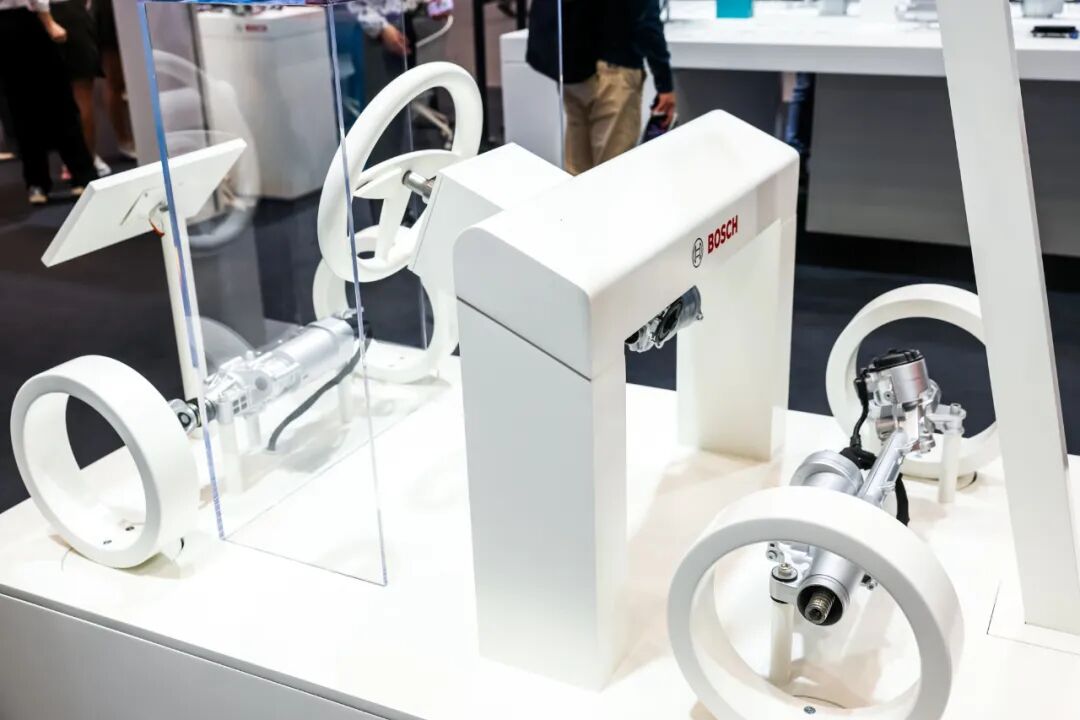
Bosch Steer-by-Wire Four-Wheel Solution; Image Source: Bosch
On the other side, Chinese suppliers are also moving outward.
WBTL has established R&D centers in the U.S. and Germany, built a production base in Mexico, and is advancing new overseas manufacturing layouts. Baolong’s business and manufacturing network have entered markets including the U.S., Germany, Austria, Hungary, and Thailand.

Baolong’s Global Layout; Image Source: Baolong Tech
This is different from the simple "parts export" of the past.
Becoming a true global Tier 1 has never been about shipping a container of parts to Germany. It’s about whether you can enter global automakers’ platform development systems, whether you can complete R&D, validation, manufacturing, and delivery locally, and whether you can shoulder the responsibilities of a system supplier.
So, the idea that "the old pattern of smart chassis is being rewritten" doesn’t mean Chinese companies have already captured the majority of the global market.
The change is happening at a deeper level.
On one side, Chinese suppliers are entering the core strongholds of braking, steering, and suspension. On the other, international Tier 1s are integrating China into their global R&D and technology output systems.
The past one-way division of labor—"Western R&D, China manufacturing, global sales"—is evolving into an increasingly complex two-way flow.
This is perhaps what truly makes "Chinese Solutions to the World" worth watching.
In the first part of this series, we looked at the Global Tier 1 Top 100 list and saw the result: more Chinese suppliers, higher rankings, and shifting positions for traditional giants.
In this piece on smart chassis, we are seeing the deeper reasons behind that list.
The real change in China’s supply chain isn’t just that companies are getting bigger or that localization rates are rising.
It is that, before the rules for the next technological roadmap are fully set, some Chinese companies have already taken a seat at the table. Meanwhile, global giants are also leveraging the Chinese market, Chinese engineers, and the Chinese supply chain to define the next generation of products.
The watershed moment for "Chinese Solutions to the World" may be right here: it is no longer about Chinese companies making what foreigners have already made, only cheaper. It is about Chinese companies, engineers, and markets participating in the answer to the question of what the next generation of cars should look like—before that question is even fully settled.
From entering the global supply chain to participating in defining it—this may be the true old pattern being rewritten in the global race for smart chassis.


