



According to Gasgoo Research Institute, BYD's passenger vehicle exports from January to March 2026 showed clear characteristics of "high concentration in leading markets, diversified regional structure, and differentiated powertrain strategies." Brazil emerged as the core growth engine with a significant volume advantage, while multiple European markets recorded simultaneous growth, providing stable support for overall exports.
Meanwhile, the Middle East and several emerging markets achieved structural breakthroughs driven by plug-in hybrid models. Overall, BYD continues to strengthen its global market penetration through a dual-track strategy of battery electric vehicles (BEVs) and plug-in hybrid electric vehicles (PHEVs), combined with differentiated regional market strategies, maintaining solid export growth momentum.
Here are the top 10 destination countries by BYD passenger vehicle exports from January to March 2026, with detailed data:
NO.1 Brazil: 53,355 battery electric passenger vehicles and 36,282 plug-in hybrid electric passenger vehicles were exported from January to March 2026, totaling 89,637 units.
NO.2 United Kingdom: 5,120 battery electric passenger vehicles and 12,283 plug-in hybrid electric passenger vehicles were exported from January to March 2026, totaling 17,403 units.
NO.3 United Arab Emirates: 553 battery electric passenger vehicles and 14,332 plug-in hybrid electric passenger vehicles were exported from January to March 2026, totaling 14,885 units.
NO.4 Belgium: 6,840 battery electric passenger vehicles and 7,693 plug-in hybrid electric passenger vehicles were exported from January to March 2026, totaling 14,533 units.
NO.5 Australia: 9,558 battery electric passenger vehicles and 4,419 plug-in hybrid electric passenger vehicles were exported from January to March 2026, totaling 13,977 units.
NO.6 Germany: 6,320 battery electric passenger vehicles and 4,329 plug-in hybrid electric passenger vehicles were exported from January to March 2026, totaling 10,649 units.
NO.7 Spain: 4,170 battery electric passenger vehicles and 4,022 plug-in hybrid electric passenger vehicles were exported from January to March 2026, totaling 8,192 units.
NO.8 Hong Kong, China: 7,329 battery electric passenger vehicles and 21 plug-in hybrid electric passenger vehicles were exported from January to March 2026, totaling 7,350 units.
NO.9 Israel: 275 battery electric passenger vehicles and 5,668 plug-in hybrid electric passenger vehicles were exported from January to March 2026, totaling 5,943 units.
NO.10 Slovenia: 3,673 battery electric passenger vehicles and 2,070 plug-in hybrid electric passenger vehicles were exported from January to March 2026, totaling 5,743 units.
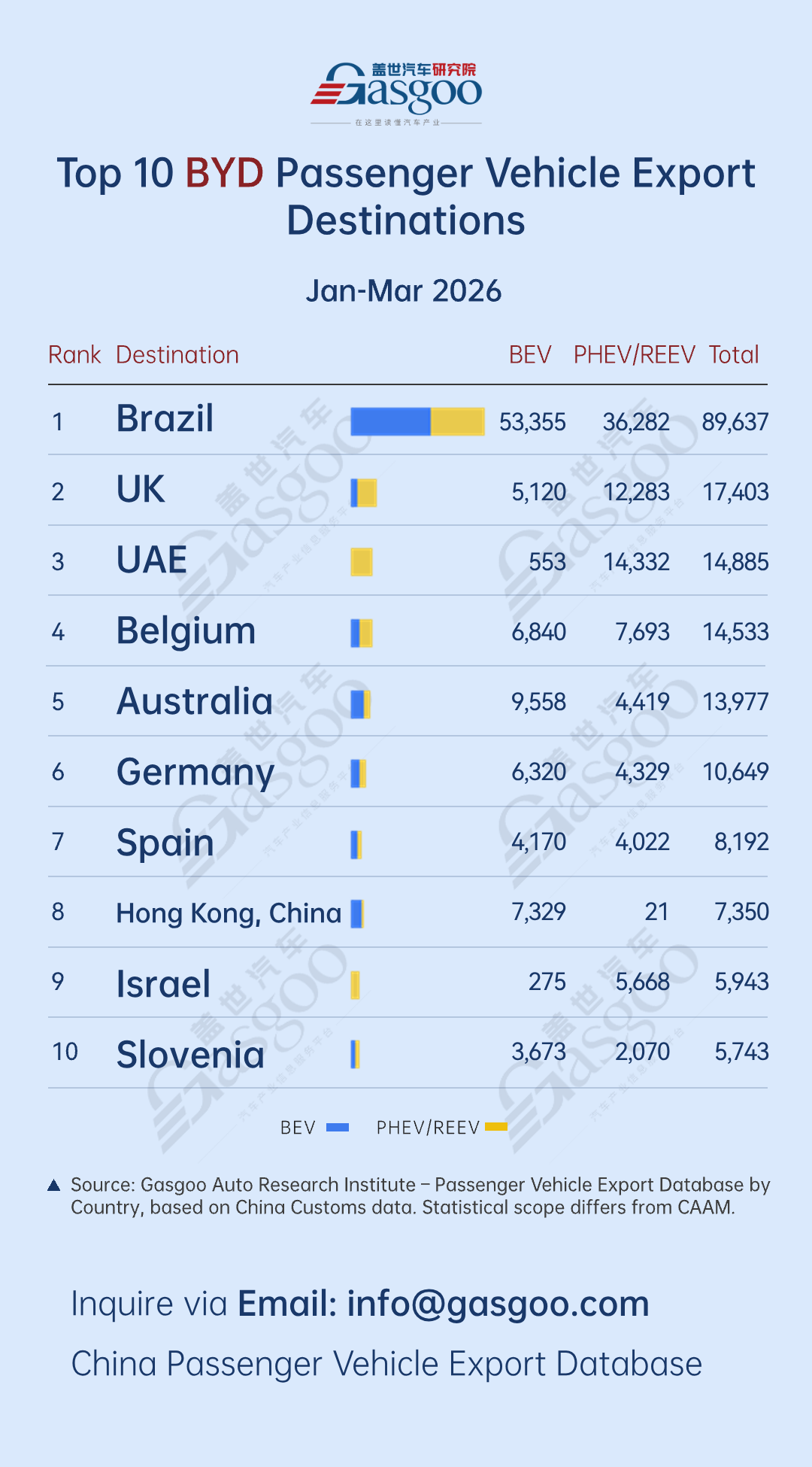
From the distribution of BYD's passenger vehicle export destinations in January–March 2026, Brazil ranked far ahead with 89,637 exported units, significantly outperforming the second-largest market and becoming BYD's most important overseas market at present. In terms of product mix, the Brazilian market demonstrated a typical "BEV + PHEV dual-drive" structure, with BEVs (53,355 units) accounting for a larger share, while PHEVs (36,282 units) also reached a considerable scale. This reflects the strong acceptance of multiple powertrain routes in response to local mobility needs that combine both urban commuting and long-distance travel. Such a dual-track structure has become a key driver supporting BYD's rapid volume growth in emerging markets.
The European market, meanwhile, showed characteristics of "multi-market growth and balanced structure." The UK (17,403 units), Belgium (14,533 units), Germany (10,649 units), and Spain (8,192 units) all ranked among BYD's top export destinations, with relatively balanced overall distribution across the region. Among them, the UK market was mainly driven by plug-in hybrid vehicles (12,283 units), while Germany and Spain showed a relatively balanced mix between BEVs and PHEVs. Belgium also demonstrated a balanced structure, reflecting the broad acceptance of both technology routes across the European market.
In the Middle East, the United Arab Emirates (14,885 units) and Israel (5,943 units) were both primarily driven by plug-in hybrid vehicles, with PHEV volumes significantly exceeding those of BEVs. This is closely related to local long-distance travel scenarios, charging infrastructure conditions, and consumer demand for stable driving range, highlighting the adaptability advantages of plug-in hybrid models across diverse energy-use environments. Meanwhile, Oceania also delivered strong performance. Australia (13,977 units) was mainly driven by BEVs, reflecting the continued improvement in local acceptance of NEVs.
Overall, BYD has established a global strategy characterized by "regional differentiation + dual technology routes": scale-driven expansion in Latin America, balanced penetration in Europe, plug-in hybrid breakthroughs in the Middle East, and steady growth across other regions. The precise alignment between different markets and powertrain strategies is becoming a key pillar supporting BYD's continued global expansion and export growth.


