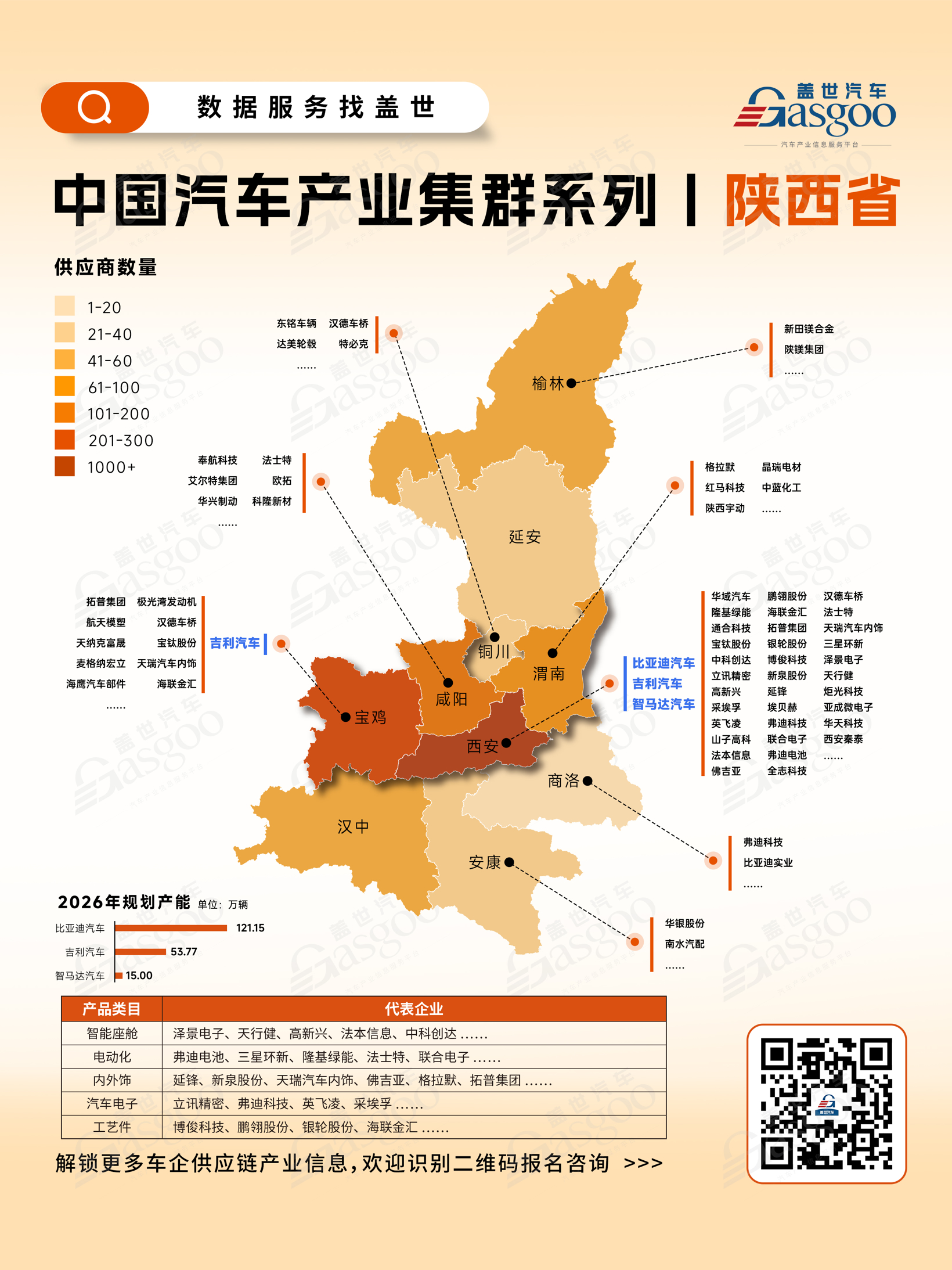
Gasgoo Munich- According to data from Gasgoo Global Automotive Industry Database, Shaanxi's auto sector is characterized by "centralized agglomeration, Guanzhong dominance, and gradient distribution." Industrial resources are heavily concentrated in the Guanzhong city cluster. With Xi'an at the core, the industry radiates outward to Baoji, Xianyang, and Weinan, forming a clearly defined hierarchical structure.
As the province's automotive heart, Xi'an boasts the highest tier of suppliers with over 1,000 firms, underscoring a significant agglomeration effect. It is not only the region with the densest concentration of OEMs but also home to one of the most complete industrial chains. On the manufacturing front, players like BYD, Geely, and smart Automobile have established a strong presence. The supply chain, meanwhile, gathers critical enterprises such as Fast, FinDreams Battery, and ThunderSoft, covering power batteries, transmission systems, and core electronics. Leveraging strong research resources and a defense industry foundation, Xi'an has emerged as the undisputed growth engine for Shaanxi's auto sector.
Baoji stands out as the most prominent industrial hub outside Xi'an, with its supplier base sitting in the upper tier of 200 to 300 companies. The city prioritizes heavy-duty trucks and key components. Geely has a manufacturing footprint here, while the supply chain features firms like Tuopu Group, Tenneco Fusheng, and Magna Hongli, covering core areas such as chassis systems, powertrains, and structural components. Overall, the region excels in equipment manufacturing, serving as a vital hardware support node within Shaanxi's automotive chain.
Xianyang, bordering Xi'an, holds a mid-tier supplier count ranging from 101 to 200. Driven by the industrial spillover from the provincial capital, the city has gradually built an ecosystem centered on auto parts and supporting manufacturing, attracting companies like Fenghang Technology and Fast. Its advantages lie in geographic proximity and relatively lower comprehensive costs, allowing it to efficiently absorb capacity transfers from the core city. This makes Xianyang a crucial supporting pillar for the coordinated development of the Guanzhong automotive industry.
In terms of production capacity planning, public information indicates Shaanxi is targeting a total planned output of over 1.89 million vehicles by 2026. BYD dominates the landscape with a planned capacity of roughly 1.21 million units, followed by Geely at approximately 537,700 units and Smart at 150,000 units, creating a complementary structure.
Overall, Shaanxi's auto industry has established a cluster-driven development model anchored by Xi'an and the Guanzhong axis, achieving a certain scale and industrial foundation. However, compared to the eastern coastal regions, gaps remain in supply chain completeness, corporate density, and market maturity. Looking ahead, as new energy vehicle projects continue to land and the supply chain strengthens, Shaanxi is poised to elevate its standing in the national automotive landscape—though its trajectory will continue to rely heavily on the sustained driving power of its core cities.