



Gasgoo Munich- It's that time of year again: the Chengdu Auto Show.
As I write this, I'm preparing for my trip to Chengdu. Unlike previous years, my WeChat and inbox have been noticeably quieter ahead of departure. Invitations for out-of-town media—complete with flights and hotels—are few and far between.
A look at this year's published floor plan reveals an even starker shift. Lamborghini, Bentley, Porsche, Rolls-Royce—the brands that once anchored the luxury halls at Chengdu—have been absent for years running.

Floor plan for the 2026 Chengdu Auto Show; Image source: Chengdu Auto Show Organizing Committee
It brings to mind an interview I conducted six years ago.
At the time, Lamborghini had just announced it was pulling out of traditional auto shows. Yet on June 20, 2020, Francesco Scardaoni, then managing director for mainland China, Hong Kong, and Macau, showed up at the Greater Bay Area Auto Show. He made a point to clarify: "We are no longer participating in international auto shows in Europe and the U.S., but we are not leaving China. We have recognized the unique nature of the Chinese market."
His reasoning was straightforward: "In China, auto shows play a direct and critical role in sales. But many clients in Europe and the U.S. aren't enthusiastic about them; they prefer one-on-one communication with dealers and the brand."
A month later, Lamborghini was back at the Chengdu Auto Show.
Six years on, Chengdu remains a major hub for car consumption in China, and the auto show is still packed with crowds. Yet Lamborghini stopped exhibiting in 2025, and it's nowhere to be found on the 2026 floor plan.
Lamborghini is far from the only change. Over the past two years, a slew of luxury, joint-venture, and even new-energy brands have vanished from the Chengdu floor plan. Meanwhile, Chinese automakers like BYD, Chery, and Changan have started "booking entire halls," expanding their presence with ever-larger booths.
Some are pulling back, while others are doubling down.
This makes a question that seemed answered six years ago worth asking again: If auto shows directly drive sales, why are more and more automakers concluding they can skip some of them?
Or to put it more bluntly—Does China really need this many auto shows today?
Has the Chengdu Auto Show really "cooled off"?
A week before the 2026 Chengdu Auto Show opens, chatter about the event's "cooling down" has already begun circulating in automotive media circles.
The sentiment is easy to grasp. With brands skipping the event and fewer media invitations going out, it's hard not to feel that the buzz is fading.
But another set of figures makes it hard to square with that narrative.
The 2025 show spanned 220,000 square meters, drawing nearly 120 brands and more than 1,600 vehicles. It ultimately attracted 910,200 visitors, generated 33,745 orders, and racked up 5.753 billion yuan in transaction value.
The halls aren't empty, and consumers haven't vanished. More intriguingly, as one group of brands exits, another is doubling down. BYD, Chery, and Changan have each booked entire halls at the group level…
So, rather than declaring the Chengdu Auto Show "dead," a more accurate shift might be this: Perceptions of its value among companies are diverging.
Looking back now, it's clear that "sales-driven" was never really a new label for Chengdu.
As a key consumer market in the Southwest, Chengdu has always had a solid sales foundation. It also sits neatly between the April Beijing and Shanghai shows and the year-end Guangzhou show. In the past, when automakers had deeper pockets, many chose Chengdu for new product launches, brand events, and media outreach.
Thus, the convergence of Southwest sales demand and national brand communication needs created the buzz of Chengdu auto shows past.
Today, those 900,000-plus visitors and 30,000-plus orders prove consumers are still here, and the numbers are still substantial. What has truly changed is that as industry profits compress and marketing budgets tighten, automakers are cutting back on communication spend where returns are hard to measure directly.
The "fewer invitations" journalists noticed this year may be the most visible result of that shift.
The Chengdu Auto Show hasn't suddenly turned into a marketplace; rather, as brand communication spending recedes, its sales-driven foundation is becoming more apparent.
This also explains why companies are making such starkly different choices.
For automakers like BYD, Chery, and Changan, with their massive product portfolios, hundreds of thousands of consumers flooding the halls represent a vast pool of potential buyers. Booking an entire hall allows them to display dozens of models at once, all directly driving leads and orders.
Luxury and ultra-luxury brands, however, are doing a different kind of math.
China's luxury car market has been under sustained pressure for years. Porsche, for instance, delivered roughly 21,000 vehicles in China in the first half of 2025—a 28% year-on-year decline. When sales and profits squeeze, marketing spend must be targeted with precision.
For brands like Lamborghini, Bentley, and Rolls-Royce, genuine potential buyers make up a tiny fraction of those hundreds of thousands of visitors. Compared to erecting massive stands, reaching high-net-worth individuals directly through brand centers, track experiences, or private viewings is simply more efficient.
And so we have the intriguing scene playing out in Chengdu today: Some are exiting, while others book entire halls; some are cutting marketing spend, while others still see this as the place to move metal.
This isn't about the Chengdu Auto Show being simply "hot" or "cold." It's about an industry entering an era of belt-tightening, where companies are re-evaluating the same event through the lens of their own return on investment.
Viewed this way, the media value of the Chengdu Auto Show hasn't diminished—only the way we observe it is shifting.
Automakers Aren't Skipping Auto Shows—They're Getting Picky
The shifts aren't limited to Chengdu.
From the cancellation of the Geneva Motor Show to the growing number of brands scaling back at traditional international events, the era when automakers would automatically pay up just because a show had history and "A-level" status is fading.
Automakers are starting to crunch the numbers seriously.
In early 2026, while speaking with a marketing chief at a foreign Tier 1 supplier, she vented to me: I hear the Beijing Auto Show is breaking its biennial tradition to run back-to-back with Shanghai. My biggest headache is where to find the budget—and which show gets the global CEO's time.
At that time, the 2027 Beijing show hadn't even been announced, but for companies, it already had to be factored into next year's planning.
Now, it's happening.

The 2027 Beijing Auto Show is scheduled for March 27 to April 5, with the Shanghai Auto Show following in late April. For the first time, China's two top-tier auto shows—traditionally held in alternating years—will clash directly.
Once the news was confirmed, I reached out to friends at automakers and suppliers. The most common response? A headache.
Suppliers can still pick and choose based on results and budget, but automakers have a tougher call. Neither Beijing nor Shanghai is easy to skip, so some are already considering scaling back their presence at other shows.
Even if they attend both, the dilemma remains: Within a single month, which show takes priority? Where do the heavy-hitting new car launches go? Which event gets the next-generation technology reveal? And where does the global CEO show up?
Auto shows may be multiplying, but corporate budgets, flagship products, and management time do not.
This is the crux of the automakers' reassessment today.
When budgets were looser, even if a show's return on investment wasn't immediately calculable, sheer industry influence made "you can't miss it" reason enough to attend. But with profits under pressure, companies are demanding that every marketing dollar prove its worth—and auto shows are no exception.
The question, then, has shifted from "Which shows are we attending this year?" to "Which shows are actually worth it?"
This also explains another apparent contradiction.
On one hand, brands are skipping domestic shows like Chengdu; on the other, the Chinese auto industry is flocking to overseas events in droves.
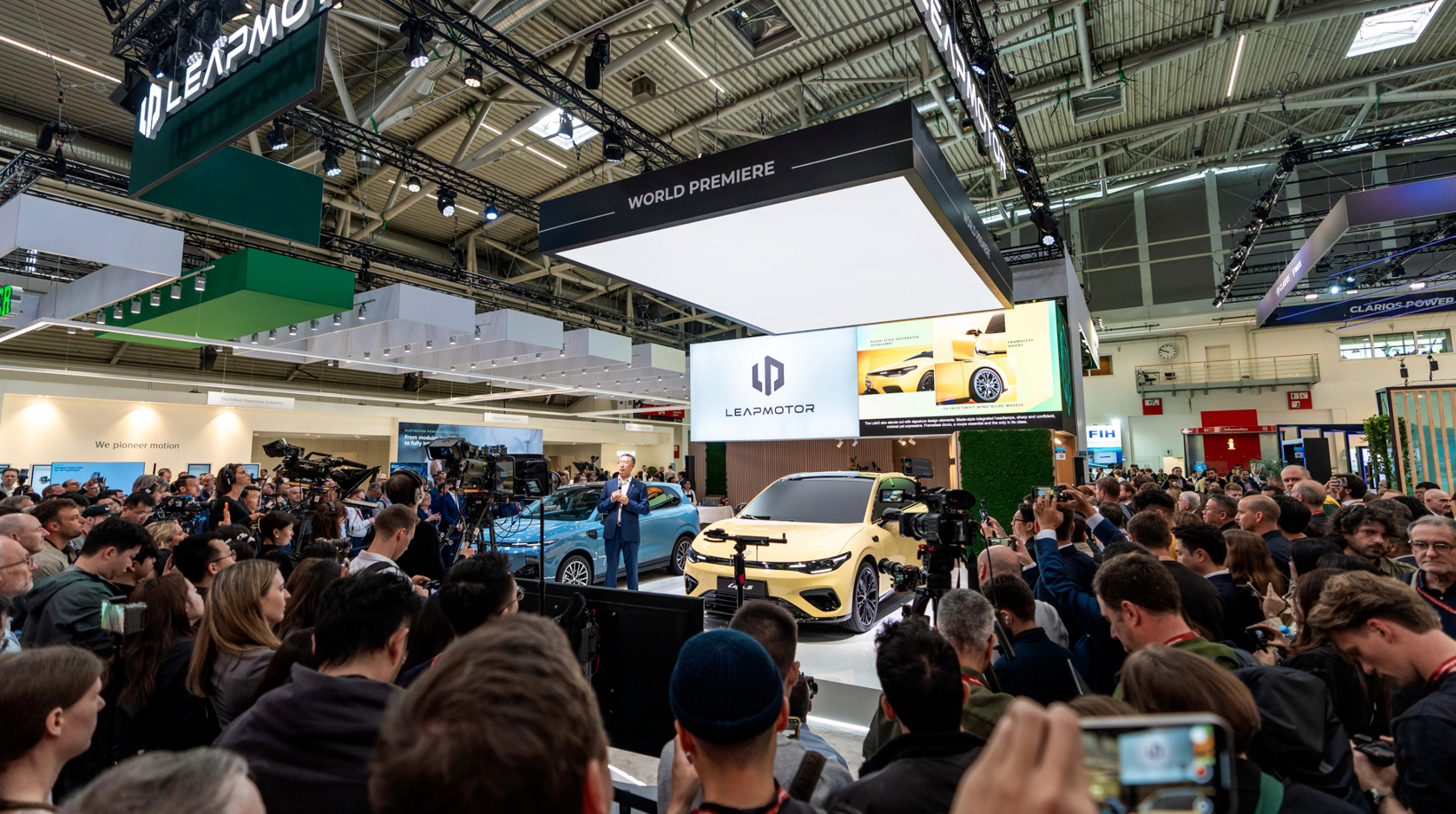
Leapmotor at the 2025 IAA; Image source: Leapmotor
The 2025 IAA featured 748 exhibitors. According to data compiled by Gasgoo, more than 110 hailed from mainland China, Hong Kong, Macau, and Taiwan—roughly one in seven.
For a Chinese auto industry accelerating its globalization push, Munich offers more than just a few days of booth exposure. It provides concentrated access to European clients, supply chain partners, media, and potential consumers. As going global becomes a strategic priority for more companies, auto show budgets are naturally following the business focus.
So, reduced spending on some domestic shows and increased investment in the IAA by Chinese firms are not fundamentally at odds.
Companies haven't stopped needing auto shows; they've just started reprioritizing them.
The money is still being spent—it just increasingly requires an answer to the question: Why here?
And as more companies begin asking that question, the burden of providing an answer falls not only on automakers.
Auto Shows Are Also Facing a Reckoning
As companies reshuffle their auto show priorities, the pressure naturally shifts to organizers.
For a long time, major auto shows relied on a relatively fixed set of success metrics: more floor space, more brands, more premieres, and higher attendance.
These numbers are certainly still important. But as companies recalculate every line item of their exhibition budgets, simply proving "we're big" may no longer be enough.
The real question that needs answering is: Why must a company be here?
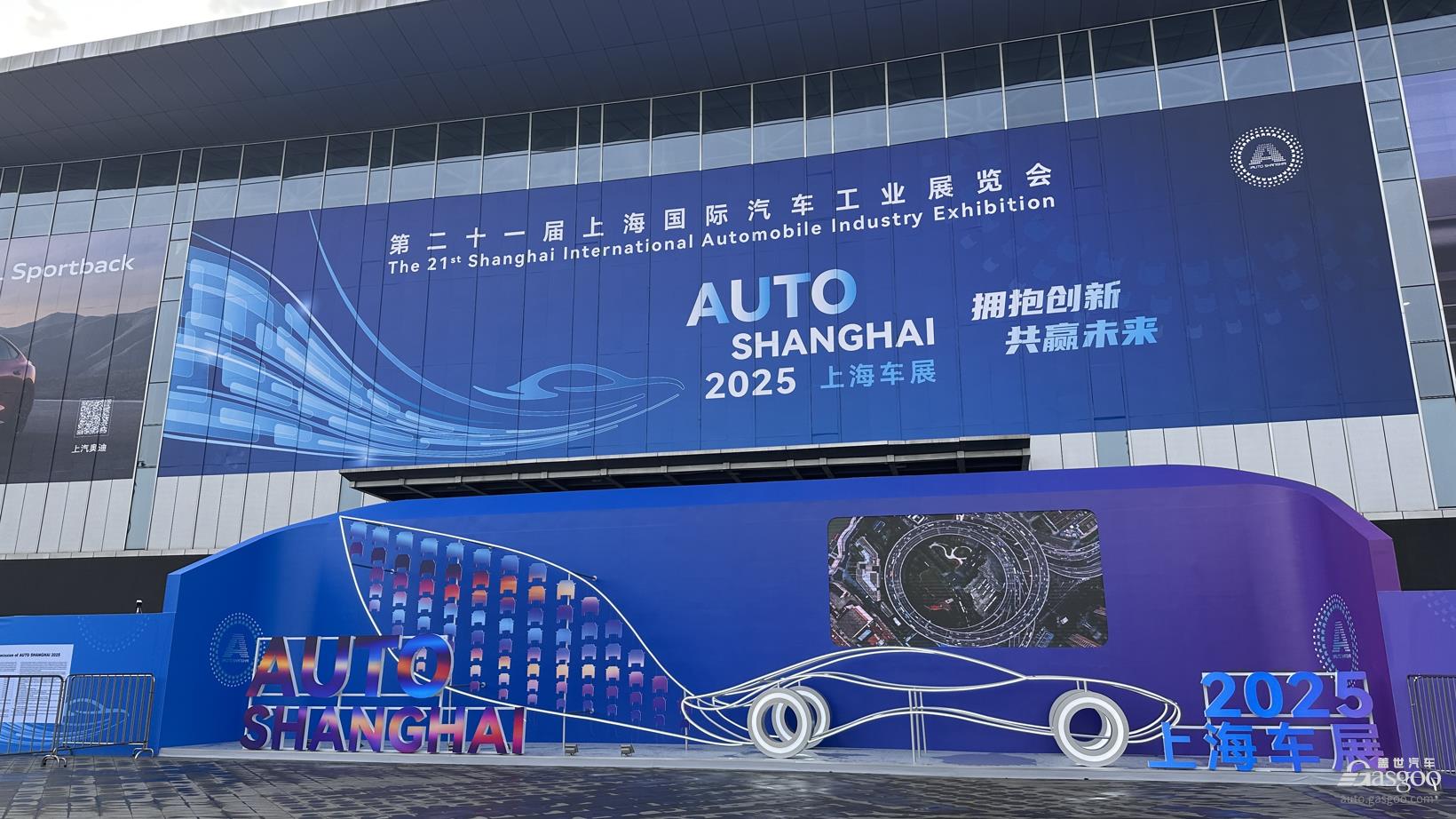
The back-to-back scheduling of the 2027 Beijing and Shanghai shows will make this question even more concrete.
Both are vital showcase windows for the Chinese auto industry and carry immense clout. The real story isn't about who wins or loses, but rather what choices companies make when forced to reallocate products, technology, marketing, and management resources across a very short timeframe.
It's too early to draw final conclusions.
But looking beyond Beijing and Shanghai, it's clear that different auto shows are already carving out their own value propositions.
Chengdu, the subject of this discussion, is a prime example. The massive consumer market in the Southwest ensures that sales conversion remains a core foundation. As some brands pull back on marketing spend, that value becomes even clearer.
Chongqing offers a different path.
The Chongqing Auto Show usually falls close to the Beijing or Shanghai events. If judged solely by the number of major launches, it's hard to guarantee enough national buzz every year. Yet the concurrent China Auto Chongqing Forum creates an industry ideas marketplace separate from the show floor.
For many journalists, the trip to Chongqing isn't just about "what cars launched," but "who showed up and what they said." A chairman's comment on price wars, smart tech, or globalization can sometimes become industry news faster than the vehicles on display.
Guangzhou, leveraging the South China market and its year-end slot, has found its own rhythm as well. It captures year-end consumption and serves as a window for companies' final product launches of the year and previews of the next.
This isn't about slapping labels on different shows. On the contrary, the ultimate character of an auto show cannot be defined by its organizers alone. It depends on the local market and industrial base, but also on the genuine choices made by companies, media, and consumers time and again.
And this may be the question Chinese auto shows truly need to face going forward.
More than "too many," the greater risk may be "too alike."
If every show offers the same mix of new car launches, celebrity appearances, and executive interviews—using floor space, exhibitor counts, and attendance to prove influence—then when companies start counting every penny, that repetitive value is the easiest to put back on the chopping block.
In other words, the battle for future auto shows isn't just for automakers' money—it's for media attention and consumer time.
Every participant is voting with their feet in their own way.
So, as automakers start crunching the numbers on auto shows, the shows themselves must prove their worth all over again.
Automakers haven't stopped needing auto shows; they've just stopped assuming they need every single one.
In the past, automakers fought for the stage at auto shows.
Next, it may be the auto shows' turn to fight for automakers' budgets, media attention, and consumers' time.
And every auto show must answer the same question: Why must it be this one?


