



Gasgoo Munich- Here are the major headlines in embodied intelligence and driver assistance this week:
He Xiaopeng: This Year Is a Watershed Moment for Autonomous Driving R&D
On March 5, He Xiaopeng, chairman of XPENG, issued a Weibo post, saying that this year marks a watershed moment in the development of autonomous driving.
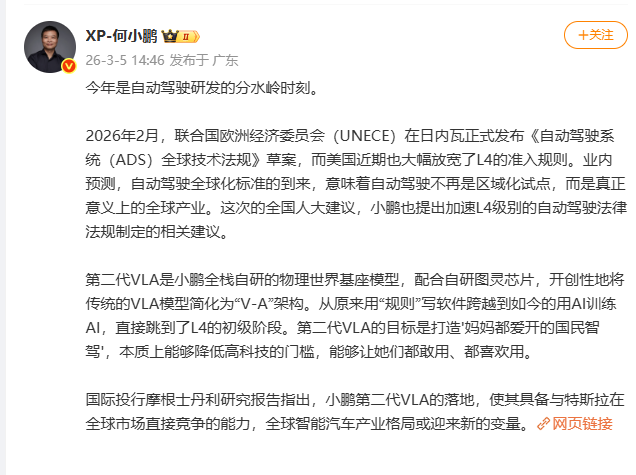
Image source: Weibo screenshot
He Xiaopeng noted that in February 2026, the United Nations Economic Commission for Europe (UNECE) officially released a draft of the "Automated Driving System (ADS) Global Technical Regulation" in Geneva, while the United States recently significantly relaxed its L4 access rules. Industry predictions suggest that the arrival of global standards for autonomous driving means the technology is no longer just a regional pilot, but a truly global industry. In this year's National People's Congress proposals, XPENG also recommended accelerating the formulation of laws and regulations for L4 autonomous driving.
He Xiaopeng stated that the second-generation VLA is XPENG's fully self-invented physical world foundation model. Paired with the self-developed Turing chip, it innovatively simplifies the traditional VLA model into a "V-A" architecture. This represents a leap from writing software with "rules" to training AI with AI, jumping directly to the preliminary stage of L4. The goal of the second-generation VLA is to create a "national intelligent driving system that even moms love to use" — essentially lowering the barrier to high technology so that everyone dares to use it and enjoys using it.
Furthermore, He Xiaopeng mentioned that a research report from international investment bank Morgan Stanley indicates that the implementation of XPENG's second-generation VLA gives it the ability to compete directly with Tesla in the global market, potentially introducing a new variable to the landscape of the global smart vehicle industry.
It is understood that at this year's "Two Sessions," XPENG Chairman He Xiaopeng submitted three proposals, focusing on autonomous driving, humanoid robots, and flying cars.
Specifically in the field of autonomous driving, He Xiaopeng suggested that on the basis of solidifying L2 safety supervision, policies should be pushed to leap directly from L2 to L4, simplifying intermediate L3 steps; clarifying registration and traffic rules for L4 vehicles to support compliant driving nationwide; conducting assessments of traffic regulation adaptation to establish norms for human-machine driving classification; and granting mature cities the right to conduct C-end pilot programs for L4 unmanned driving in specific low-risk scenarios to form replicable experience. This move aims to transform China's L2 industry advantage into a global L4 competitive advantage, seizing the initiative in the strategic development of intelligent connected vehicles.
XiaoZhi Comment: Global tech competition is now running in parallel, with XPENG directly targeting Tesla using its VLA architecture.
Joyson Electronics Partners with Enpower to Develop Solid-State Battery Systems for Embodied Intelligent Robots
Recently, Joyson Electronics and solid-state battery company Enpower reached a strategic partnership. The two parties will focus on the power energy sector for embodied intelligent robots to jointly develop energy system solutions that integrate battery cells, BMS, and data services.
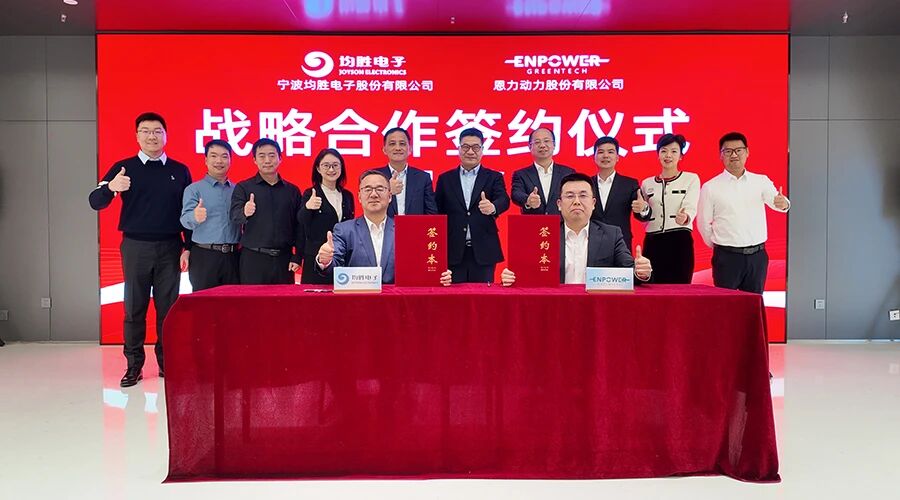
Image source: Joyson Electronics
With the increasing demands for robotic motion performance and computing power, higher requirements are being placed on the energy density, safety, and lightweight nature of power batteries. High-energy-density solid-state batteries are considered a key direction for future robot energy management due to their adaptability in miniaturization and lightweight design.
In this collaboration, Joyson Electronics will contribute its automotive-grade battery management system (BMS) technology and data service capabilities. The company's BMS products have already achieved large-scale supply to global automakers such as Volkswagen, BMW, and Mercedes-Benz. Based on the logic of technological homology, Joyson is migrating its R&D and manufacturing experience from the automotive sector to the robotics field, having previously launched a chest assembly solution that integrates robot controllers and energy management.
Enpower, for its part, brings its R&D and industrialization capabilities in solid-state batteries. Its products cover semi-solid and quasi-solid routes, with energy densities reaching up to 600Wh/kg, and have already been applied in fields such as robotics and drones.
The two parties plan to form a joint working team to promote the implementation of specific cooperation projects. Joyson Electronics Chairman Wang Jianfeng stated that Enpower Power's layout in advanced battery technology complements Joyson's accumulation in energy management and data services. Enpower Power Chairman Dai Xiang noted that Joyson Electronics' global customer network and manufacturing capabilities will help the verification and popularization of its advanced battery technology in high-end scenarios.
XiaoZhi Comment: Spillover from automotive supply chain technology, as Joyson Electronics brings automotive-grade BMS expertise to empower robot solid-state batteries.
Huawei Qiankun Launches 896-Line LiDAR, to Debut on MAEXTRO S800 and AITO M9
On March 4, at the Harmony lntelligent Mobility Alliance's new technology launch event, Huawei Qiankun launched a new generation dual-optical-path image-grade LiDAR. This product is currently the sensing component with the highest wire specification among mass-produced vehicles globally, reaching up to 896 lines, and will make its debut on two flagship models: the MAEXTRO S800 and the AITO M9.
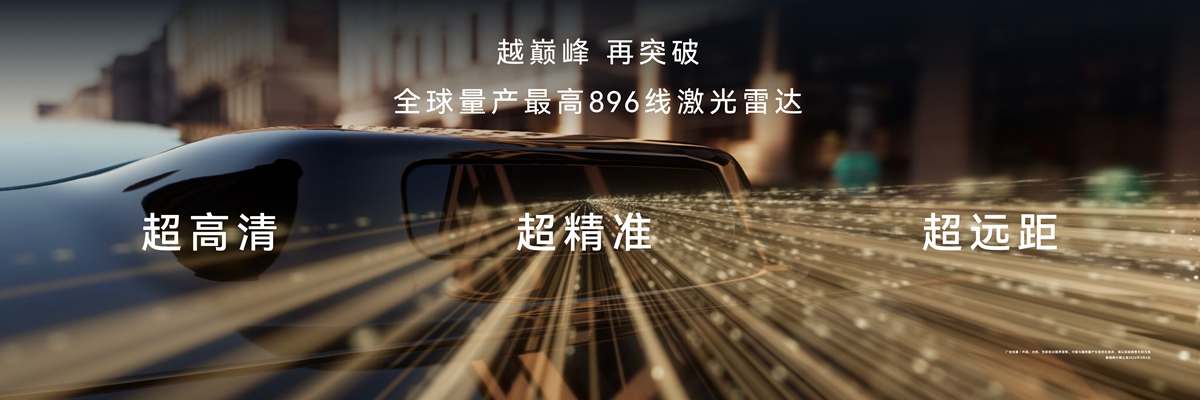
Image source: Huawei Qiankun livestream screenshot
This LiDAR adopts a dual-optical-path patented architecture pioneered by Huawei Qiankun, integrating receiving units with different focal lengths internally to achieve fused imaging of wide-angle and telephoto views. Its vertical resolution has increased 4-fold compared to previous products, and the company claims its perception capability has leaped from the traditional "point cloud level" to an "image level."
In terms of specific performance, the radar can identify low obstacles as short as 14cm at a distance of 120 meters. The recognition distance for low-reflectivity targets like fallen tires has improved by 190%, and for irregular obstacles like horizontally fallen cones, it has improved by 77%.
Beyond enhanced detection capabilities, the radar has also been optimized for durability. Its window uses high-transmission tempered glass, increasing hardness by 25% and doubling durability. According to official tests, the radar can cope with harsh climates such as sandstorms, maintaining stable perception performance after 30 hours and 3,000 kilometers of durability testing.
XiaoZhi Comment: Huawei Qiankun refreshes the upper limit of intelligent driving perception with its highest mass-production spec of 896 lines.
Xiaomi Robots Already "Interning" at Auto Factories; Netizens: No Need to Urge Lei Jun to Tighten Screws Anymore
There is new progress in Xiaomi's robotics business.
Gasgoo learned that Xiaomi Group founder Lei Jun recently announced that Xiaomi robots have already started interning at the automotive factory.
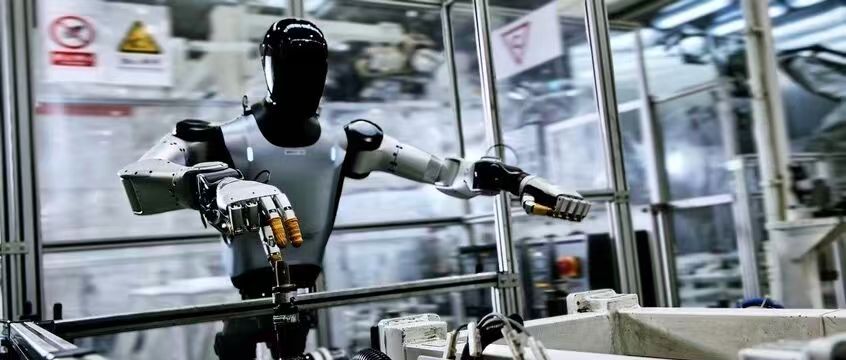
Image source: Xiaomi
He mentioned that Xiaomi will continue to contribute to the large-scale application of humanoid general-purpose robots in intelligent manufacturing, and expects that large numbers of humanoid robots will enter Xiaomi factories to work within the next five years.
Meanwhile, Xiaomi Group partner Lu Weibing also stated in a report that two Xiaomi humanoid robots worked continuously for three hours on the automotive production line, achieving a 90% work accuracy rate. Additionally, Xiaomi will release a new robot product this year, achieving a convergence of self-developed chips, self-developed OS, and self-developed AI large models.
In response, many netizens commented: "Very optimistic, this track is indeed a must-compete zone." Others said: "In the future, there's no need to urge Lei Jun to enter the factory to tighten screws."
It is reported that technically, based on the general VLA foundation model Xiaomi-Robotics-0, combined with multimodal perception capabilities and reinforcement learning technology, Xiaomi's humanoid robots have initially achieved autonomous operation in scenarios such as self-tapping nut loading stations and box handling.
When robots truly move from the laboratory to the auto factory, a huge reality gap emerges: production cycle time and yield rates. In the laboratory, thousands of failure iterations can be conducted, but the factory requires precise and reliable movements, with production cycle times accurate to the second. How to grow from an "apprentice" to a "regular worker" is a hard-core test facing robots.
According to data provided by Xiaomi, the results of the Xiaomi robot running autonomously for 3 hours in a real auto factory at a self-tapping nut loading station were: a simultaneous bilateral installation success rate of 90.2%, while meeting the production line cycle time requirement of a maximum of 76 seconds.
Lei Jun stated that key metrics such as the Xiaomi robot's mean time between failures and single-task success rate are steadily improving, and work is continuing to advance the actual deployment and verification around more classic workstations.
XiaoZhi Comment: Xiaomi humanoid robots enter the factory for "internships," taking a critical step from the lab to the production line with 90% accuracy.
Pony.ai Achieves Single-Vehicle Profit in Shenzhen! 7th-Generation Robotaxi Daily Net Income Reaches 338 Yuan
On March 2, Pony.ai announced that its seventh-generation Robotaxi achieved positive monthly single-vehicle operating profit in Shenzhen in February 2026. Following achieving this goal in Guangzhou last November, Pony.ai has now made a key breakthrough in two of China's first-tier cities.
Data shows that Pony.ai's market-oriented operations in Shenzhen are strong. As of February 28, its seventh-generation Robotaxi achieved an average daily net income of 338 yuan per vehicle for the month, with an average of 23 orders per vehicle per day.
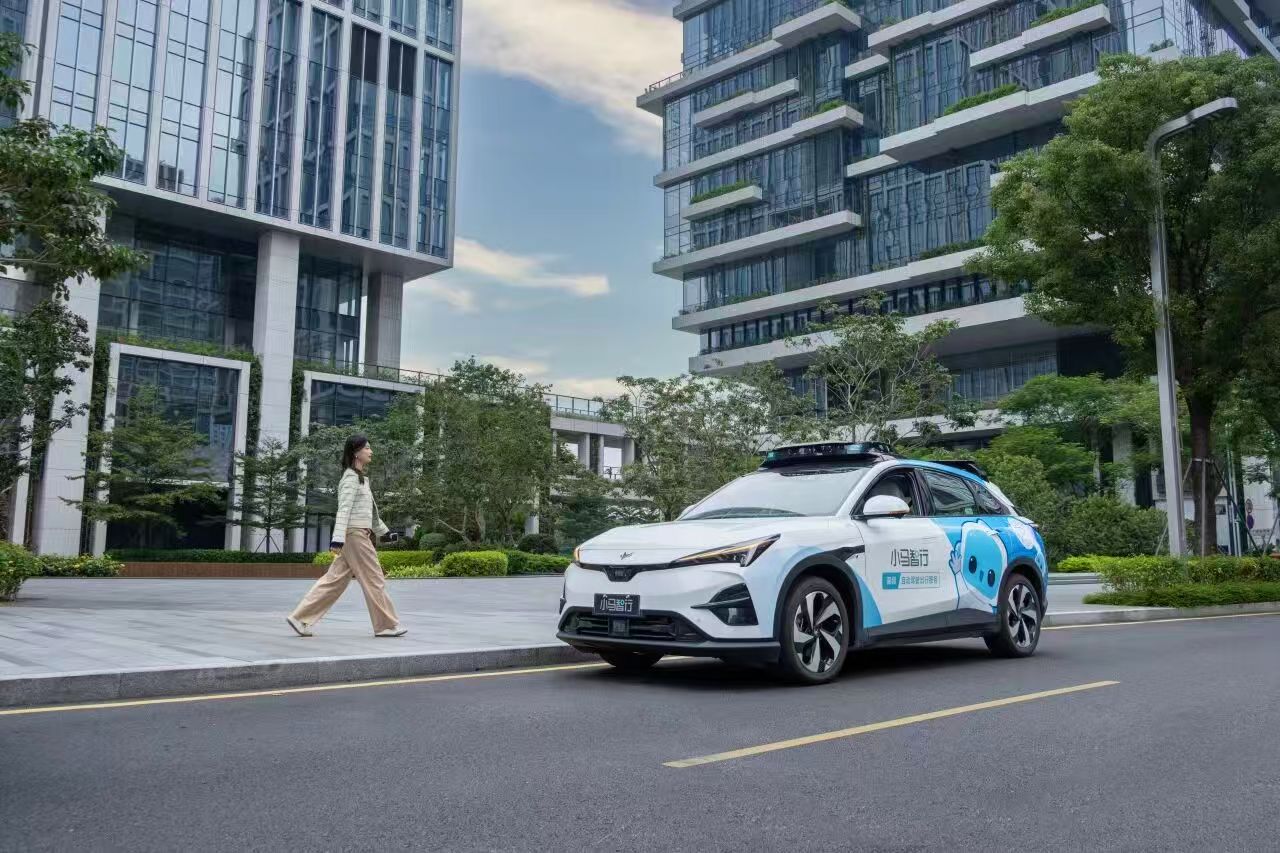
Image source: Pony.ai
Starting from an initial 21.7 square kilometers, Pony.ai's Robotaxi operating range in Shenzhen had rapidly expanded to 167.4 square kilometers by December 2025.
With the large-scale deployment of the seventh-generation Robotaxi, this model has achieved a significant upgrade in user experience: functions such as Bluetooth automatic unlocking, in-car voice interaction, online music, and pre-trip air conditioning preconditioning have greatly increased ride comfort; optimized acceleration and deceleration control more effectively reduces driving bumps and lowers the risk of motion sickness.
The improvement in product strength and the expansion of operating range have directly driven rapid growth in the user base. As of February 16, 2026, the volume of paid orders for Pony.ai's Robotaxi in Shenzhen this year had already surpassed the total for the entire year of 2025.
It is reported that Pony.ai's single-vehicle operating costs cover depreciation of vehicles and autonomous driving kits, charging fees, daily maintenance, remote assistance operations, insurance costs, ground crew labor costs, as well as parking and network infrastructure expenditures. Sustained growth in user demand, improved operational efficiency, and structural cost reductions have jointly driven the optimization of the single-vehicle economic model.
Pony.ai's seventh-generation autonomous driving system uses 100% automotive-grade components, with the bill of materials (BOM) cost reduced by approximately 70% compared to the previous generation. At the same time, relying on mature AI algorithms and fleet management capabilities, the company has further improved vehicle utilization and optimized the staffing ratio of remote assistance personnel, thereby continuously enhancing overall operational efficiency.
XiaoZhi Comment: Pony.ai conquers Guangzhou and Shenzhen in succession, verifying the critical leap of Robotaxi from technical feasibility to commercial viability.


