



Here are the major developments in embodied intelligence and driver assistance this week:
MIIT: Humanoid Robot Output May Top 100,000 Units This Year
Gan Xiaobin, deputy director of the Ministry of Industry and Information Technology's Department of Science and Technology, said at a July 7 press conference that China's full-year production of humanoid robots is poised to exceed 100,000 units.
By 2026, as domestic supply chain collaboration deepens and localization of core components accelerates, companies are speeding up product launches and mass production. That is set to unleash significant capacity.
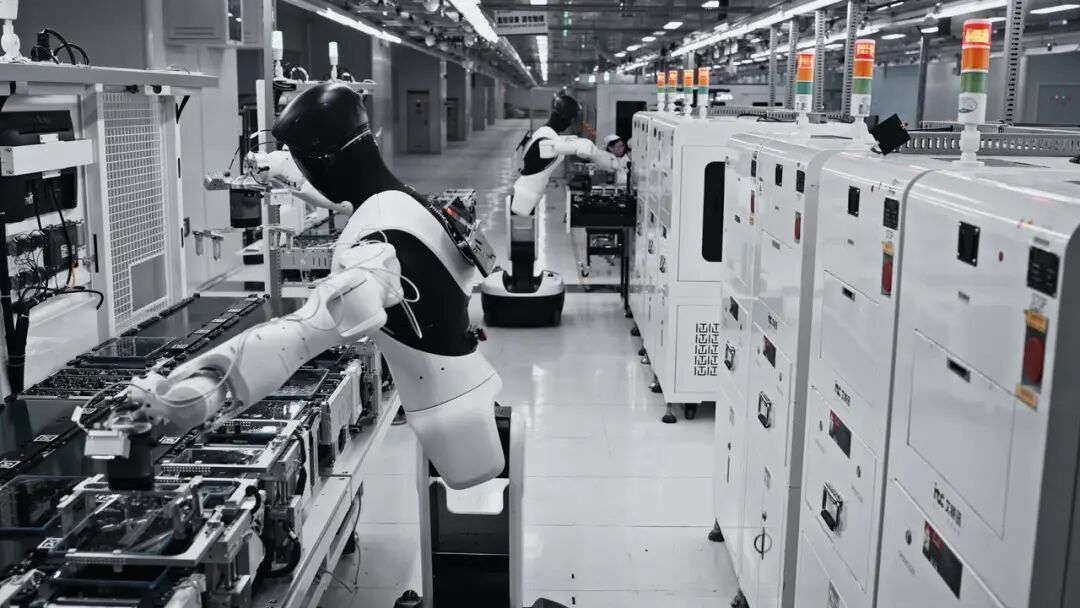
Image Source: Agibot
Unitree announced in early June that it has produced roughly 11,000 units of a single bipedal humanoid model. Agibot, meanwhile, rolled out its 15,000th embodied intelligent robot in late June — less than three months after hitting the 10,000-unit mark.
Others like Zhenge Robotics and Leju Robotics are ramping up too. In late March, Dongfang Precision and Leju launched China's first automated line capable of over 10,000 units annually, rolling out one robot every 30 minutes. By May, Zhenge's Shenzhen base cut that cycle to 15 minutes.
The shift signals that humanoid robots are moving past the era of small-batch trial production and into standardized manufacturing.
Commentary: 100,000 units is a psychological barrier — and proof that the humanoid robot industry is maturing.
Insta360 Officially Enters the Robotics Fray
On July 9, Insta360 marked its 11th anniversary by announcing a new robotics team focused on consumer products. Founder Liu Jingkang revealed the first robot, aimed at ordinary households, is slated for release in the second half of 2027.
The company unveiled a long-term vision: a "Cameraman" photography robot. Designed to frame shots, capture smart snaps, and track subjects like a pro, it aims to let users focus on living rather than operating gear. The ultimate goal, Insta360 says, is to "let the camera step back so life can move forward."
The project has reportedly been in the works for at least 18 months. The core team of nearly 100 people comes from DJI, Ecovacs, and Horizon Robotics, pointing to a mobile home camera robot. No pricing or mass production timeline has been set.
Commentary: The robotics sector is vast — and everyone wants a slice.
RoboSense's Robot Business Surges 510% in First Half
RoboSense reported total LiDAR sales of 719,200 units in the first half, a 170% year-on-year jump. Robot-related sales hit 282,600 units — up 510% — while ADAS sales climbed 98% to 436,600 units. The "robotics + automotive" dual-engine strategy is gaining traction.

Image Source: RoboSense
RoboSense has held the top spot for global robot 3D LiDAR shipments for multiple quarters. It leads in five niche markets: lawn mowers, unmanned delivery, humanoid robots, embodied intelligence, and commercial cleaning.
The company now partners with over 3,400 robotics firms, including nearly 50 leaders in humanoid and quadruped robots like Unitree, Agibot, GalaxyBot, Zhenge Robotics, and Dobot. It is positioning itself as the perception platform connecting robots to the real world in the physical AI era.
On the automotive front, RoboSense has secured design wins from 36 automakers for 177 models as of March 31, 2026. Its order backlog exceeds 9 million units.
Commentary: Automotive secures the present; robotics bets on the future.
Mitsubishi Motors to Develop Humanoid Robots
Mitsubishi Motors announced on July 9 that it has partnered with Japanese startup Highlanders to push toward mass production of humanoid robots.
Production could start as early as 2027 at Mitsubishi's Kyoto engine plant, with a planned monthly capacity of 1,000 units. The automaker plans to deploy these AI-powered robots in its own factories for tasks like parts transport and engine assembly. If tests go well, Mitsubishi may sell them to other manufacturers.
The robot will be developed jointly with Highlanders, a spinout from the University of Tokyo. Mitsubishi invested in the startup in May, and Takao Kato indicated further investment is possible, though details remain undisclosed.
Commentary: Validate in-house, then sell externally. It is a pragmatic roadmap.
StarDance Secures Another 1 Billion Yuan in Funding
StarDance closed a new 1 billion yuan funding round on July 6.
It marks the company's third major round this year. StarDance raised 1 billion yuan in strategic funding in early March, followed by over $200 million in late April. That brings total funding to more than 3 billion yuan in just a few months.

Image Source: StarDance
StarDance is building a general-purpose "embodied brain" and humanoid robot through full-stack self-research. It has established an AI-native system capable of "real work," spanning the brain, motion control, data, dexterous hands, and the body itself.
On the hardware side, the company claims over 95% self-sufficiency, covering everything from core motors and drivers to complete units.
Batch deliveries of 1,000 robots began in the second quarter.
Commentary: Integrating brain and body is a difficult path, but mastering it creates a formidable moat.
Morphi Closes Over 1 Billion Yuan in Angel Round
Embodied intelligence startup Morphi announced it has raised over 1 billion yuan in an angel round, pushing its valuation past 7 billion yuan — a record for an initial public round in China's embodied intelligence sector.
The round was co-led by Alibaba and Tencent, with participation from BlueRun Ventures, Legend Capital, Huaye Tiancheng, Gaorong Capital, CAS Star, Source Code Capital, Photosynthesis VC, BR Capital, and 58 Industry Fund.
Founded in 2025 by Huang Qingqiu and Gao Wenli, Morphi is led by Huang as CTO. A former head of Huawei's autonomous driving AI division, he oversaw the evolution from ADS 1.0 to 4.0 and pioneered the commercialization of end-to-end architectures.
Commentary: A 1 billion yuan angel round and a 7 billion yuan valuation? Investors are betting less on a new company and more on the founders' proven track record.
"Physical AI First Stock" Momenta Makes Market Debut
Momenta began trading on the Hong Kong Stock Exchange on July 8 under the ticker 6880.HK, branding itself as the "Physical AI First Stock." Shares opened at 301 HKD — a gain of over 6% — pushing its market value past 70 billion HKD.

Image Source: Momenta
Priced at 295.6 HKD per share, the IPO raised roughly 6.8 billion HKD. Assuming the over-allotment option is exercised in full, about 22.93 million shares were sold globally.
Founded in 2016, Momenta aims to improve life through breakthrough AI. Using a world model as its foundation, the company runs a "data flywheel" that drives both mass production and scalable autonomous driving, bringing physical AI into everyday life.
The "flywheel effect" is now visible. Over 1 million mass-produced vehicles are equipped with Momenta's systems across more than 100 delivered models and 210 designated ones. Its client roster includes all major Chinese automakers, and 9 of the world's top 10 carmakers.
Momenta's Robotaxi arm has partnered with global ride-hailing platforms like Uber, Grab, and ShaoDao, as well as Mercedes-Benz. Operations have launched in Asia, Europe, and the Middle East, with expansion into new regions planned for this year.
Commentary: Momenta's successful debut underscores capital market confidence in physical AI — and validates the company's technical and commercial progress.
XPENG Launches Internal Testing for Robotaxi
XPENG held its first company-wide meeting on the Robotaxi business this week, announcing the start of internal employee testing.
Chairman He Xiaopeng outlined his vision for the next decade, predicting that all forms of embodied intelligence will fall under the robotics category. He views Robotaxi as a pivotal step in XPENG's transition from a traditional EV maker to a "robot car" company.
The first mass-produced XPENG Robotaxi rolled off the line in Guangzhou on May 18 — a milestone as the first time a Chinese OEM has built a fully self-developed Robotaxi at scale. Pilot operations are expected to begin in the second half of the year.
Built on the flagship GX platform, the vehicle features four in-house Turing AI chips delivering 3,000 TOPS of computing power. It uses XPENG's second-generation VLA large model to achieve Level 4 autonomous driving.
Commentary: Launching internal tests signals that XPENG's Robotaxi business is moving beyond production and into real-world validation.


