



Gasgoo Munich- At a recent major achievements release during the ZGC Forum annual meeting, the Beijing Financial Regulatory Bureau announced the launch of commercial insurance development for intelligent connected new energy vehicles. It marks the first domestic policy tailored specifically to autonomous driving scenarios, designed to uniformly adapt to L2 through L4 smart connected NEVs. While the L2 tier initially targets new energy vehicles, L3 and L4 levels apply to those legally testing or already road-qualified in Beijing.
Just half a month ago, Arcfox announced that its Alpha S (L3 version) has officially kicked off large-scale road trials, with individual users able to book test drives starting in the second quarter of 2026.
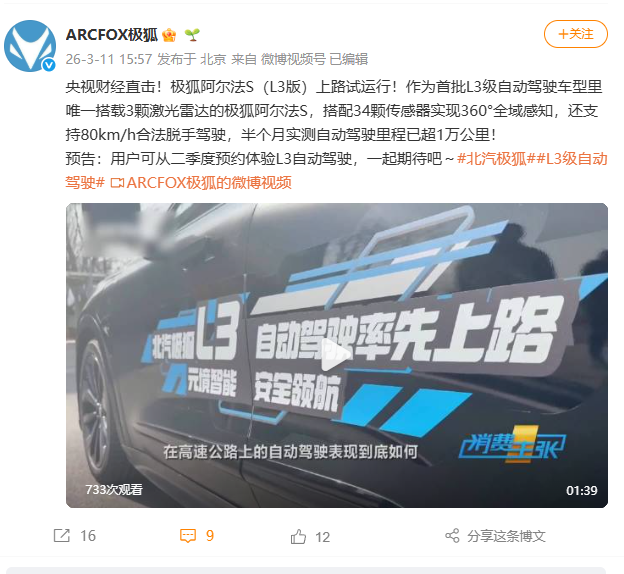
Image source: Weibo screenshot
Policy and product are hitting the accelerator in near unison. The countdown to L3 commercialization has begun.
This countdown isn't triggered merely by a few models securing license plates; rather, it’s driven by a comprehensive support system spanning technology, regulation, insurance, and infrastructure that is visibly taking shape. The rollout of Beijing's smart driving insurance is a critical piece of this safety net. Yet, it must be said: the current dedicated policy remains a "pilot" initiative, far from the final product. The debate surrounding it, however, helps illuminate the path still required to move from L3 road access to mass adoption.
Why is "Smart Driving Exclusive Insurance" Indispensable?
L3 represents conditional autonomous driving, where the system takes control in specific scenarios, but the driver must intervene promptly when a takeover is requested. In essence, primary control shifts from human to machine. That seemingly subtle shift fundamentally destabilizes the underlying logic of traditional car insurance.
Traditional auto insurance logic is built on the premise that a human is driving. At the L2 stage, the system is strictly defined as "driver assistance," so insurance remains essentially "human driving risk management." But at L3, provided the Operational Design Domain (ODD) is met and the system is engaged, accident responsibility no longer automatically defaults to the driver. This directly challenges the foundation of traditional insurance, which centers on personal liability. As Zhu Junsheng, a professor of applied economics at Peking University, noted, L3 isn't a simple upgrade from L2—it reshapes the very bedrock of auto insurance logic.
Specifically at the insurance product level, the "maladaptation" of existing car insurance is mainly evident in three areas.
First, the subject of liability shifts from "single" to "multiple." The focus moves from the driver to a multi-party split involving the human operator, the autonomous system, the automaker, and suppliers. Consequently, claims processing will pivot from primarily assessing damage to tracing the source of the fault. Existing policies define drivers based on basic human scenarios, rendering them ill-equipped for L3 or L4 "human-machine co-driving" or fully autonomous driving.
Second, the risk structure has evolved. Intelligent driving introduces new perils like algorithm errors, sensor failures, software updates, and cyber-attacks—none of which fall under traditional coverage. L3 also creates a unique "human-machine co-driving" environment. When the system is active, it leads; when it requests intervention, the driver takes over. This dynamic switching of responsibility between human and machine is something existing clauses simply cannot accommodate.
Third, asset forms have changed. Consumers purchasing L2 vehicles often pay out-of-pocket to upgrade driver assistance systems, adding lidar or buying smart driving software packages. The loss of this value-added hardware and software is entirely absent from current coverage.
In short, when vehicles start to drive themselves, logic dictates that insurance covering only "humans" no longer suffices. The rollout of exclusive smart driving insurance isn't about collecting extra premiums; it's about plugging a rapidly widening gap in protection.
Don't Celebrate Too Early—This Is Not the Final Answer for L3 Insurance
A sober realization is needed: the smart driving insurance launched in Beijing is essentially a transitional scheme—an optimization of the existing new energy vehicle insurance framework.
The head of the Beijing Financial Regulatory Bureau explicitly stated that the dedicated products retain the existing framework for three reasons: maintaining legal consistency with the Civil Code, which holds the vehicle party liable for traffic accidents; protecting victims by avoiding compensation delays caused by complex liability disputes over smart driving systems; and empowering industrial innovation by allowing insurers to pay claims first and then seek legal recourse from automakers if defects are found.
This design is pragmatic given that L3 hasn't yet rolled out at scale. It uses the existing insurance framework to "catch" accident costs, preventing consumers from getting stuck in the quagmire of liability determination. Yet, precisely because of this approach, it is not the ultimate form of insurance for the L3 era.
True smart driving insurance will inevitably shift toward "liability insurance." Industry insiders predict a structure combining "product liability, cyber security, and user liability," with automakers becoming the primary policyholders. Owners would only be liable for rule violations or driving when the system is disengaged. The insured subject would shift from "human driving behavior" to "technical system reliability." Insurers would no longer evaluate driver habits but rather automakers' algorithm iteration speeds, code quality, sensor fusion capabilities, and cyber security defenses.
The shift from "insuring people" to "insuring technology" is the fundamental transformation required. Beijing's current "pilot" serves to accumulate data and explore pathways for this shift, but it is certainly not the finish line.
From "Allowed on the Road" to "Used with Confidence," What Shortcomings Remain?
Insurance is merely one piece of the security puzzle. To achieve true commercial popularization of L3, at least three gaps need to be filled.
The first gap is the legal and standard system.
The current Road Traffic Safety Law is built on the premise of human driving, leaving autonomous driving systems without clear legal status. During this year's "Two Sessions," representatives and legislators voiced strong support for autonomous driving legislation. Feng Xingya, an NPC deputy and chairman of GAC Group, called for accelerating laws to build a unified national standard and evaluation system. Meanwhile, XPENG Chairman He Xiaopeng proposed pushing policy to leapfrog from L2 to L4, paving the way for compliant nationwide use of L4 vehicles.
L3 liability allocation must be codified into higher-level laws, and regional testing standards require mutual recognition. Currently, these basic institutional frameworks significantly lag behind technological progress.
The second gap is data infrastructure.
Determining liability for L3 accidents hinges on reconstructing the "system state." Was the function active? Was it within the design parameters? Did the system issue a takeover prompt? Did the driver respond in time? Answering these requires vehicle data. A member of the Beijing CPPCC suggested establishing a cross-regional public data zone for intelligent connected vehicles to promote the conditional sharing of test, high-definition map, and traffic flow data. The goal is to push for unified standard recognition in testing, demonstration operations, and licensing. Balancing data sharing with privacy protection, and establishing the validity of data storage as evidence, are urgent institutional challenges.
The third gap is the liability determination mechanism.
L3 autonomous driving involves multiple stakeholders—automakers, sensor manufacturers, and software developers. When accidents occur, liability can be scattered across these parties, complicating the pursuit of accountability. Insurance practitioners note that determining L3 liability has shifted from "inspecting the scene" to "inspecting the scene plus the system state," raising the bar for evidence chains. Pricing logic is pivoting from "driver-based differences" to "scenario and system-based variables," demanding more refined management. Who determines liability? What third-party assessment agencies are needed? How can assessment standards be unified? These questions remain unanswered.
The finish line for the L3 commercialization countdown isn't the day an automaker announces mass production. It's the day ordinary consumers can naturally select appropriate insurance for their smart vehicles—just as they buy compulsory traffic insurance today—with the clear assurance that if the system fails, someone will be held accountable.
Beijing has taken a significant stride. From the Arcfox Alpha S securing the nation's first batch of L3 license plates to gaining conditional admission from the Ministry of Industry and Information Technology, and now the launch of exclusive insurance, a complete chain spanning "technical verification," "legal road access," and "risk underwriting" is being linked together. Yet the significance of this countdown lies precisely in the fact that time waits for no one.
Technology is moving too fast for the system construction to lag behind. Exclusive insurance products, legislative progress, data standards, and liability determination mechanisms—these seemingly dry institutional details are exactly what will decide whether L3 remains a "novelty toy" for the few or becomes a daily mobility norm for the masses.
The time window for putting these supporting systems in place is rapidly closing.


